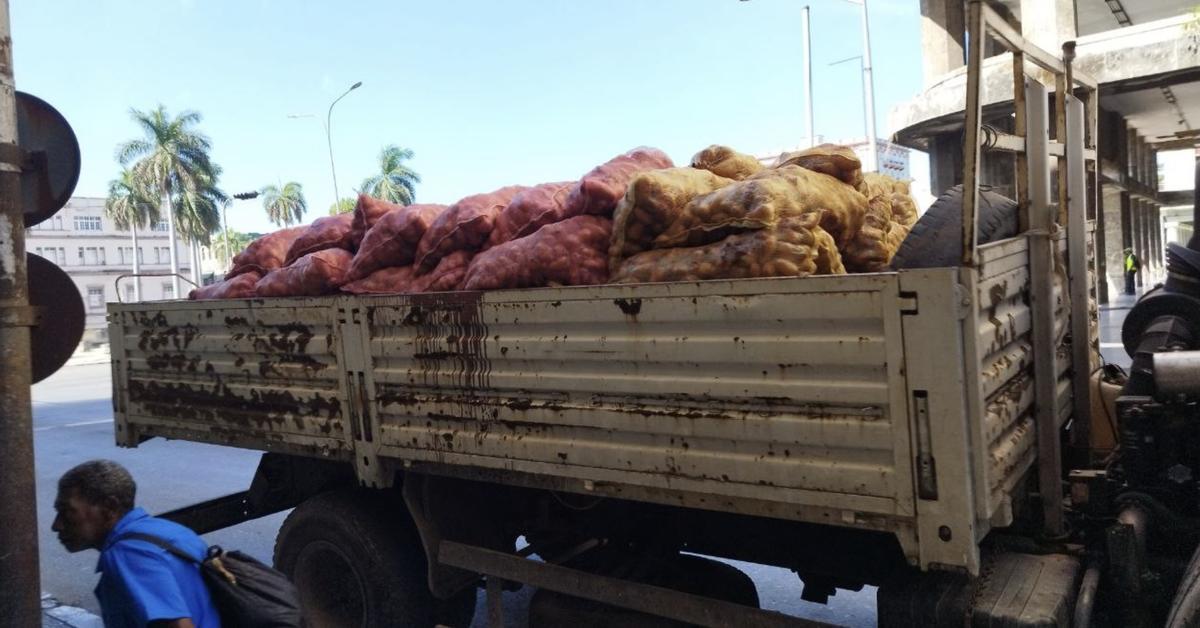
Havana/There was someone left to talk about the issue of rice and potatoes and it was this Monday when Roberto Caballero, protagonist of the controversyhe has done it. The words of this agricultural and forestry technician, who last week advocated in the Cuadrando la Caja program for reducing potato and rice crops in Cuba because they are not the most conducive to its climate and soil, have captured the latest controversy of the year.
“I NEVER (sic) said that rice and potatoes had to be taken away from the people, but rather that a healthy and balanced diet should not be unbalanced towards one or two products,” says the specialist, who has written a post in Facebook in which he wants to make his position clear, which he limits to a personal opinion subject to criticism.
The coach considers that it is possible that the ruling party does not agree with what he said
“I had stayed out of the entire debate, because unlike those who react with rudeness and insults, I respect everyone’s opinions, even if I do not understand them or do not agree with them. But because it is such a repetitive error, I consider it necessary to make some clarifications,” says Caballero, who emphasizes from the beginning that he neither belongs to the Ministry of Agriculture nor has he had links with state entities for more than 20 years. The coach also believes that it is very possible that the ruling party does not agree with what he said.
Caballero recalls that “there is an enormous lack of the inputs required to produce,” something that –he highlights– “has been said for many years, without a solution appearing, nor food on the plate”, therefore, he considers, “it is wise to put emphasis on crops more adapted to our conditions and therefore less demanding of those inputs, which nothing indicates will appear in the short or medium term.”
The specialist considers that the effort to allocate resources to rice production has led, precisely, to not dedicating them to other crops, so that “we are left without one or the other.” He takes the opportunity, at this point, to put even more distance with the authorities and reproaches that he himself has not received the rice that corresponds to him for a long time. “If we stop focusing on large volumes of rice and guarantee other alternatives, we could have rice and also the others compensating volumes,” he says.
Although he does not leave data, Caballero points out in his post that the potato has been consumed almost concentrated in Havana and some provincial capitals. “I think that more than 50% of the country barely ate dad, even in the years of greatest production,” he says. The expert affirms that he has exercised the “sacred” right to express his opinion, which can be discussed and that he is open to this in a “respectful” manner and asks that no one worry about being “fired or dismissed.”
“Don’t worry, I’ve been fired since the first days of this century for saying what I think. Since then and before that my only objective in life has been to help Cuba achieve what Marti said, ‘that with its production it can supply its consumption’. And for that, obviously, we have to make very strong changes in food production, because with what has been done and is being done until today, we haven’t gotten anywhere other than extreme scarcity and inflation,” he concludes.
With this message, which has received countless reactions, mostly supportive, Caballero wants not only to put an end to a controversy that is dragging on in this agonizing end of the year too full of shortages, but also to put distance from the authorities.
Caballero wants to put an end to a controversy that is dragging on this end of the year
The presence of the technician in the program clearly places him, for the population, as a voice of the ruling party. Most of the criticisms that have been made of his comment focus on highlighting the productive disaster to which the Government’s agricultural policies have led and how the solution is not in stopping eating this or that product, but in changing the system.
Caballero now converts his words into a kind of criticism of government policies and presents them as a necessary change that the regime has never attempted, on the contrary, it has focused on two foods that – especially with the crisis of recent years – have a more difficult time thriving on the Island. It is doubtful, however, that the population that has felt especially bothered by a comment – “today, with the shortages that exist, anything you give to people in the little square will walk” – will forget those words.