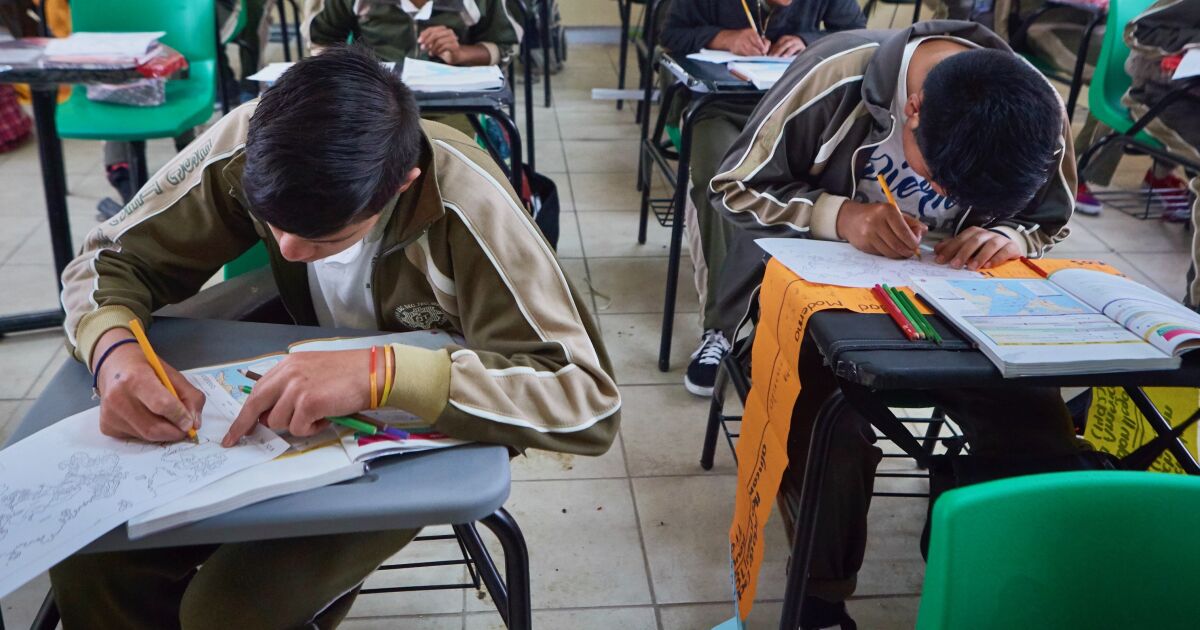
“Education becomes a luxury good, which is consumed more only when income significantly increases,” said Natalia Campos, coordinator of the Society of the Mexican Institute for Competitiveness (IMCO).
This behavior is reflected in a persistent inequalitywhile the homes of the highest decile spend up to 20,376 pesos to the quarter in education, those of the lowest decile destined only 2,888 pesos.
In relative terms, the decile of higher income allocates 8.3% of its total expenses to education, compared to 2.6% of the poorest.
According to the data of the National Institute of Statistics and Geography (INEGI), expenses in the encompassing of education and recreation dropped 13.1% in the period, although with a slight recent recovery.
The paradox is that, although today’s household has more resources, they go less and less to activities or services that can detonate social mobility or long -term well -being, IMCO expert said.
The greatest income does not allow free recreation of the poorest. In fact, there is a big difference in spending on tour packages among lower income households, which spend only 24.95 quarterly pesos on average, against more than 2,243 pesos of the decilment of higher income.
Scholarships do not explain the lowest expense
Natalia Campos acknowledged that there is an increase in educational scholarships for different levels of training, including scholarships provided by state governments. However, he pointed out that, unlike other programs of the past, these scholarships are not conditioned to necessarily allocate educational materials.
This means that many of the scholarships do not require that they are used specifically for education, which makes it difficult to establish a direct relationship between scholarships and a lower need to invest in education by households. In addition, educational spending has been stagnant in recent years.
In fact, health government spending is far from what was achieved a decade ago, when in 2016 Mexico dedicated about 4.9 % of GDP to education, which represented 17.9 % of the total government expenditure, according to UNESCO data.
In 2025, the budget to education represents only 3.2% of GDP and just over 12% of total expenditure.
Health competes with basic needs
Mexican households are reorganizing their consumption priorities, and not by choice, the specialists said. In fact, half of the poorest household spending goes in food and drinks, according to the IMCO analysis.
And health spending, increasingly inescapable, competes directly with other basic needs. In 2024, Mexican households spent an average of 1,605 quarterly health pesos, an 8% increase compared to 2022.
But if compared to 2018, the real increase exceeds 40%, according to Jorge Cano, coordinator of the Public Expenditure Program of Mexico evaluates.
The analysis of Mexico evaluates reveals that 1.11 million households incurred catastrophic health expenses, that is, expenses greater than 30% of their available income and that forces many families to borrow, sell heritage or reduce “drastically” their investment in education or recreation services.
“People without affiliation to public systems face greater health pocket expenses, and that directly impacts what they can allocate to education, recreation or even food,” Cano warned.
As the coverage and quality of the public health system weakens, Mexican families must resort to private services, such as pharmacy consultations, which generates a disproportionate charge for households with less income.
Experts agree that this dynamic deepens the inequalities, since while some can invest in their future, others barely spend to survive.