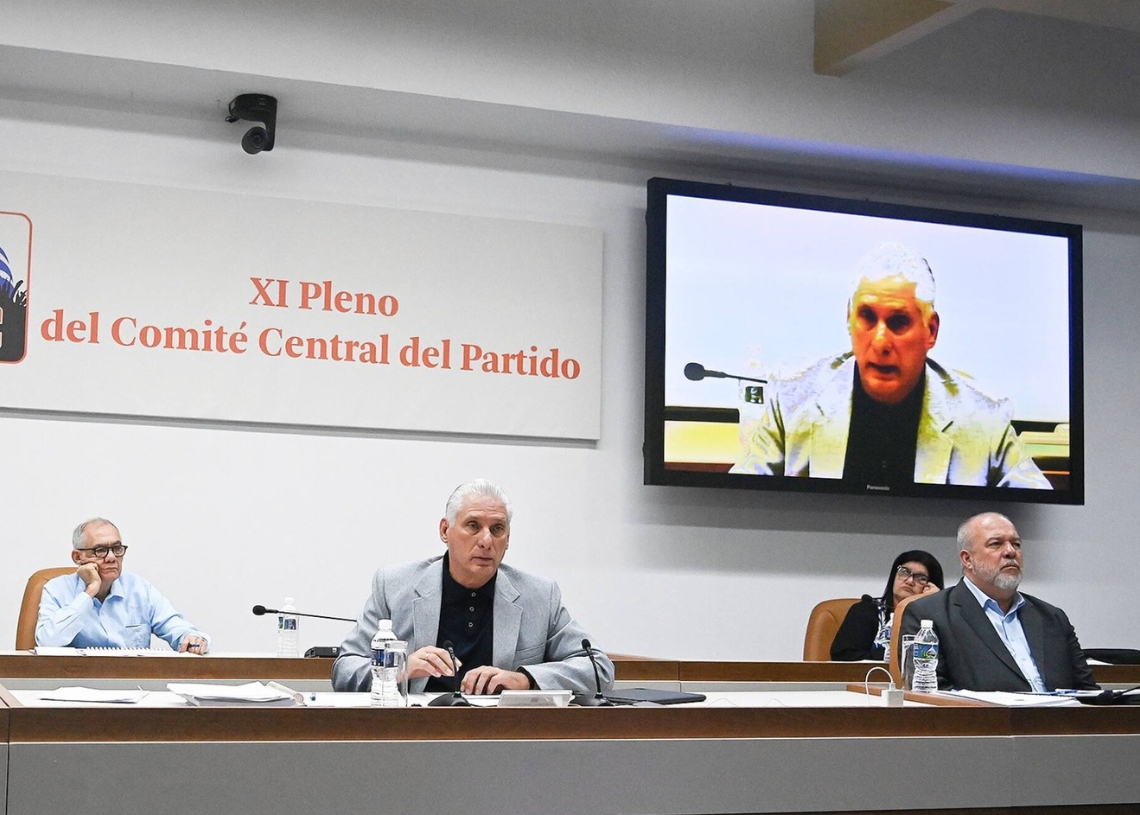
The Communist Party of Cuba postponed its ninth congress scheduled for April 2026 “for a later date” amid the serious crisis that the island is going through, state media reported this Saturday.
He diary Granma reported that the proposal came from the “leader at the head of the Cuban Revolution, Army General Raúl Castro,” who sent a letter to the plenary session of the Central Committee that met for one day.
In a letter presented to the plenary session, Raúl Castro said that he considered it “advisable” to postpone the holding of the conclave and decided to “consecrate from now on all the resources that the country has, and the effort and energy of the cadres of the Party, the Government and the State, to resolve the current problems.”
He thus called to “dedicate 2026 to recovering as much as possible,” according to Granma.
The former Cuban president (2008-2018) pointed out that the decision “cannot be seen as a setback,” but as “necessary and timely.”
In his opinion, “it will allow forces to unite, improve the situation of the nation, and create conditions for a better and fruitful Congress, which consolidates, as our Constitution endorses, the construction of socialism and the advance towards communist society.”
The last congress of the Cuban communists was held in April 2021, when Miguel Díaz-Canel held the position of first secretary.
The PCC itself reduced the holding of this plenary session to one day due to the “complex situation” in the country.
The crisis also forced Parliament to reduce its sessions to one day, next December 18, and cancel the meetings of the working committees that usually took place three days before the plenary session.
“Working in these times”
The president of Cuba, Miguel Díaz-Canel, pointed out this Saturday that the Cuban Communist Party must “demand of itself a different way of functioning” in the midst of the “economic and media war” that in his opinion the island faces.
“Everything that we have discussed here until this part of the Plenary (…) would remain empty words if the Party does not demand of itself a different way of functioning in these times,” said the also first secretary of the PCC, according to state television.
The PCC meeting began in the morning behind closed doors and without media appearances with an agenda focused on the economy, in the midst of the serious crisis that the island has been going through for more than five years.
“We cannot allow ourselves in the current conditions, and I am speaking from the attitude of the Party (…), for bureaucratism, formalism and inertia to continue being brakes,” Díaz-Canel added.
The Cuban leader insisted that Cuba is suffering from an “economic and media war,” as well as “pressures” imposed by US economic sanctions, which, he added, “have intensified.”
In this regard, the Secretary of Organization of the PCC, Roberto Morales, stated that “although we are aware that the blockade is the main obstacle to development, we cannot ignore that there are problems resulting from errors, deviations and negative trends.”
Morales added that these problems “compromise the purpose of moving forward,” and criticized that on issues such as food, the country is “very far” from achieving objectives such as increasing production.
Anti-crisis program
The PCC plenary session also evaluated the economic adjustment program announced in 2023 and implemented since 2024, which includes, among other things, an increase of more than 400% in the price of fuel, important cuts in public spending and a partial dollarization of the economy.
In this regard, the Prime Minister of Cuba, Manuel Marrero, maintained that the officially called “Government program to correct distortions and re-boost the economy” has been “executed” under “limited conditions,” according to a report of Cubadebate.
“(The program) has had to be executed under limited conditions, with reduced availability of electrical services, fuel, restricted access to convertible currencies and inflationary pressures generated by the combination of external and internal factors,” said Marrero.
The head of the Government, in charge of presenting the reforms two years ago, added that they are aligned “with the strategic priorities, but their success will depend on the ability to prioritize tasks, execute with greater discipline, reduce dispersion, integrate actors and secure essential resources, especially in energy, currencies and national production.”
Cuba has been mired in a serious crisis for five years with shortages of basic products, high inflation, partial dollarization of the economy and long blackouts.
The pandemic, the tightening of US sanctions and failed economic and monetary policies have aggravated the structural problems of the national economy, which has already contracted by 1.1% in 2024 and has added a cumulative fall of 11% in the last five years, according to official data.
Added to this is the current epidemic outbreak of dengue and chikungunya with thousands of cases detected, severe symptoms, an unfavorable prognosis in the short term and, to date, at least 47 deaths, mostly minors.
EFE/OnCuba