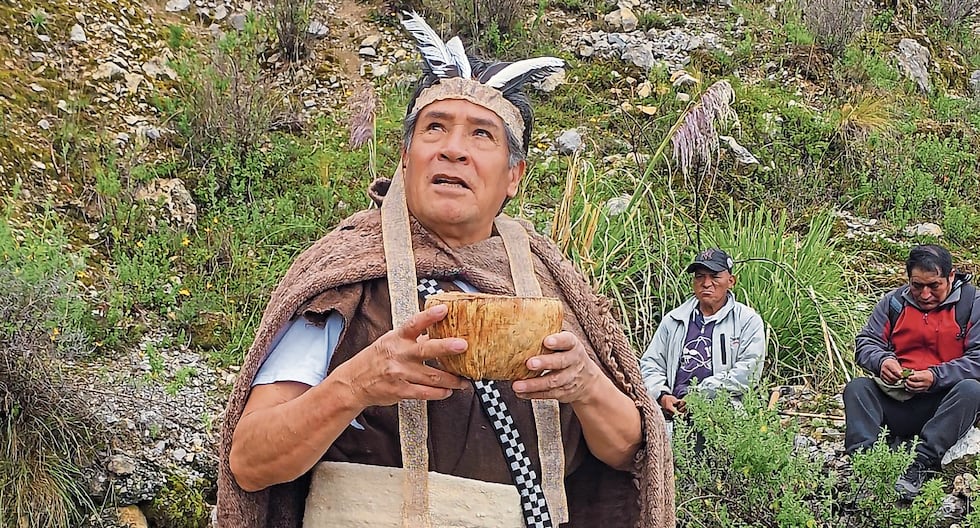
Last Sunday, approximately thirty community members, including men and women, carried out a collective task to clear the spring and irrigation canals that supply water to the Cochangará annex, in the district of Ahuac, of weeds.
This was not just another day, it was a ritual party in which the people and a spiritual advisor merged, thanking nature for the water and fruits it provides.
Before work, the group went through a brief “chacchapada” (ancient Andean ritual, which consists of a collective and ceremonial act of chewing coca leaves – chacchar), which was enlivened by a rhythmic sonata coming from a tinya and a flute.

In addition, those present accompanied their solemnity with cigarettes and cane liquor.
And it is about expressing respect for the Mamapacha and that this season is productive and that the water cycle is not interrupted.

The event took place in the place known as “Matapachi”, where there is a spring that supplies more than 200 residents of the town, because they lack basic sanitation.
Ronald Arroyo Aquino, president of the Users Committee, pointed out that the water that comes from the spring is used for irrigation and consumption, since the town lacks drinking water even though it is a latent need.
An Andean ritual
The scholar Pompeyo Cerrón was in charge of “kutichi”, which in the Andean context refers to the action of returning something. In other words, he presided over the ceremony of gratitude, depositing the offerings brought by the residents into the spring of the well. “It’s about giving back or being grateful for what the puquio gives us. That’s why we brought flowers,” said the anthropologist, who is one of the most concerned about studying the history and customs of Cochangará.

The professor and researcher is a well-known writer, anthropologist and cultural manager from the province of Chupaca. His work focuses mainly on the rescue of the identity, history and traditions of the central region.
His published books include: History and traditions of Chongos Bajo (2025); Shapish: Chupaquina cultural identity (2023); Ućhaaka/Cochangará, Wanka cultural emporium (2022).
Precisely, in this last monograph he describes the pre-Inca era of the Wankas in the Cochangará area. With intellectual daring he points out that the origins of the wankas are in the heights of Cochangará.
His theory is not far-fetched, since along a few kilometers of the slope you can find architectural signs in the Wanka style. Even in the countless rock shelters of the area there are bones and ceramics that reveal the presence of past inhabitants that cry out to be studied.