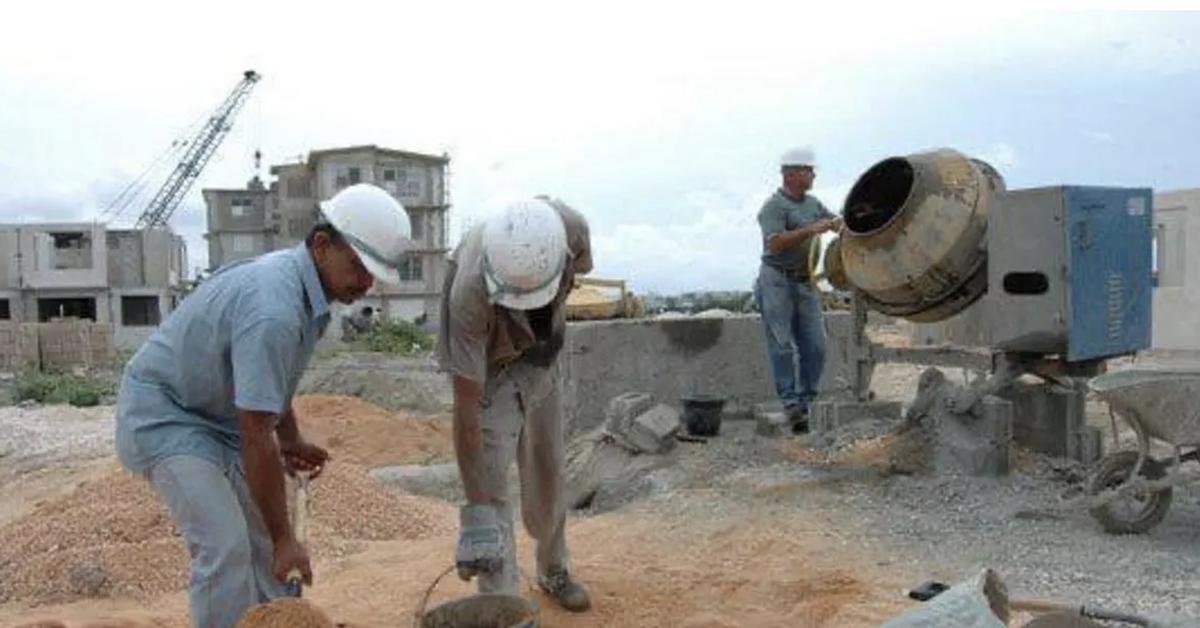
Madrid/The most recent data from the National Office of Statistics and Information (Onei) shows that in several economic sectors on the Island, private companies are far ahead of the mammoth state sector. The main one, construction: 89% is covered by MSMEs, which reveals, indicates the consulting firm Auge in an analysis published on its social networks, “that construction in Cuba relies mainly on small entrepreneurs.”
They are followed by hotels and restaurants, of which private ones represent 87% of the entities, and the manufacturing industry -excluding sugar-, in which 82% of the entities are private MSMEs. In “trade and repair of personal effects” the majority are also individuals, 58%, which consolidates them, says Auge, “as fundamental actors in a key activity for daily consumption.”
Onei’s numbers are, at first, positive. Last year it closed with 9,941 MSMEs in the country, 7.6% more than the previous year, and the number of private entities, including institutional ones, already accounted for 48.9% of the total.
This means, indicates Boom in its report, “a silent but profound change in the ownership structure” on the Island, “where the private sector – led by MSMEs – practically equals the state sector in number.” However, the consulting firm qualifies the figures, putting them in perspective, and assures that the matter “reveals a more complex pattern.” Hence the title of his publication, which closes with a question: “Private MSMEs in Cuba close 2025 with 9,941: controlled growth or stagnation?”
In Havana, which is home to almost 43% of all MSMEs (4,258), the private sector accounts for 70% of the entities in the province
To begin with, Auge highlights a “clear slowdown” in authorizing private ventures from 2023, due mainly to the “deep crisis” in the country, but also to countless bureaucratic obstacles. Precisely to speed up the approval process for MSMEs, the regime transferred this power, in August 2024, to municipal governments. The result was the opposite of what they intended, laments the consultant: “In practice, the procedures have become slow and discretionary, which slows down the entrepreneurial drive in an already adverse context.”
In his report, Auge insists on something that he already pointed out in a previous report – about the impact of the worsening fuel crisis in private companies–, that in Havana, which is home to almost 43% of all MSMEs (4,258), the private sector accounts for 70% of the entities in the province, which shows its weight in the capital’s economy.
The map of MSMEs on the Island, however, reflects deep territorial inequalities, says the consultant: at the opposite extreme, Isla de la Juventud barely registers 92 MSMEs.
In any case, and despite its growing weight in number, it is not so important in the real economy, warns Auge. “In terms of gross domestic product (GDP), the picture is reversed. The state sector, despite the crisis, continues to be the dominant actor: it controls most of the national assets, concentrates 80% of foreign trade, manages strategic infrastructures and maintains enormous productive capacities,” recalls the consulting firm. “The gap between the numerical weight of the private sector and its real contribution to the economy continues to be one of the great imbalances of the Cuban model.”