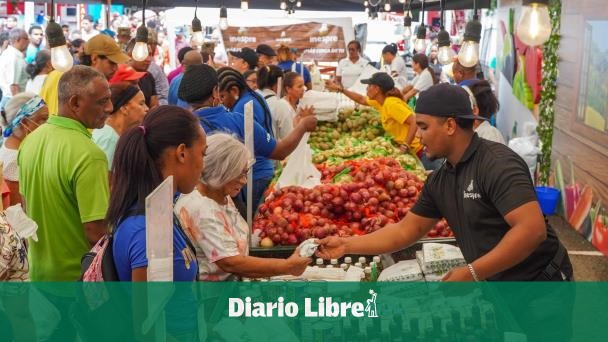
The cost of the family basket national value went from 46,420.68 pesos in January to 47,534.46 pesos in September 2025, which represents an absolute increase of 1,113.78 pesos and a growth of 2.4% in the first nine months of the year, according to data from the Central Bank of the Dominican Republic (BCRD).
According to published information, the value of the basket recorded almost consecutive increases during the aforementioned period. On average, each month the cost increased around 124 pesos, driven by increases in food, transportation and services.
By quintiles, the cost of the basket also shows proportional increases. In quintile 1 (lowest income households), the cost rose from 27,828.58 in January to 28,445.17 in September, 2.2% more, while in quintile 5 (highest income) it went from 75,490.79 pesos to 77,191.37 pesos, an increase of 1,700.58 pesos in nine months. Quintile five was the one that increased the most, equivalent to 2.3%.
In contrast, the smallest increase was recorded in Quintile 1 (lower income), with 616.59 pesos, equivalent to 2.2%. This reflects that, although the increase was generalized, the basket of higher-income households rose more in absolute and relative terms.
The Central Bank calculates the value of the family basket from the National Survey of Household Expenses and Income (ENGIH 2018) and updates it monthly according to the variation of the Consumer Price Index (CPI).
Latest report
On October 7, the Central Bank of the Dominican Republic (BCRD) reported that the CPI registered a monthly variation of 0.34% in September 2025. With this result, the interannual inflation measured from September 2024 to September 2025 was 3.76%.
According to data from the BCRDthe calculation of CPI determines inflation, that is, this index serves to measure how the prices of goods and services purchased by households have changed, generally in the space of a month.
It details that a group of expert interviewers, coordinated by the Central Bankvisit a sample of commercial establishments in towns and cities throughout the country daily, collecting prices, in order to have accurate information as a basis for calculating the CPI. This data is so relevant that it serves as a starting point to negotiate salary increases, or to review the amount of a rent year by year, among other uses.
For the report October, when analyzing the results of the monthly variation of the general CPI in September 2025, the BCRD observed that the groups with the greatest impact on inflation were Food and Non-Alcoholic Beverages, Education, Restaurants and Hotels, Alcoholic Beverages and Tobacco, and Miscellaneous Goods and Services.
In the opposite direction, the Transport, Recreation and Culture and Communications groups rreductions were recorded in their price levels, contributing to the variation of the CPI generally of lesser magnitude.