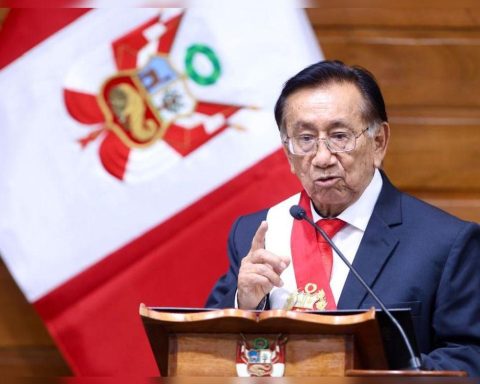
A bad reading of Manuel González Prada in the eras of TikTok can end up justifying some grotesqueries. For example, a political influencer, one of those who make you see what you want to see in the hall of mirrors of social networks.
MORE LAS, LESS MGP
Better to read the biography of Don Manuel, by Luis Alberto Sánchez, who recalibrated the famous adage to its exact dimension and described a young country like few others. Because, when talking about bringing young people to work, the anarchist refers to young, read modern, ideas. And in the same way it asks to bury, not the elderly, but the outdated thoughts of the old Peruvian regime.
Confusion lies there and continues to reign in the country of bewildered people. In this tower of Babel, the phrase is reread as a knife in the back, ad hominem patricide and ungrateful betrayal. And that applies to the fleeting furor that José Jerí caused in this surveyocracy. If we survive in a teenage country, with ancestral authoritarianism and modernity in its infancy, to paraphrase LAS, we are now facing the portrait of a teenage president.
LAS was supported by the historian Carmen McEvoy, who added her point to the cry of “control this teenager, this Peter Pan”, perhaps a little kid who uses hook and claw. A sign of the times, with bodies of prolonged aesthetic adolescence, but ethical fragility typical of the glass generation.
APRA AND AP
The trend towards generational change is also seen in the two oldest parties in contemporary Peru. The performances of Julio Chávez and Enrique Valderrama in the primaries of Acción Popular and APRA, respectively, announced a democratizing process that has been developing for years within both traditional parties.
The two candidates share some symptomatic characteristics. Chávez (44) and Valderrama (38) are young people who have moved from the periphery to the very epicenter of their respective parties. They did not know the patriarchs or the founders intimately. They do not belong to the aristocracy of the group nor do they have surnames of party lineage. They did not come under the protective wing of some historical hierarch. Quite the opposite: they faced the old barons of each brotherhood. And they prevailed in their own way. Not only are they young, but they were born without lineage or party surname to welcome them. That makes them doubly young.
But like any democratization process, this has implied its consequent ‘mediocratization’. By expanding citizen participation and massifying access to party power, it has inevitably become trivialized. We are not dealing with the most gifted students or the most powerful debaters. Nor before the most charismatic candidates, politically speaking. But perhaps before the most representative ones, with all that that implies. Those who embody post-Castillo Peru, where campaigns are no longer won with academic records or oratory contests. They are won, yes, with new faces and old tricks, the kind that have abounded in the primaries of both parties. But after the internal victory, the political game had to take precedence and, for this reason, the star has run the risk of following the path of the lamp and being left out of the race. Because reality has been showing both candidates that it is not enough to reissue old plays behind a youthful face. We also need a political wrist, the kind that Belaunde and Alan—two young dinosaurs—had enough to maintain discipline at the bases.
YOUNG THOSE FROM BEFORE
This confirms a hard truth: the cult of the youngest is more about form than substance, about packaging than about substance. The ephebolatry of these times is a downward democratization, chronologically, but also meritocratically speaking. A democratization that is more mediocratization than anything else.
And today’s young people are not even a shadow of what the new political class of yesterday was. At the beginning of the last century we had youthful titans of Peruvian politics. Candidates and presidents who marked the 20th century from its early years. The paradigmatic example is Haya de la Torre, who was already presidential from university. But the “condor pigeon,” as the also young César Vallejo called it, was not an isolated case, but the norm. Those were times when ephebolatry dominated Peruvian politics and poetry (Young Poet Award).
Comparison cries.
MVLL AND THE SHOW
And in the middle of the civilization of the spectacle, reality hits Jerí. Because just as you went up in the surveys for a few photos and videos, you will also go down for some videos and photos. It is the cost of your youth and inexperience to receive praise, premier dixit. Those who know him say that he also expresses himself politically with Star Wars metaphors and references to the Avengers. And he hopes to emerge unscathed from the dark side. Like your average podcaster, more or less.
RECOMMENDED VIDEO