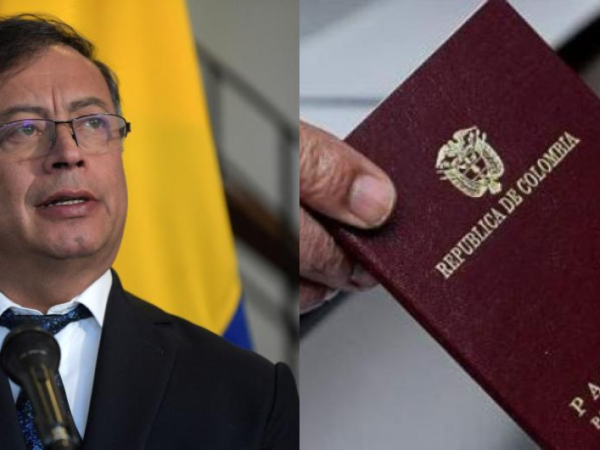
Colombian president, Gustavo Petro, announced Tuesday that he already signed the agreement with Portugal To implement the new passport expedition modela controversial process that has cost two foreign ministers and is currently investigated by the Public Ministry.
(Read more: Opinions divided by two crimes opinions to former president Álvaro Uribe)
“Finally the monopoly is over”, The president exclaimed from Santa Marta, during a commemorative act for the 500 years of the foundation of this Caribbean city.
In this case of passports, the Attorney General’s Office (Public Ministry) opened this month a disciplinary investigation against the head of the presidential office, Alfredo Saade, and the former corn Laura Sarabia and Luis Gilberto Murillofor alleged irregularities in the implementation of the new model.
The passport production contract also caused Sarabia’s resignation in early July, just five months after assuming the Foreign Ministry.
The controversy with passports began in 2023, when the then chancellor, Álvaro Leyva, suspended a contract that the company Thomas Greg & Sons had for 17 years to manufacture the documents, claiming that in the last tender there was no free competition.
(Read more: bridge visas: what you should know about the new US visa that is broadcast in Colombia)
Passports
To replace that firm and end the “monopoly” That, according to Petro, there is, his government signed a Memorandum of Understanding with Portugal and the National Printing of Colombiabut according to Sarabia, the latter lacks technical capacity and is not yet in a position to take care of the printing, personification and distribution of documents.
For that reason, before leaving office, Sarabia extended for a year, as of September 1, the contract with Thomas Greg & Sons.
Petro reported on the signing of the agreement with Portugal from the fifth of San Pedro Alejandrino de Santa Marta, Place where Liberator Simón Bolívar diedwithin the framework of a commemorative day loaded with symbolism and historical speeches about the colonial past and the institutional present of the country.
(More news: corruption, a debt in force in national legislation: MOE)
EFE