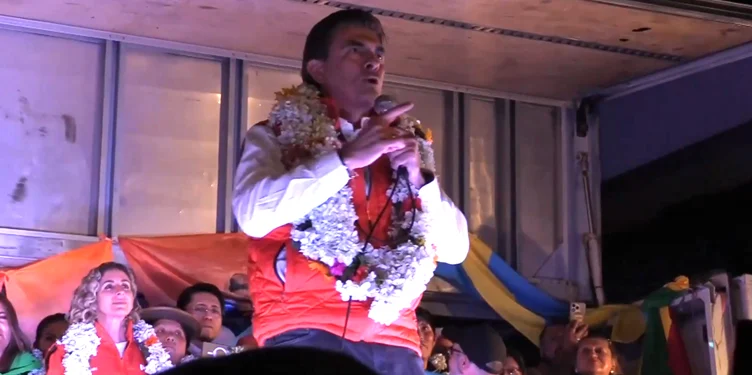
The departure of the Movement to Socialism from the presidential ballot coincides with the rise of Rodrigo Paz Pereira, who won the second round and will lead a political turn in Bolivia after two decades of MAS dominance.
MADRID, Spain.- For the first time in two decades, the Movement towards Socialism (MAS) did not participate in Bolivia’s presidential race. His absence in the second round of the 2025 elections marks a historic break for the political force that dominated the country for much of the 21st century.
This October 19, Bolivia held the second round of the presidential elections. Centrist senator Rodrigo Paz Pereira won with 54.5% of the votes compared to the 45.5% obtained by former president Jorge Quiroga. With this result, the MAS, which had governed or influenced power since 2005, was completely left out of the runoff.
Towards decline
The force led for years by Evo Morales It reached its peak after the 2005 elections, when it promoted a political project that included the nationalization of natural resources and a new Constitution. However, his power began to erode after the 2019 electoral crisis, when allegations of fraud and an audit by the Organization of American States triggered mass protests and Morales’ departure from the country.
Although the MAS returned to power in 2020 with Luis Arce, internal unity began to crack. Disputes between factions, accusations of corruption and tensions between the old guard and renewal sectors weakened the party structure. In 2023, a ruling by Bolivia’s Plurinational Constitutional Court disqualified Morales from running again, a direct blow to his historic leadership.
The worst electoral defeat in its history
In the first round of 2025, the MAS suffered its greatest setback: not only did it not present a presidential candidate, but it obtained minimal parliamentary representation, with just two seats. Analysts consider that this result reflects a profound loss of popular support and the lack of a renewed political project.
The economic context aggravated the wear and tear: the country is experiencing a severe shortage of dollars, problems in the supply of fuel and growing inflation. This crisis, added to the political erosion, widened the gap between the population and the party that for years presented itself as an alternative to neoliberalism.
Rodrigo Paz’s victory marks the first center-right government in Bolivia in more than two decades and represents a change in the country’s political orientation. The new president will take office on November 8 with an agenda focused on economic stabilization and the search for parliamentary alliances, since he does not have an absolute majority.
During the electoral campaign, Rodrigo Paz Pereira promoted the idea of “capitalism for all” as the central axis of his economic proposal. Its program includes reducing taxes and tariffs, expanding access to credit and establishing an exchange band with maximum and minimum limits to stabilize the currency. The new president thus proposes a transition “from state and clique capitalism” towards a more open economy, with a leading role for private and foreign investment.