Given the scandal of alleged irregularities in the use of the S/80 million public funds that 38 organizations have received to contract spaces in the media, the National Office of Electoral Processes (ONPE) reported that it is the political parties that must be responsible for the destination of the money. But the statement is not enough to explain what happened.
“The parties have selected the spaces where their spots will be broadcast, depending on the audiences they want to reach and their communication strategies. They are responsible for both the selection of the spaces and the production of the spots that will be broadcast,” said ONPE, evading the issue.
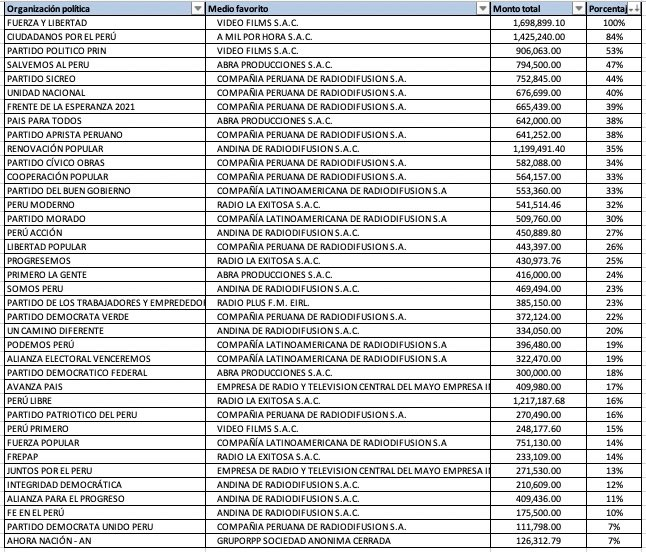
The case broke out when it was revealed that the party First, the People awarded 24% of the budget that the ONPE assigned (S/416 thousand) to the Nativa TV channela company with which Miguel del Castillo was linked. The alleged conflict of interest was made evident when it was confirmed that Del Castillo, candidate for deputy number one of the aforementioned political group, intervened in the hiring. The vice president of Primero la Gente, Manuel Ato Carrera, declared that Miguel del Castillo did participate in the hiring of Nativa TV, whose corporate name is Abra Producciones SAC.
Del Castillo gave another version to La República: “It was a political decision of the Communications Committee of which I was a part and was the one that carried out the assignment of the slot, (the decision was) made on (based on) the powers it had. I do not believe I have betrayed the trust (of the party).”
The incident exposed the need to specify responsibilities and accountability regarding the use of funds allocated to finance parties’ access to the media and social networks. It was not the only case.
YOU CAN SEE: Jerí sinks Fujimori and Acuña: Fuerza Popular and APP among the banks with the greatest citizen disapproval
The presidential candidate of Country for All (PPT), Carlos Álvarez, upon learning that 38% (S/642 thousand) of the allocation for his group also went to Nativa TV, declared that he had not intervened in the distribution of the funds and threatened to renounce the application if the leadership did not give a satisfactory explanation.
Shortly after, PPT reported that “it has become absolutely clear and categorically that there has been no undue benefit or act of corruption. What happened responds to a scenario of inexperience in the strategic distribution of the electoral strip, typical of a new party that does not have specialists or media agencies.” Next, PPT renounced the use of the electoral strip. Álvarez is still in the race.
Another striking episode is carried out by the party Strength and Freedomwhose presidential candidate is Fiorella Molinelli. The grouping awarded 100% of the funds (S/1,698,899) to the company Video Films SAC., which manages Sol TV, with a presence in the north of the country. The organization justified the decision, stating that Molinelli had not participated.
“The territorial prioritization responded to objective criteria of scope efficiency and demographic concentration. The northern regions such as Trujillo, Piura, Chiclayo and Cajamarca group some of the main urban centers after Lima,” the party indicated in a statement.
The law does not prevent a party from deciding to invest all funds in a single medium.
YOU CAN SEE: Elections 2026: candidates propose eliminating electoral strip after questions about misuse
For his part, the PRIN Political Party, which is running for Walter Chirinos Purizaga, has reported having invested 53% (S/906,063) of the funds also to Sol TV. Chirinos acknowledged that there was an error and that he will make the readjustments, in accordance with the rules, and ruled out irregularities.
The case of Alianza para el Progreso (APP) that has directed S/349,882 to the company Cosmo Televisión has also aroused interest. The candidate Jair Ramírez denied that the media belongs to the Acuña family, but another story appears in Public Records. Although the founders Anthony Alfaro Acuña, Christian Alfaro Acuña and Juan Carlos Alfaro Acuña left the board of directors in 2016, there is no document indicating the renunciation of ownership or the transfer of shares to third parties.
The The incidents mentioned reflect the opacity in the use of funds allocated to political parties to contract spaces in the media.
“When the use of the electoral strip was expanded to digital media, intermediaries were not regulated, nor were transparency mechanisms established. In the case of Nativa TV, these legal loopholes are evident. The law does not prohibit (party) leaders from allocating funds to their own media, nor does it regulate intermediary commissions,” explained electoral law specialist, Kevin Advincula Medrano.
The former head of the ONPE and political scientist Fernando Tuesta Soldevilla stated that False versions circulate about the indirect public financing of the electoral strip and that it is a system enabled for 25 years.
“The electoral slot is the access that the parties have to the media. It was implemented in 2001 under that format. Then, in the period 2001-2005, Congress incorporated it into the Law of Political Parties, today called the Law of Political Organizations, which established the distribution of time for each party. This is what happened for the elections of 2006, 2011, 2016,” he stated.
“On December 8, 2018, under the referendum, this form of indirect public financing was maintained, but it was considered the only way to access the media. Parties could not, as had happened before, buy spaces outside of this form of access. As a consequence of the change in the Constitution, the Congress of the 2016-2020 period modified the law of political organizations, which is how it operates now. So indirect financing has been operating for a quarter of a century,” he specified.
YOU CAN SEE: Electoral strip scandal: how much money did each political party receive for the 2026 Elections?
So that the cases that are now the subject of investigation by the National Prosecutor’s Officeelectoral law expert, Kevin Advíncula Medrano, proposes fundamental changes in the rules related to the use of public funds allocated to political parties in campaigns.
“The new Congress (2026-2031) would have to carry out an in-depth reform. For example, prohibit assignment to media linked to leaders or candidates, so that there is no conflict of interest. It must also regulate intermediaries and their commissions, because that is not provided for in the electoral law either. For example, there is no prior supervision by the ONPE,” Advíncula highlighted.
The Republic consulted with the ONPE about the case that generated the scandal over the farce of the allocation of funds for the electoral strip. The entity acknowledged that it is not authorized to verify which means a political party contracts with.
“The ONPE does not supervise the selection of media and digital media chosen by political organizationsgiven that the Law empowers them to choose based on their preference and financial allocation. Said selection is carried out directly by each political organization, through the person duly accredited by its legal representative.
The catch is in the law.
YOU CAN SEE: APP allocated 349 thousand soles per electoral slot to Cosmos TV: the channel was founded by the UCV of César Acuña
The part that corresponds to Congress
- The expert on electoral issues, Kevin Advincula, said that the episodes of alleged cases of opacity in the destination of the funds are due to the inaccuracies of the current Congress.
- “It has not legislated in a precise and supported technical manner. How is it possible that a small media outlet, social media or streaming, receives millions of soles without demonstrating its audience or its true technical capacity?” Advíncula pointed out.