The Colombian former president Álvaro Uribe was convicted on Monday of bribery of witnesses and procedural fraud by a court in Bogotá. What follows?
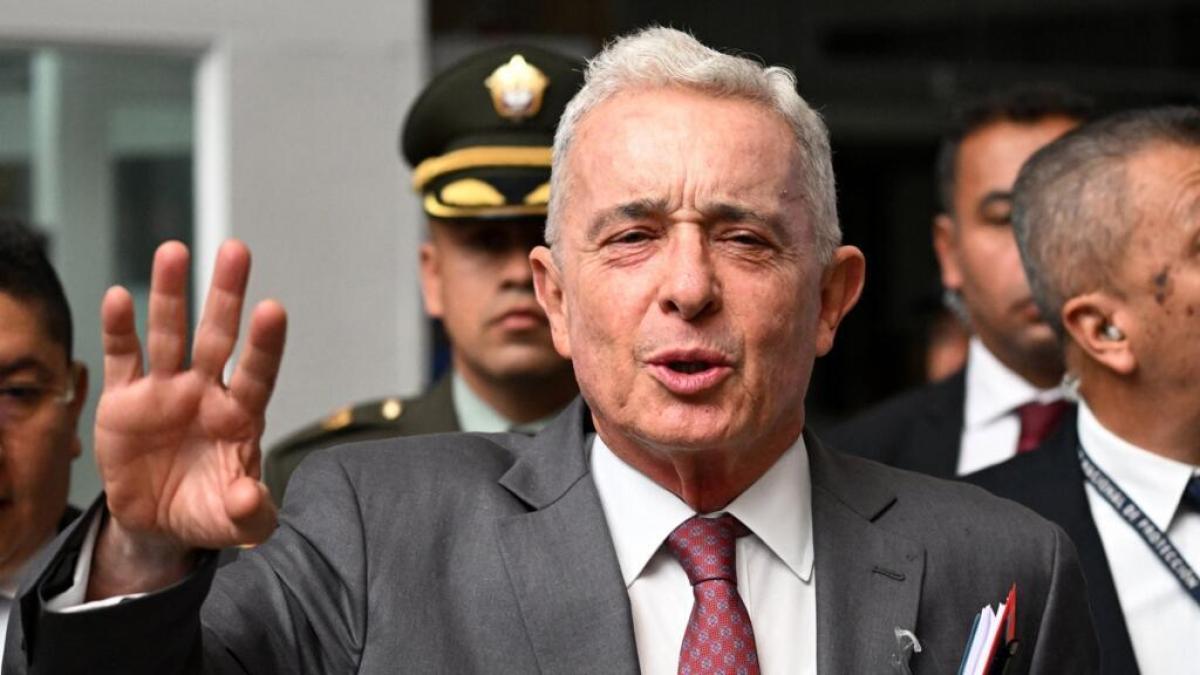
After 475 days of judgment, the former Colombian president Álvaro Uribe was convicted this last Monday of Procedural fraud crimes and bribery in criminal actionafter determining his participation in the manipulation of witnesses through his lawyer, Diego Cadena.
The reading of the verdict, which lasted about eleven hours, was at the hands of Judge Sandra Heredia, in charge of closing almost 13 years of judicial process against the former president; “Mr. Álvaro Uribe Vélez knew the illicit of his actions,” said the judge on Monday.
Although Uribe always He declared himself innocent And he claimed to be a victim of a political persecution, this Friday is expected to know the penalty to face. Although due to his age and condition, the former president will not enter prison but will comply with house arrest. With this condemnation the It was Uribebut a milestone is also marked in politics as it is the first head of state of Colombia’s history to be convicted.
Act I. The end of the Uribe era
Son of a landowner and born 73 years ago in Medellín. Of liberal origin and formed in law, with studies in Harvard, Álvaro Uribe came to power when Colombia faced one of its greatest internal crises with an ardual conflict between guerrillas, paramilitaries and state forces. In fact, the day of your possession The FARC The presidential headquarters attacked with rocket. Attacks that would be repeated during your mandate.
Just arrived to power, he achieved a questioned constitutional reform that allowed him to re -elect and govern eight consecutive years, in which he became the number one public enemy of the FARC, whom he accused of having killed his father. Hence his main battle was to end the guerrillas.
“Those bandits was time for total defeat,” Uribe said in 2003, later, by the hand of United States and Plan Colombia As a financial and military arm, launch an unprecedented offensive against the FARC.
A plan that did not provide all the popularity that the president imagined, since his government was questioned by thousands of murders committed by military during the fight against the guerrillas. Under their mandate, more than 6,000 “false positives” were documented, civilians riddled and dresses as guerrillas to inflate combat results and receive rewards. Of the eight million victims that at that time left the armed conflict -between displaced, dead and wounded -40 % were recorded during their mandate.
With a popularity that It was 80 % during his governmentUribe abandoned power in 2010, after justice vetoed a referendum to apply for a third consecutive mandate. Although his political career did not end there.
After his departure from the presidency, he returned to Congress and broke records: in 2018 he became the most voted senator in Colombian history and promised to serve the country “until the last day” of his life. Despite corruption scandals, espionage and links with paramilitaries that entangle its nearby circle, in March it kneaded a popularity of 52%, according to a Bloomberg survey.
This trial is the most popular and politicized of the last decades in the country, and is the tip of the iceberg of other investigations on their links with the antiguerrilla paramilitaries who delivered the weapons under their government, in a controversial negotiation.
Act II. The condemnation
Former president Álvaro Uribe could face a penalty of up to Friday 12 years in prison, although he would still have the possibility of appealing the conviction under his arm.
During the reading of the conviction that lasted just over eleven hours, Judge Sandra Heredia found Uribe guilty of the crimes of procedural fraud and bribery to witnesses after being accused of having links with paramilitary groups. Heredia points to Uribe as the author of the order to third parties to manipulate imprisoned witnesses in order to declare in their favor after being accused of having links with paramilitary groups by the leftist senator Iván Cepeda in debates in Congress in 2012.
With the view for the sentence, 13 years of investigation and controversy is put an end. In 2020, the Supreme Court ordered the house arrest of Uribe because it considered that there were “risks of obstruction to justice.” He former president was arrested for 66 days and at that time he renounced his seat as a senator in Congress.
Despite the guilt, the judge acquitted Uribe in one of the bribery acts when considering that the defense was able to prove that it had nothing to do with the transfer of one jail to another to the former Hilda Hilda Niño Farfán, convicted of corruption.
This Friday, the former president is expected to receive the sentence that could condemn him to 12 years in prison, although for his status and his age, Uribe will not step on the prison, but could comply with house arrest.
Act III. The consequences
The consequences of this ruling are now unpredictable, since Uribe is currently almost removed from politics, although it maintains an important weight in the Colombian right.
Even so, this conviction is already historical. Álvaro Uribe is the first head of state of Colombia to be convicted of justice, and whatever the final sentence, is a fact that marks the history of Colombian policy and feels a judicial precedent.
On the part of the defense, Uribe’s lawyers can still appeal and can ultimately carry out an appeal for the Criminal Cassation before the Supreme Court of Justice.
However, the judicial resolution has already generated controversy and tension in Colombia. On the Uribista side, some politicians described the conviction as the “infamy ruling”, considering it arbitrary.
ANDThe US Secretary of State, Marco Rubio, He also showed his support to the former president by considering that his “only crime” has been “defending his homeland” and indicated that he is concerned that justice is being instrumentalized by “radical judges.”