Havana/In recent weeks, while the news repeats reassuring figures on cases of arbovirus and hospitals avoid offering complete statistics, funeral homes tell a different story. This newspaper took a tour of some wake rooms in Havana and observed a pattern that does not fit with the official discourse of “epidemiological control.”
In Guanabacoa, the Bertematti funeral home, between Máximo Gómez and Maceo, had all its chapels occupied this Saturday, something quite unusual for the location. Outside, some families were waiting their turn to get a space where they could say goodbye to their loved ones.
No one claims with certainty that the deceased were victims of a specific virus. But nothing else is talked about either. The whispered conversations on the outskirts of the place repeat the same words and phrases: “jelly,” “soup,” “fevers,” “he became dehydrated,” “the pain didn’t leave him.” They are symptoms without a written diagnosis, but the population has already learned to recognize them immediately.
/ 14ymedio
The same thing happens at the San Miguel del Padrón funeral home. Of the three rooms, two were used at the time of the visit. 14ymedio.
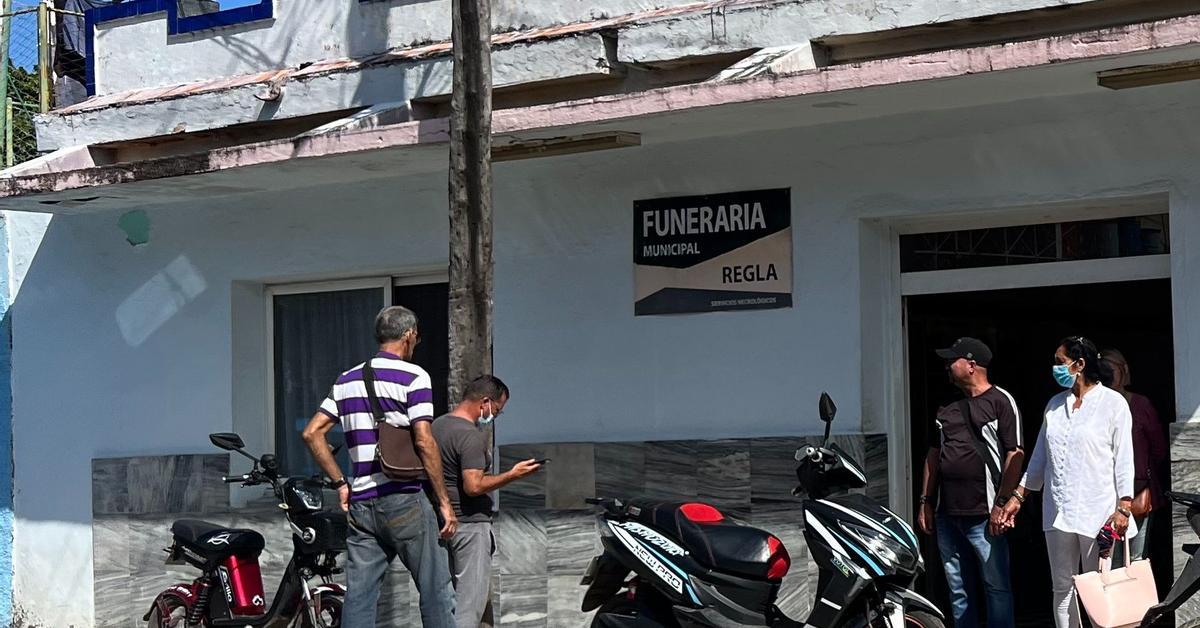
In the smaller Regla funeral home, two rooms were also working this Saturday at the same time. And in one of them you could see a doctor wearing a mask. Their presence there seemed to be part of a health protocol that has not been reported in the official media, but which points to a greater emergency than they admit.
“The majority don’t go to the hospital. So how do you know how many sick people there are?” commented the son of one of the deceased, leaning against the wall. Someone close argued that, even when a virus is what caused the patient’s fatal deterioration, it rarely appears as a cause on the death certificate. “If the person had diabetes, heart disease or asthma, that’s what they put in, not the virus,” he says.
A doctor from Cotorro consulted by 14ymedio confirms it with a more technical nuance: “The virus can cause encephalitis and myocarditis, which are considered a direct cause of death. Dengue can cause shockwhich also kills. But in emergencies no epidemiological statistics are kept. That is controlled—in theory—in Primary Care. In practice, the record is fragmented.”

/ 14ymedio
In the Regla cemetery, a custodian summarizes the social climate with a phrase that functions as a collective diagnosis: “They see a dead person and they already believe it is the virus.” This reaction, far from being a sign of epidemiological ignorance, is a fear based on the experience that is lived daily, with entire neighborhoods infected, and on the loss of credibility of the health authorities.
In the crematorium of the New Cemetery of Guanabacoa there were no burials at the time of the visit, but the workers admit that “the movement has increased” in recent days.
Even those who emerge victorious from the viruses that they circulate without brakes throughout the country they retain consequences for a long time. Yolanda is 22 years old, she got sick a month ago and has not yet returned to normal. “I still have dizziness, persistent pain and exhaustion,” the young woman, who still needs physiotherapy and rheumatology consultations, confesses to this newspaper. “I thought it wasn’t dawn,” he says. She is the mother of a small child, and in the nursery school, she assures that “there is panic” because families perceive that the symptoms in minors are more aggressive.
/ 14ymedio
In the La Jata neighborhood, a deceased child shook the community. It is the only death that residents undoubtedly attribute to the virus. There is no communication, but there is local memory.
In the eastern provinces it is much worse than in Havana. A resident of Guantanamo confirmed that 27 deaths were recorded in the local funeral home on the same day. It does not offer an exact date, only the context: “After Storm Melissa everything was turned upside down. Accumulated garbage, lack of hygiene, bad environment.” The figure, say local sources, exceeded the ordinary perception of mortality. “The whole city is talking about it. People are scared,” he said.
The panorama in hospitals and funeral homes throughout the country is clear: unsanitary conditions, increase in infections, distrust in health institutions and resistance to going to hospitals for fear of not leaving them. The virus – be it dengue, chikungunya, hepatitis or a mixed condition – is a social precipitator of panic.