The general fear is that any increase in pensions causes inflation even greater than the current one.
Holguin, Cuba. – “What does the government do with the checkbook if prices also go up? Thus we will continue in them,” complains the Mayra Batista Cruz holguinera, who remains skeptic by The increase in pensions for retirees announced by the Cuban regime in the middle of this month.
The measure will enter into force as of September, it will benefit 1,324,599 people (almost 80% of the country’s total retirees) and will double the minimum pension to 3,056 pesos. However, in the streets, the news has not caused great joy, but pessimism.
The general fear is that any increase in pensions causes inflation even greater than the current one.
“The increase in pensions would press prices, which in turn would quickly diminish the purchasing power of pensions,” Cuban economist Pedro Monreal wrote in his account on social network X.
In a panorama of economic crisis, the news has been interpreted by many not as a solution, but as a desperate and economic foundation to divert attention after the scandal by the “resignation” of the former minister of work and social security, Marta Elena Feitó Cabrerawho denied before the Parliament that in Cuba there were beggars.
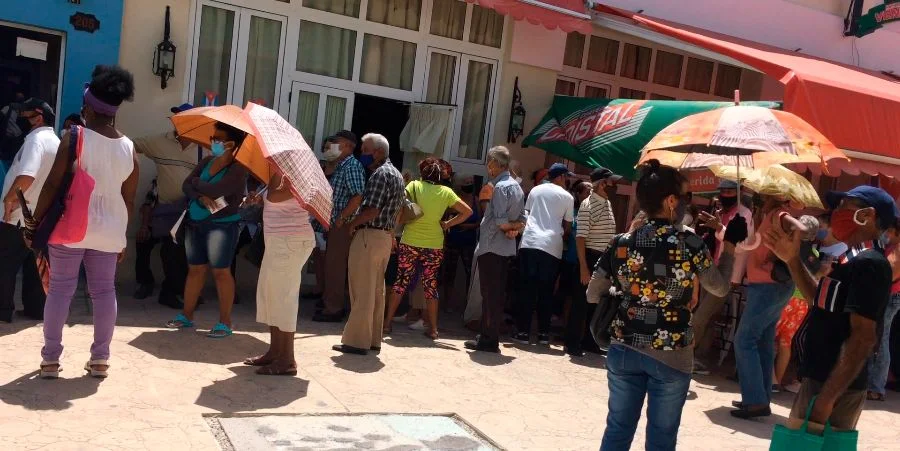
“The rise of the checkbooks was an exit to cover the nonsense that the minister said, because the announcement is a mistake that will cause the rise in prices and we will be worse,” says retired Esther Oliva, who waits in a long line to collect her pension, in front of the Popular Bank for Saving of Aguilera Street, in the city of Holguín.

Lázaro Almaguer Leyva, also in the tail, coincides with the opinion and adds that there is a disconnection between the official figures and the reality of the pocket. “With 4,000 pesos I do nothing. I can barely buy an egg cardboard,” he laments.
The market reaction to increased retirement pensions, according to Holguineros, has been immediate.
Rolando Osorio González, another retiree, says that, “although the increase in the checkbook begins in September, Fongo’s hand rose from 150 pesos to 250”.
Ángel Marrero confirms the trend: “prices began to rise since they gave the news, now every day is more expensive.”
The official data are outdated at day -to -day changes, as explained by the holguinero Juan Carlos Góngora: “You are going to buy one thing one day and it has a price and the next day is more expensive. The pound of chicken that recently was 320 pesos is already more than 400”.
On the other hand, the increase in pensions worsens, in turn, the logistics crisis that Cubans already suffer to remove cash from banks and ATMs. Ernesto Rodríguez, in a tail to collect his pension at the Bank of Credit and Commerce (Bandec) of Arias Street, anticipates the immediate effect of the increase: “When they upload the checkbook, the lines will be longer.” “There will be more queues, there will be more waiting time to get the money,” says another retiree, in the same tail.

The fragility of the pension system is, in reality, a symptom of a much deeper structural crisis. “The checkbook is not enough, so you see old people looking in the garbage to survive. The one who is lucky and can go, to live outside Cuba because if you become old in this country you will go hungry and many needs,” he tells Cubanet Sergio Fonseca, while waiting in tail to collect his checkbook, before an ATM from José Antonio Cardet Street.
This perception stimulates a historical exodus and without a history in Cuba. Carlos Pantoja thinks about this change. “From 11 million Cubans living on the island and we decrease to nine million,” he says. “Young people are going and the population is aged,” he adds,
Your observation The official statistics confirm it of the National Office of Statistics and Information (ONEI) that set the population of Cuba at the end of 2024 in 9,748,007 inhabitants, a figure that reduces every year driven by a negative immigration balance and a birth rate in historical minimums.
This accelerated aging exerts pressure on public services. As Pantoja says, an older population leads to more diseases and, therefore, to the need to “increase medication expenses, hospitals and pensions.”
The constant emigration of Cuban young people has direct impact on national productive capacity, especially food production. “If young people are going, then who goes to the field to grow?” Asks the Holguinero Lázaro Camejo.
On the subject, Raúl Ochoa Cisneros believes: “It is not that youth does not want to work, it is that agriculture is a lot of sacrifice, they pay very little and life is very expensive.”
And another retired Holguinero, Francisco Valera, takes the question even further: “If we are getting old, if youth is leaving, if those who remain do not want to work, if the checkbook is not enough even if they upload it … how will this country move forward?”