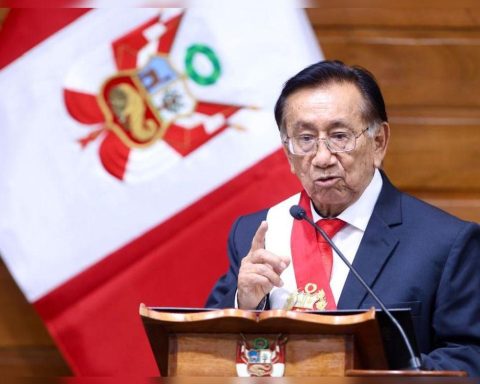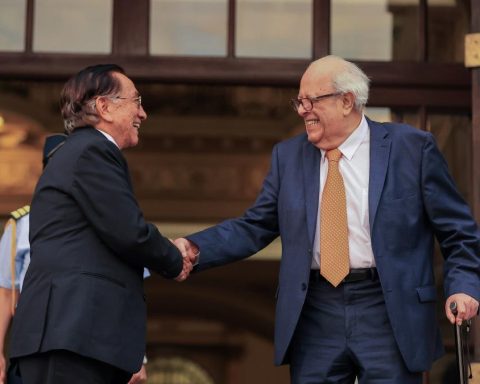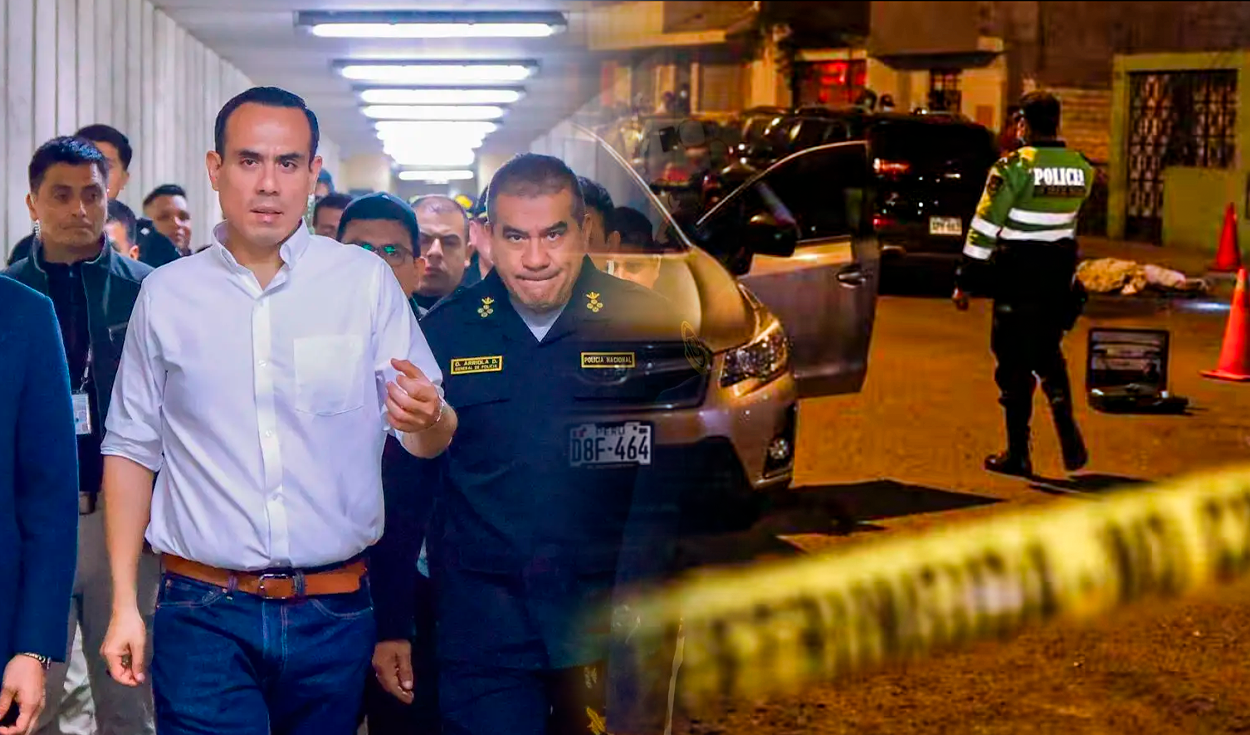
José Jerí He visits prisons, goes to police stations and participates in operations at dawn, always under the lens of a camera and publishing each action on his social networks. Before the press, he energetically assures that, from the Executive, they fight against citizen insecurity. Reality, however, contradicts the image. Since his government took office, 75 murders have been recorded nationwide, of which 28 belong to Lima and Callao, according to Sinadef figures.
He successor of Dina Boluarte participates in operations and searches in prisons. On October 25, he led the transfer of 45 highly dangerous inmates to the new extreme security pavilion in the Ancón I prison. Before that, on the 22nd of the same month he visited the Lurigancho prison, known as the most overcrowded in the country. On October 13, he participated in the ‘Ciclón’ operation at the Miguel Castro Castro prison.
At the same time, homicides due to extortion and hitmen in the transportation sector continue and there was even a murder during the October 15 demonstration. In addition to this, only on the first day of the state of emergency decreed in Lima and Callao, five murders were reported. The number continues to increase.
In this context, “the reality of the criminal overflow begins to seriously contradict Jerí’s narrative, which has very clear propaganda cues,” warns journalist and political analyst Ivan García in an interview with La República.
The narrative he refers to is, as he explains, a “click-style communication strategy, that is, one that seeks to generate impact on social networks. “In his public appearances Jerí appears very dynamic, with night-time energy and the same is reflected in the communication pieces that tend to be very audiovisual that show the president exercising leadership and initiative,” García says.
“I don’t think that’s wrong. The problem comes when reality does not match the image that Jerí projects. It is a strategy that has short wings and feet of clay, if there are no concrete results and reforms. Propaganda sells us a dream and an illusion that hits if it is not fulfilled,” he adds.
Political marketing similar to that of Alberto Fujimori
The Sociology professor at the National University of San Agustín (UNSA) in Arequipa, José Luis Ramos Salinas, agrees that “showing” that actions are carried out to combat citizen insecurity does not necessarily imply that they have results.
In fact, Ramos identifies certain similarities between José Jerí and former dictator Alberto Fujimori.
To do this, he explains, Jerí starts from the context that “citizen insecurity is quite high in the country and that the previous government did nothing.” Given this, the strategy, both for your government and for any other that faces this problem, is to identify how citizens will think that the Executive “is doing something.”
To reverse that perception, you simply have to resort to “the same methodologies that all dictatorships in the world have used,” says Ramos.
YOU CAN SEE: Government of José Jerí ratifies Alfredo Ferrero as ambassador of Peru to the United States
“In our case we would have to remember what Fujimori did. Jerí is a president who does things, he is not a president who orders it to be done, he is a president who participates in what is being done, he is not someone who orders others to do it. So, if there is a search in a prison, he is there. If there is an operation somewhere, he is there, just as Fujimori did,” he noted.
That presence, he says, is strategic. “The president contrasts with those who accompany him. They are dressed formally, he is not. He is wearing blue jeans, sport shoes, a white shirt and his sleeves rolled up, which is the ABC of political marketing. White expresses honesty and having the sleeves rolled up to the elbows, work. So, that feeling is generated that the president is doing something,” he specifies.
To complete the perception that changes are being made, it would be enough to “invent” culprits.
Ramos Salinas highlights that although, to date, this is not the case of the current government, it is a scenario that could occur.
“We have to see later if what the president does brings results. And well, we don’t have proof of that yet, but the dictatorships invent it. So it wouldn’t be at all strange if the arrests and achievements displayed by the Police are not true, but rather they are arrests of people who are not directly responsible for the crimes they are accused of, but who have a record such that it easily allows citizens to assume that they are the guilty ones,” he says.
Citizens are willing to lose the rule of law for the sake of citizen security
It also highlights the use of security as an element for the loss of the rule of law. “All dictatorships know that the population is willing to sacrifice their rights in the name of security. In fact, Peru has had a tendency to do this for a long time. Once fear of crime is generated, citizens ask for the death penalty to be implemented, they ask for a state of emergency, which is what has been happening in the country,” mentions Ramos Salinas.
Iván García complements this position by adding that this scenario is taken advantage of by congressmen, who acting as “electoral actors” promote punitive populism to gain followers in view of the 2026 Elections.
“The negative impact that is added to the overflow of insecurity is that we have a transitional presidency that ends up giving in to a punitive populism that arises or emerges in Congress. And we are already hearing some initiatives that seem worrying to me. For example, the return of faceless judges,” he noted.
Measures against insecurity: are they efficient?
The possible initiatives of Congress and the current ones taken by the Executive are not as novel as its communication strategy, says Noam López, political scientist at the PUCP.
“(Jerí) seeks to position himself as someone who really wants to solve the problem, although measures such as the state of emergency may necessarily be questionable, given that in history we have several results that have not necessarily been effective,” he tells this medium.
López identifies a certain “lack of creativity to face the problem.” “I don’t know if the president has to go to prison. The INPE Army, the general commander of the Police, could suddenly go to the Minister of the Interior. The president is rather the one who has to lead the meetings and reach agreements with private devices. For example, with telephone operators, who know very well about the problem, with financial agencies, banks, who also know very well about the problem. A lot of extortion occurs through digital wallets, so that is where he should direct his efforts,” considers the university professor.
Comparison with Nayib Bukele should not be encouraged
On the other hand, although related to insecurity, José Jerí has been compared to Nayib Bukele, his counterpart from El Salvador.
His tour in prisons is recorded in photographs that he later shares on his X account. Photos that, in aesthetics, resemble the Bukele. The similarity comes from the clothing chosen by Jerí for the operations, always blue jeans and a rolled-up shirt.
The shots chosen by his communication team also resemble those of his Salvadoran counterpart. Jerí is in the center observing a group of kneeling prisoners.
Even so, both Iván García and José Luis Ramos agree that comparison with Bukele should not be encouraged, since he is a president who has affected the rule of law and his regime has similarities to those of a dictatorship.
“It’s not going to be that Jerí creates the label and ends up in similar actions,” said García.
José Jerí, meanwhile, has ruled this out. “(Do you consider yourself the Peruvian Bukele?) No, I consider myself José Jerí, but we are learning based on other experiences that are important to highlight. Each one has a personality, a different style and we are learning to apply here in our country that has a particularity,” he responded to the press.
Somos Perú, José Jerí’s party, would seek to gain popularity
Elsewhere, related to the point of electoral actors, García does not consider that the president seeks media prominence in favor of Somos Perú, since every presidency always affects the figure of the person who assumes it.
“Personally, I consider that all government action wears out rather than adds. It seems that Somos Perú has already realized that these months will be a very strong drain on their party, so they have begun to compensate for this. In what way? In an electoral, populist and fast manner. There was talk about adding Sussy Díaz to their ranks and, finally, it was her daughter Florcita Polo who confirmed that she will run as a representative,” he expressed.