Havana/The version that has circulated in Cuba – according to which the Ilyushin IL-96 flights between Havana and Caracas would be intended only to repatriate doctors and civilian personnel – is false. Thus he assures 14ymedio a source with direct access to the Cuban security forces, who confirms that the aircraft is mainly transporting uniformed personnel from the ministries of the Interior and the Revolutionary Armed Forces and that, furthermore, it is not returning empty to Venezuela.
“They are doing rotations. Some return, they take others,” explains the source. The soldiers who return to the Island are replaced by new troops, recruited under a “volunteer” regime, but incentivized with payments in foreign currency. “It is 1,000 dollars a month, regardless of the salary in Cuba,” he says.
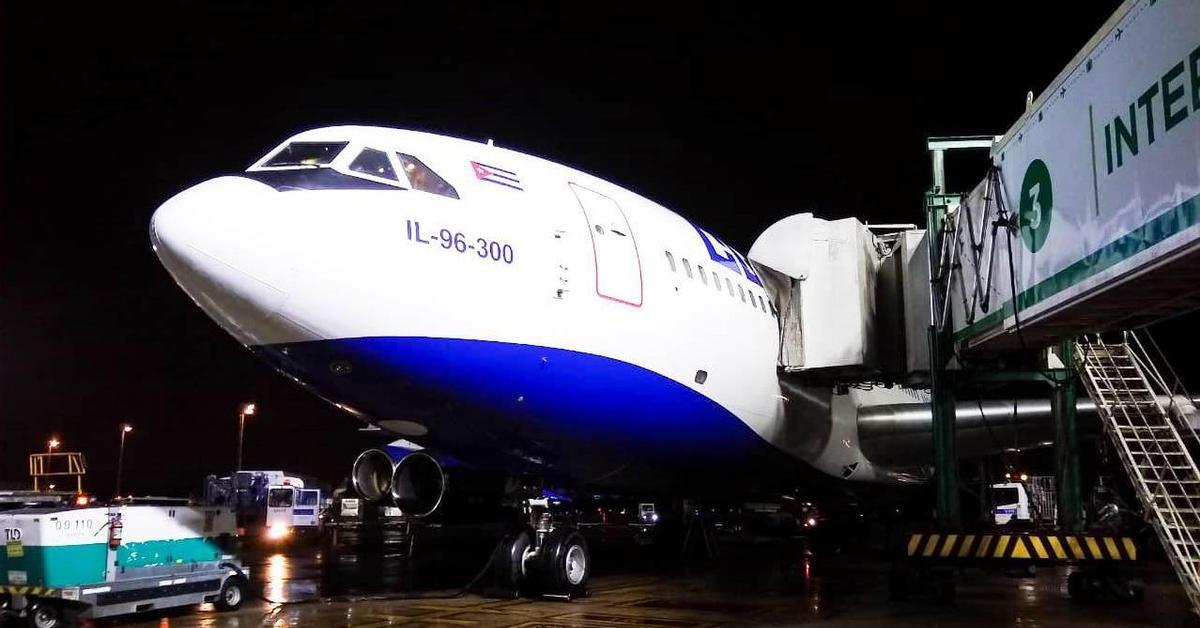
Cubana de Aviación’s IL-96 – the only long-range four-engine in the state fleet – has already completed nine trips to Caracas since the capture of Nicolás Maduro, as confirmed by this newspaper. The most recent landed again in the Venezuelan capital this weekend, pointing to an accelerated reorganization of the Cuban military contingent deployed in that country. He is scheduled to return to Havana this Sunday at 4:00 pm, and to return to Caracas on Monday morning, according to sources consulted by this newspaper.
This same plane was the one that transported wounded Cuban soldiers to Havana during the US operation in Caracas. Since then, their movements have multiplied, almost always shrouded in strong secrecy. Sources from the José Martí International Airport consulted by 14ymedio They assure that the aircraft is parked on remote runways and operated almost exclusively by military personnel. “They do not allow civilian employees to approach, except those they consider absolutely trustworthy,” says an airport worker who requested anonymity.
“It is 1,000 dollars a month, regardless of the salary in Cuba”
The CU-T1250 was delivered to Cuba at the end of 2005 and is identified in aeronautical records with the serial number 74393202015. It is equipped with four PS-90 engines, a characteristic design of Russian aviation at the beginning of the century that prioritizes redundancy and range over consumption efficiency. Although this type of aircraft has been practically relegated from regular civil traffic due to its high operating costs, it continues to be valued for government flights due to its robustness and its ability to operate with high loads and non-stop on long routes.
With a standard capacity of close to 300 passengers – expandable to more than 400 seats in emergency configurations – the IL-96 has made it possible to transport thousands of people in a few weeks. The most conservative calculations indicate that, in the first six flights alone, up to 2,500 Cubans could be transported.
The chronology of the flights reinforces the thesis of a military and non-humanitarian operation. The first takeoff after Maduro’s capture occurred on January 5, just 48 hours after the US intervention. Some of these routes are not reflected in public air tracking platforms, a common practice in this aircraft, which usually activates the transponder when it is already at high altitude.
He flight of 8 January ended abruptly when the plane circled off the Colombian coast and returned without landing in Caracas. As explained then by a specialist consulted by 14ymedioColombia denied overflight permission and the IL-96, due to its technical limitations, could not divert its route through Curacao. Days later, however, the aircraft again crossed Colombian airspace without incident, which gives more strength to the initial hypothesis that the presence of a US drone dissuaded it from continuing its flight on January 8.
Havana needs to maintain its influence in Venezuela
The silence of the Cuban Government contrasts with the magnitude of the operation. No authority has reported on the departure or relief of military personnel in Venezuela, despite the fact that the IL-96 flights have become impossible to hide.
The reconfiguration coincides with high-level diplomatic moves. The recent visit of CIA Director John Ratcliffe to Caracas and his meetings with the new Venezuelan authorities triggered rumors about a supervised withdrawal of Cuban forces dedicated to security and intelligence tasks. Regional analysts maintain that Washington would have demanded greater transparency and an immediate reduction of the island’s military presence.
According to versions discussed in intelligence circles, the process would be monitored by the United States Southern Command, deployed in the Caribbean. The recent meeting of the head of mission of the US Embassy in Havana, Mike Hammer, with the head of that military command is also part of this context, a meeting that the diplomatic headquarters itself described as focused on “the situation in Cuba and the Caribbean.”
For the source consulted, the logic is unequivocal: “They are not bringing in doctors, they are moving soldiers. And those who arrive in relief know what they are going for.” Incentives in dollars, in a country where the state salary is barely enough to survive, work as a powerful hook, but also as an indicator of urgency. Havana needs to maintain its influence in Venezuela, even at the cost of exposing more Cuban military personnel to an increasingly unstable scenario.