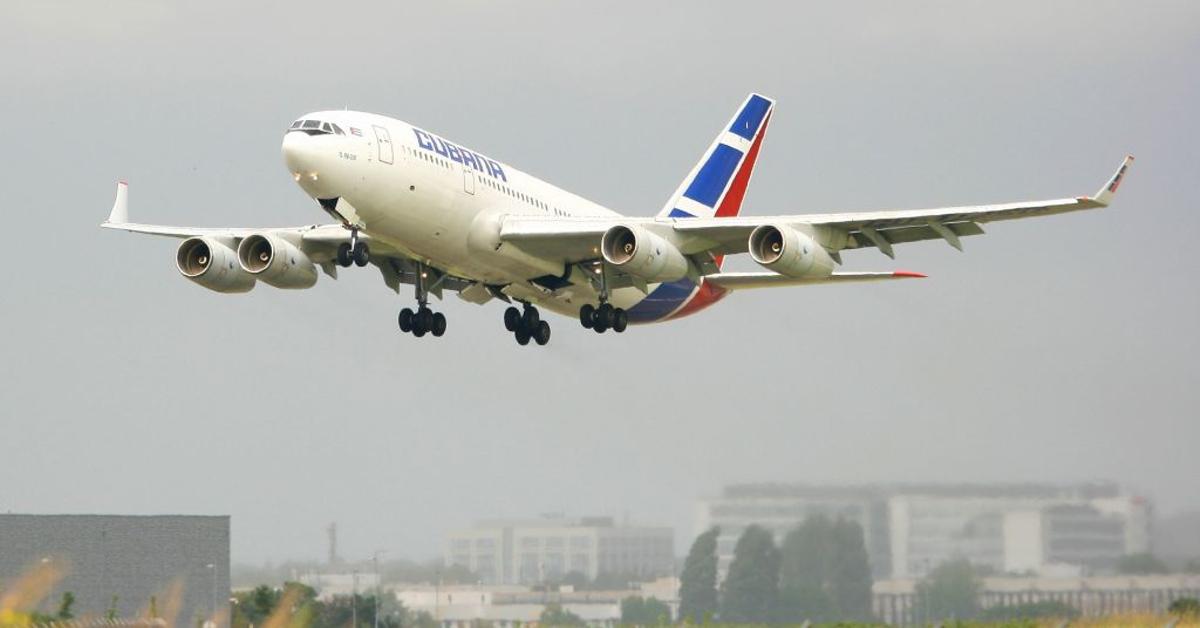
Madrid/The same Ilyushin IL-96-300 from Cubana de Aviación that brought the wounded Cuban soldiers back to Havana in the United States operation in Venezuela which ended with the capture of Nicolás Maduro, left again this Tuesday for Caracas. It is the fourth round trip to the Venezuelan capital in the last five days and, so far, the strongest indication that the regime is repatriating its “collaborators” deployed in that country.
This plane, returned to Cuba two years ago tcomprehensive maintenance In Russia, it has a standard capacity of around 300 passengers, but more than 400 seats can be added if necessary. There were six flights in the last 15 days, which allows us to deduce that up to 2,500 Cubans have been able to be repatriated in this way, almost 10% of the contingent deployed in Venezuela.
“Mainly doctors come, but also other workers and even soldiers,” a source from the José Martí International Airport in Havana tells this newspaper, who requests anonymity. This person asserts that all operations with this aircraft have been carried out, until now, with the greatest secrecy. “They always leave it on a track out of sight, and normally they don’t let civilian employees get close, only military personnel.” If it is “operated” by civilians, he continues, they are “those who they know are very similar, those who wear a Che pendant.”
“They always leave it on a track out of sight, and normally they don’t let civilian employees get close, only military personnel.”
The first trip to Venezuela of the IL-96-300 after the fall of Maduro was made on January 5, just two days after the US military intervention, but the movement did not appear on the satellite tracking websites. This is normal for this aircraft, Cubana de Aviación’s only long-haul four-engine aircraft, which is used for special operations such as the transfer of senior officials and which flies on numerous occasions with the radar off.
That Monday, a knowledgeable source revealed to 14ymedio that It was “full of soldiers” and assumed that “they are going to stay there.” The same person said that the flight was headed to pick up the bodies of the 32 Island agents who died on the night of January 3, but this did not materialize.
One day after a voyage that took place on January 7 that was not shown on the radar, the Ilyushin departed again for Caracas, but did not land. Just like could be seen on flight location pages, the aircraft flew in circles for several minutes in the morning hours off the Colombian coast, probably waiting for permission to land, and then turned around, but towards the east of the Island. It had left Havana, although the airport was not listed in the satellite tracking.
As published on January 8 by the Venezuelan media The Patilla, an American reconnaissance drone It had been flying over the same area where the Cuban plane decided to change course, which led to the belief that this was the cause of the frustrated return of the IL-96. A specialist explained to 14ymedio which was because Colombia denied him permission to pass through its airspace and “it is an old plane, without the modern systems required to pass through Curacao,” which is the shortest route. However, it has continued to fly over the South American country without problem on its subsequent trips.
On January 9, the aircraft returned to Caracas, and again on the 13th. A strange parenthesis represents the trips made on January 14 and 16, according to this newspaper on the Flightradar24 page, since they were made not to Venezuela but to the east of the Island. From there, on the afternoon of Wednesday the 14th, the wounded arrived in the Cuban capital. The remains of the deceased, for their part, they arrived on the island in a small ATR.
The head of mission of the US Embassy in Havana, Mike Hammer, met with the head of the Command, Evan L. Pettus, this Tuesday
Since then, the IL-96 has made three other round trips to the Venezuelan capital – on January 17, 19 and this January 20 – that is, six in total in two weeks, without the authorities having mentioned anything about the return of workers from the Island. On the contrary: the Government’s slogan in the face of the multiplied testimonies on social networks about desertions and quarterings has been convey tranquility through their media.
The visit of the director of the CIA, John Ratcliffelast Thursday to Caracas, where he met with the president in charge, Delcy Rodríguez, has also unleashed all kinds of rumors about the fate of the Cuban military forces deployed in Venezuela since the times of Hugo Chávez. Is it part of the negotiations with the Rodríguez Government that the United States supervises the immediate departure of troops from the Island destined for security and intelligence work? He influencer Colombian Fabian Dicosta He asserts, with sources from knowledgeable Venezuelans, that this is the case.
It will be supervised, says the communicator, by the US Southern Command, which is deployed in the Caribbean, in principle. monitoring the presence of sanctioned oil tankers.
Precisely with the head of the Command, Evan L. Pettus, the head of mission of the US Embassy in Havana, Mike Hammer, met this Tuesday, according to a report official publication on networks“to talk about the situation in Cuba and the Caribbean.”