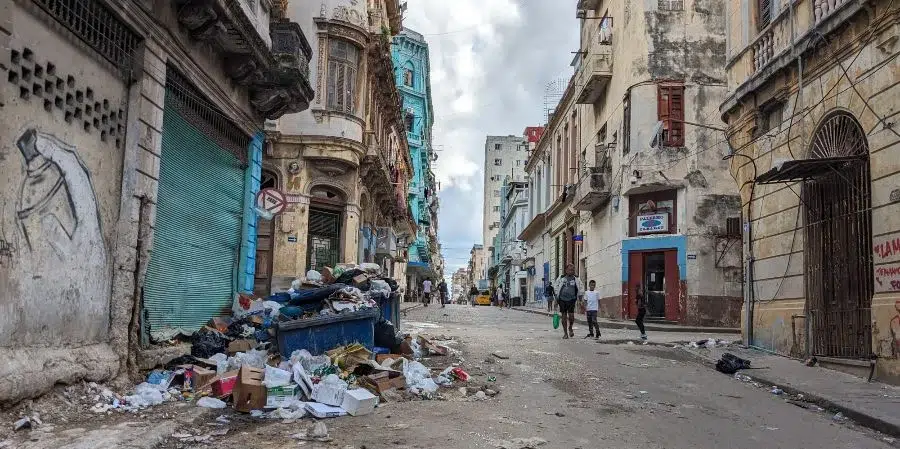
The huge garbage dumps that proliferate throughout the city generate pestilence and diseases, such as the current arbovirus epidemic.
HAVANA.- We celebrate one more anniversary of the founding of San Cristóbal de Havana. On November 16, 1519, 506 years ago, the founding ceremony was held. As always, the date comes with its commemorative ritual and planned events.
It is a source of pride for those of us who were born in this city and also for those who came from other parts of the country and today live in the “capital of all Cubans.”
Regarding the foundation, several historians disagree about the original place. Some maintain that the town was first established on the southern coast of the current province of Mayabeque.
Others even doubt the exact location of the famous ceiba tree where, they say, the first mass was celebrated. That tree was almost at the edge of the sea. The current ceiba has been replaced several times due to saltpeter damage. If Cuba was a large forest, couldn’t another ceiba tree nearby have been chosen?
The date is also a cause of doubt. The Capitular Act, which proved the founding day, was lost when the French pirate Jacques de Sores attacked and burned Havana in 1555.
There is no copy of the document in the Archives of the Indies either. That is why it is not possible to state with certainty that Havana was founded on November 16, 1519. It is believed that that date was chosen because in Catholic saints it corresponds to Saint Christopher.
The small initial settlement grew over five centuries to reach about 800 square kilometers.
Before 1959, urban modernization progressed steadily. To the large colonial residences were added the mansions of Miramar and the hotels and skyscrapers of Vedado in the 1950s. The rest of the city was filled with multi-family buildings, humble homes, lots, quarters and markets of all kinds. Everything coexisted in a city crossed by wide avenues and roads.
The documentary sources about Havana are vast. There are works by Cuban and foreign authors, as well as prints, photos and films. Among the essential texts are “What we were and what we are or ancient and modern Havana”, by José María de la Torre; “Ancient Havana”, by Manuel Pérez Beato; and “Havana; historical notes”, by Emilio Roig de Leuchsenring, the city’s first historian.
Today, walking through Havana reveals a bleak panorama. Much has disappeared due to the carelessness and apathy of the authorities. Only a small part of the historic center is restored, thanks to the late City Historian, Eusebio Leal. This area is also the most visited by tourists.
Landslides are frequent and cause injuries and deaths. Behind them, or after demolitions due to poor condition, empty spaces remain. In the best of cases, they become parks or parking lots.
The huge garbage dumps that proliferate throughout the city generate pestilence and diseases, such as the current arbovirus epidemic. Waste collection is slow and poor.
If we add the blackouts that leave large areas in darkness, closed businesses and services, the lack of drinking water in many neighborhoods, the terrible urban transportation and the increase in crime, we have a panorama that is reminiscent of the hell described by Dante.
Juan Formell titled one of Los Van Van’s best-known songs “La Habana no Aguanta Más”.
TRUE. That is a truth like a temple.