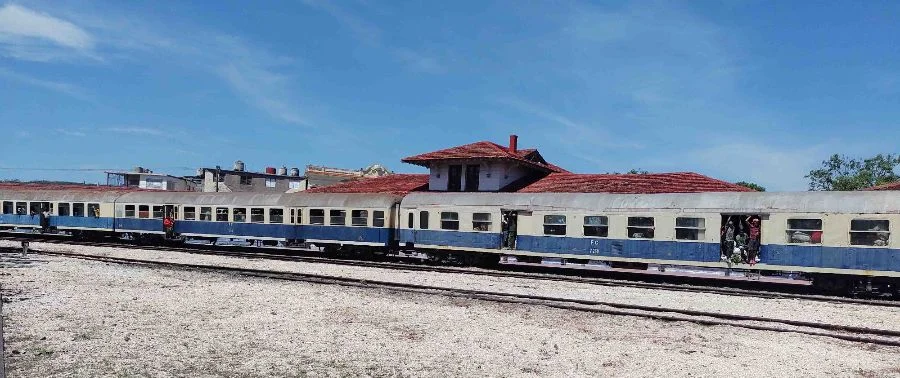
The arrival of the train from Guantánamo – loaded with fruits, vegetables and other foods – to the city of Holguín has become a weekly struggle for survival.
HOLGUÍN, Cuba. – “The Guantánamo train is, at the same time, the lifeline and the shame of the people of Holguín. It is a salvation because thanks to it one can buy cheaper food, but it also makes us ashamed because how is it possible that here, in Holguín, with the land that there is, we have to wait for the people of Guantanamo to be able to cook? That shows that here in Holguín things are not being done well,” argues Juan Carlos Valdes.
He himself, a resident of the provincial capital of Holguín, remembers that the arrival of the Guantánamo train – loaded with fruits, vegetables and other foods – has become a weekly struggle for survival. Three times a week, on Tuesdays, Thursdays and Saturdays, the train travels the more than 220 kilometers that separate both provinces, loaded with various foods.
With its almost 9,300 square kilometers, the province of Holguín is the third largest in Cuba, only surpassed by Camagüey and Matanzas. In contrast, Guantánamo, its food supplier, is considerably smaller: it ranks tenth in the country, at almost 6,200 square kilometers.

This crisis, therefore, does not originate in the lack of fertile land, but in a network of bureaucratic inefficiency and failed policies that have stifled Holguín’s agricultural production and forced its residents to depend on neighbors for something as fundamental as food.
For countless families, the difference between a decent meal and almost nothing to eat is marked by the whistle of the Guantánamo-Holguín train. “It is cheaper to buy from the vendors who come on the train from Guantánamo, who sell a hand of fongos for 150 pesos, a banana for 50 and an avocado for 50, because here in Holguín an avocado and a banana cost 100 pesos each, a pound of sweet potato 90 pesos and a hand of fongos between 200 and 250 pesos,” says Marta Rodríguez.
Ricardo Fernández admits it bluntly: “We eat thanks to the vendors who bring food on the Guantánamo-Holguín train, because, if not, we would die of hunger.”
“If the Guantánamo train stopped coming for a week, my kitchen would be almost empty,” adds María Elena Rojas from Holguín. “The truth is that we depend on that train. Without the food they bring, things get ugly, because what the forklift drivers sell here is for millionaires.”

The constant arrival of these agricultural products from Guantánamo raises an inevitable question. Ernesto Vega says: “It is the same government, it is one for all of Cuba, and yet, there in Guantánamo the agricultural offers are cheaper. What will happen to Holguín that does not produce food to satisfy the people?”
Others, like Lázaro Cruz, look inward, suggesting a problem of ineptitude: “I don’t know if it’s the government or if agriculture isn’t worked in Holguín.”
Journalist Daimí Peña Guillén, from the state radio station Radio Angulo, connects these opinions with a structural analysis: “Holguín is, due to its geography and tradition, an agricultural territory par excellence in the Cuban East. However, this image collides head-on with the daily reality of its inhabitants. The paradox is heartbreaking. Holguín has the land, but not the food. The peasantry not only lacks oil, it affects them the chronic shortage of fertilizers, pesticides, spare parts for machinery and even basic tools,” said the communicator.
While citizens debate between guilt and confusion, the official response is articulated in a language of meetings and guidelines. In a provincial Government Council, reported by the local newspaper Nowauthorities addressed the problem. Manuel Hernández Aguilera, the Governor, indicated the need for a change:
“This is an issue that cuts across the objectives of the economy. Precisely, agriculture is one of the physical productions that is most unfulfilled. There must be a transformation. Science must be applied to improve agricultural yields.”

For his part, Joel Queipo Ruiz, first secretary of the Communist Party in the province, at the same meeting emphasized the well-known formula of producing and supervising: “We have to increase sowing, harvesting and marketing more. Prices will drop only if we produce more, which is essential, but we also have to capture more production to sell in our markets. There must be more control in actions.”
However, these statements clash with a history of documented failures. Year after year the reports report a pattern of non-compliance. A group of independent Cuban economists, in an analysis published by the EFE agencysuggests that the root of the problem is deeper than the external sanctions, which the regime blames for the crisis on the Island.
Mauricio de Miranda, professor at the Pontificia Universidad Javeriana in Cali, Colombia, defines the situation in Cuba as the heir of “the structural problems that resulted from an ineffective economic system.”
Pedro Monreal agrees and points out the “inefficiency” of the planned economy system. Ricardo Torres, although he recognizes the weight of the sanctions, does not believe that they are “the most important factor to explain the crisis.”
While the National Office of Statistics and Information (ONEI) report year-on-year inflation of 15.2%, economist Steve Hanke calculates it at 39.5%. The average monthly salary, which is around 6,600 CUP, and the minimum pension (3,056 CUP) evaporate compared to a dollar that exceeds 460 pesos in the informal market.
Holguin native Isabela Torres sees it as a scaled reflection of a greater evil. “This train is a reflection of what is happening in Cuba, a country of absurdities. What logic does it have for a place with less land like Guantánamo to feed the one that is supposed to have more resources? This shows you that the problem is not one of land or the blockade, it is a problem of ineptitude and poor management that prevents the most basic thing from working, which is producing food,” he says, while waiting for the Guantánamo-Holguín train to buy food.