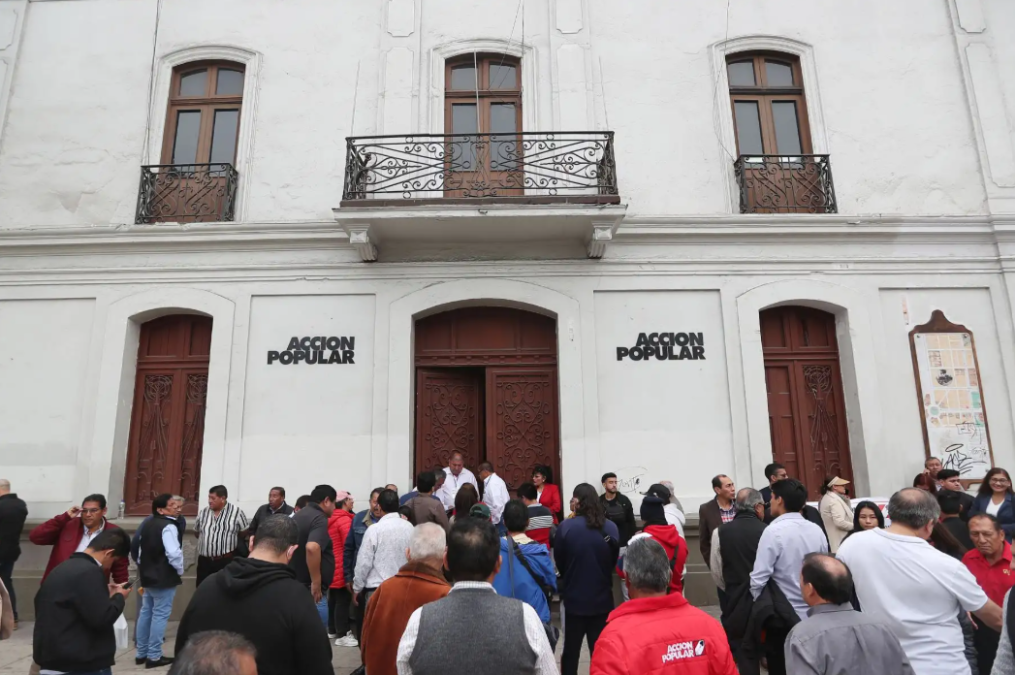
Popular Action (AP) became the first political party to be left out of the 2026 general elections, after a decision by the National Elections Jury (JNE) that annulled its internal elections.
Through Resolution No. 0745-2025-JNE, the plenary session of the JNE, by majority, made the decision when detecting “substantial defects that violated the principles of internal democracy and due process” in AP. The highest electoral body noted serious inconsistencies between the list of delegates proclaimed by the party’s National Electoral Committee and the electoral material prepared by the ONPE for the votes held on November 30 in Áncash, Cajamarca, Cusco, Huancavelica, Lima Norte, Lima Centro, Lima Oeste, Lima Provincias, Loreto, Piura, Tacna and Ucayali.
According to the statement, in all the polling stations observed, citizens who had not been elected as delegates in the internal process were included, which affected the legitimacy of the internal process. For the JNE, this irregularity, present in 100% of the tables evaluated and observed, violated the regularity of the process and the minimum standards of transparency and legality required of political organizations.
Worse still, the JNE specified that it is not possible to call new primary elections in AP, since doing so would imply breaking the electoral calendar for the April 2026 elections, whose deadlines are “peremptory and preclusive.”
The day before, Julio Chávez Chiong had directly accused former presidential candidate Alfredo Barnechea of fraud, denouncing that during the primary election process previously registered delegates were changed, which finally did happen according to the JNE resolution.
As is known, on November 30 the delegates were elected in the political groups and on December 7 they themselves voted for their candidates to represent them in the electoral contest in April of next year.
On December 5, the JNE Inspection area issued a report in which it states that “the list of delegates used by ONPE does not coincide with the communication registered by the Popular Action party” and that “delegates elected on November 30 have been omitted and people who were not elected have been included.”
However, two days later the ONPE expressed its “rejection of the observations made” by the JNE.
AP, said the ONPE, complied with “timely” communicating the list of its delegates on December 7. The registration “was in charge of the president of the electoral body, Cinthia Pajuelo, who “was accredited to the ONPE since August 25 of this year, according to Meeting Minutes No. 22-2025/EP-2025.”
“From that date onwards, and until the moment of this report, the person responsible for the user and password of the Primary Election Registry is President Cinthia Pamela Pajuelo Chávez, who on August 29 (…) communicated the C election modality and the form of nomination of candidates,” they insist.
Finally, they point out that “to state that the ONPE has wrongly recorded data on voting delegates for December 7 is false (…) Given that there is no violation of any fundamental right, the content of the inspection report (of the JNE) is rejected.” Who is to blame?
COMPLAINT IN SIGHT
As soon as the JNE ruling was known, Alfredo Barnechea, who had apparently won the AP primaries on December 7, declared on Canal N that he is “surprised and outraged” because “what was resolved by the JNE is very strange.” “This is a completely illegal decision,” he said.
“It is a completely illegal decision, which we are going to appeal. We are going to criminally denounce the members of the JNE. And I want to tell them that they do not know who they are dealing with, we are going to pursue them in all instances, we are going to find out everything about them, money laundering, all the misdeeds they have,” he continued.
He added that “Popular Action is going to be in the 2026 elections and we are going to win the elections.”
From the front, former congressman Ricardo Burga, general secretary of AP and active defender of the Chávez faction, indicated that they will challenge the JNE’s decision and pointed to the ONPE and its boss, Piero Corvetto, as responsible for the acciopopulist debacle.
“Here there is a great responsibility of the ONPE that did not feel like being able to review the list that Ms. Cinthia Pajuelo (president of the party’s Electoral Committee) had improperly uploaded. That did not cost ONPE even an hour. The JNE Control Office itself informed ONPE on December 5 that they had changed the list of legally winning delegates on November 30,” he explained.
Burga said that “we will initiate legal actions against ONPE and against Piero Corvetto, not only a criminal complaint, but we will complain to the National Board of Justice (JNJ).”
He added that now it is time to “cleanse the party of those who have motivated this grotesque, absurd fraud, the electoral fraud that has been committed.”
Meanwhile, former congressman Víctor Andrés García Belaunde told Peru21 that the JNE’s resolution “is very harsh, but evidently the events have been very serious.”
He added that there was “an implosion” in AP and lamented that “due to bad moves, totally excessive ambitions, some candidates have resorted to fraud to win the elections and that seemed horribly bad to me.”
Although he did not want to hold Barnechea responsible, he did maintain that the responsibility for what happened lies “with those who committed the fraud, those who are most responsible are obviously the candidates who declared themselves winners.”
The solution, he continued, is “to call a national plenary session next Saturday if possible, and ask all party leaders to resign. That is the solution, AP must be refounded.”
“The leadership has a lot of responsibility, the party authorities. The truth is that there have been rude interventions that have changed the will of the militancy,” he concluded.
For her part, legislator Maricarmen Alva declared to Peru21 that the JNE resolution is “very radical” and said that he does not consider that fraud has occurred.
“What I know is that the resolutions of the JNE are unappealable. We are all dismayed by that resolution. Whoever lost, did not know how to lose. In short, they declared Barnechea the winner, they challenged, it would be necessary to investigate, but the resolution has been very quick,” he said.
The lawyer specializing in electoral law, José Manuel Villalobos, declared on Canal N that “the fraud takes place because the president of the AP Electoral Tribunal changed the results of the election of delegates.”
“The president of the court changed 28 delegates for others, and those 28 participated on December 7 and, obviously, altered the result of the election, they vitiated it, and that is why the JNE declared the nullity,” he concluded.
RECOMMENDED VIDEO