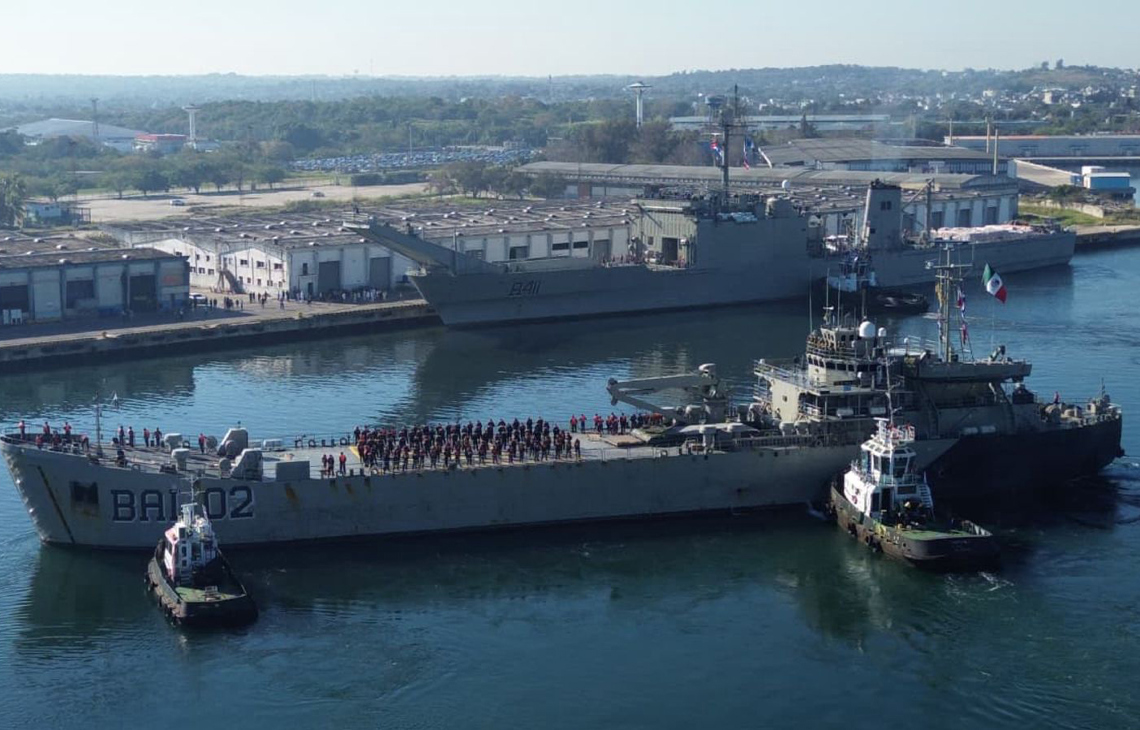
The first humanitarian aid Mexico to Cuba, who had left last Sunday, arrived on the island this Thursday, which prompted a message of gratitude from the Cuban president.
The Papaloapan and Isla Holbox ships docked yesterday in the Bay of Havana, with a load of food, hygiene items and powdered milk, reported an agency office EFE.
The Papaloapan unloaded 536 tons of basic products such as rice, beans, meat, cookies, canned tuna, sardines and vegetable oil, while the Isla Holbox transported more than 277 tons of powdered milk, intended to alleviate the shortage of dairy products on the island.
After the arrival of both vessels, President Miguel Díaz-Canel thanked the Mexican Government for the help, a gesture that he described as a sign of “solidarity” and “brotherhood” in the midst of the energy crisis and shortages that the island is experiencing.
Díaz-Canel highlighted on social networks that the shipments “are worth not only as material cargo,” but as a symbol of the historical friendship between both countries. “Thank you, Mexico. Thank you, dear Claudia Sheinbaum,” she wrote, in a direct thank you to her Mexican counterpart.
#ThankyouMexico. Thank you, dear @Claudiashein. The humanitarian aid of our Mexican brothers is worth not only as material cargo. In them travel solidarity, friendship and the exemplary history of sovereignty and respect for the rights of others that distinguish #Mexico. pic.twitter.com/MsuiRjdhI4
— Miguel Díaz-Canel Bermúdez (@DiazCanelB) February 13, 2026
The position and shipments of Mexico
The Mexican president assured that this shipment is the first of several. According to Sheinbaum, a second shipment is planned with more than 1,500 tons of powdered milk and beans, pending dispatch after the return of the military ships.
However, he clarified that the support does not include oil, whose supply is being evaluated as to how to resume without affecting trade relations with the United States, which recently announced tariffs on countries that provide fuel to Cuba.
The shipment occurs in the midst of an energy crisis aggravated by the oil blockade imposed by Washington on the island. After the capture of Venezuelan President Nicolás Maduro on January 3, the United States cut off crude oil shipments from Caracas to Havana and warned that Cuba “has its days numbered” due to the lack of fuel.
The shortage has forced the Cuban Government to activate an emergency plan inspired by the “zero option” of the Special Period of the 90s that contemplates the semi-paralysis of essential public services such as transportation; closure of hotels and relocation of tourists, as well as severe restrictions on energy consumption, among others.
According to international experts, the Maduro government, a close ally of Havana, recently sent to the island about 35,000 barrels a day – although some reports speak of a lower figure on average last year – while Russia shipped 7,500 barrels a day.
From January to September, Mexico sent Cuba about 19,000 barrels a day, of which 17,000 were crude oil and 2,000 were derived products, according to records from the United States Securities and Exchange Commission (SEC). according to the agency AP.
That figure, however, decreased in the final months of the year, and already this year deliveries have been paralyzed as a result of pressure from Washington on Mexico and the oil siege of the island.
The general director of Pemex, Víctor Rodríguez, said last week that the oil company had a single contract with the island since 2023, and that that year sales reached 367 million dollars.
During 2025, crude oil supplies from Mexico to Cuba totaled $496 million, Rodríguez reported, adding that the island does not have “any overdue invoices according to the contract.”
Mexico assures that it sent “very little” oil to Cuba in 2025
Tension between Cuba and the US
The relationship between Cuba and the United States is going through one of its most tense moments, in the midst of the oil siege of the island. While Washington insists that they are holding talks with the Cuban authorities, they also point to Havana for “harassing” their diplomats.
The Undersecretary of State, Christopher Landau, denounced this Thursday that Cuban agents “harassed” the charge d’affaires of the US embassy in Havana, Mike Hammer, during his tours of the island. refers to an office EFE.
The official warned that his Government will impose visa sanctions on those responsible.
“I want these people to understand that we know who they are and that we will respond accordingly, including with visa sanctions,” Landau said.
This episode adds to the tightening of the energy blockade and the threat of sanctions against countries that supply crude oil to Cuba, measures that have drastically increased pressure on the Díaz-Canel Government.
In this context, Mexico once again offered itself as a possible intermediary for a dialogue between Washington and Havana.
“We, both at the United States Department of State and through the (Cuban) embassy in Mexico, have stated that Mexico does everything on its part to be able to generate a dialogue that allows within the framework of Cuba’s sovereignty,” Sheinbaum pointed out this Thursday.
The president, who has already shown her Government’s willingness to mediate between both parties, highlighted the importance of “generating the conditions for a peaceful dialogue” and ensuring that “Cuba, without any country having the sanction, can receive oil and its derivatives for its daily operation.”