Just hours after the leaders of Thailand and Cambodia proclaimed a high “immediate and unconditional” fire to end five days of mortal border clashes, the Thai army accused her neighbor of raping the truce with new attacks.
The deputy spokesman of the Thai Army, Ritcha Suksuwanon, said Tuesday that, despite the agreement reached the eve in Malaysia, the clashes persist and have left more dead and wounded on both sides of one of the most tense dividing lines of Southeast Asia, which extends for about 800 kilometers.
“El Alto El Fuego was broken with riots in the area of Phu Makua caused by the Cambodian part, which unleashed an exchange of fire that continued this morning,” said Suksuwanon, cited by press reports.
According to his statements, in Sam Taet the fighting also persisted until entering the early morning of this Tuesday.
These renewed hostilities tarnish an agreement held by world and hopeful leaders for hundreds of thousands of displaced people who, after a week of terror, waited for the reopening of safe steps to return to their homes.
Thailand’s army says that Cambodian troops have violated “deliberately” the high the fire agreed on the eve between both governments and that midnight passed into force.https://t.co/ajybbfiyz0
– Efe News (@Efenoticias) July 29, 2025
Causes, victims and displacements
The conflict officially exploded last Thursday, July 24, when a mine exploded at the border and left five wounded Thai soldiers. Immediately, military from both countries accused each other of starting the fighting, which quickly climbed with the use of heavy artillery, BM-21 rockets and F-16 fighters.
This new crisis revives a centenary territorial dispute between Thailand and Cambodia, inherited from the colonial delimitation of Indochina, with previous episodes of significant violence, but none as deadly as the current one in more than a decade.
In five days, violence has gained about 40 lives – among them those of many civilians – and has forced the evacuation and displacement of approximately 300 thousand people. According to official figures and local testimonies, they would be more than 156 thousand in Thailand and about 135 thousand in Cambodia.
The villages to the border have been emptied; Women, children and the elderly have fled to temporary shelters or evacuation centers, dragging what they could save, in scenes of confusion and fear.
Both governments have exchanged accusations about the nature and objectives of attacks.
Thailand denounces aggressions against civil infrastructure, including a hospital and a gas station achieved by rockets, while Cambodia accuses the Thai forces of the use of cluster bombs.
This rhetorical crossing and mutual distrust hinders any durable tentative.
https://www.youtube.com/watch?v=aem-iyrtah8
Negotiations, diplomacy and international reactions
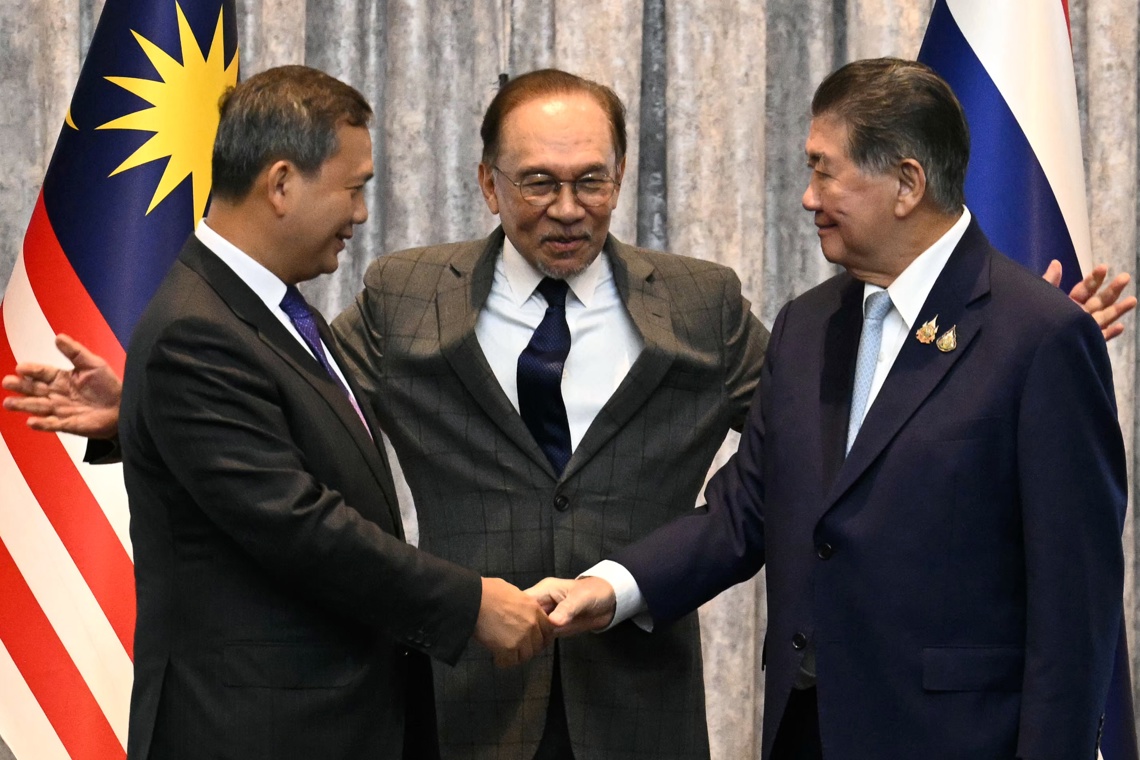
The cessation to the fire was announced on Monday after an intense round of negotiations in Putrajaya, at the initiative of the Prime Minister of Malaysia, Anwar Ibrahim, who temporarily presides over the Association of Nations of Southeast Asia (ASEAN).
The event was attended, in addition to the heads of government of Thailand and Cambodia, senior representatives of the United States and China.
Washington had exerted strong pressure by warning that it would suspend trade negotiations with both countries if hostilities did not cease, while Chinese diplomacy joined the so -called “containment and dialogue.” Malaysia, as host, was key to unlocking the initial agreement.
“The high and unconditional fire is a first vital step for peace and security,” Anwar emphasized.
The Ministers of Foreign Affairs and Defense of the three countries, together with military commanders of both sides, received instructions to create a supervision mechanism that guarantees the definitive cessation of hostilities.
The news was received with relief sighs throughout the region, although a climate of suspicion remains for the recent episodes of violence.
António Guterres, UN Secretary General, concluded the agreement as a “positive step” and urged the parties to respect it entirely to create an environment conducive to resolving old disputes.
The European Union agreed to qualify the pact as “great advance”, urging that it is implemented in good faith. Numerous Asian governments and multilateral organizations have offered technical and political support for reconstruction and reconciliation.
The United States, on the other hand, also claimed its role in mediation, with President Donald Trump qualifying the “historical” agreement and announcing the resumption of trade negotiations to prevent the entry into force of punitive tariffs from August 1.