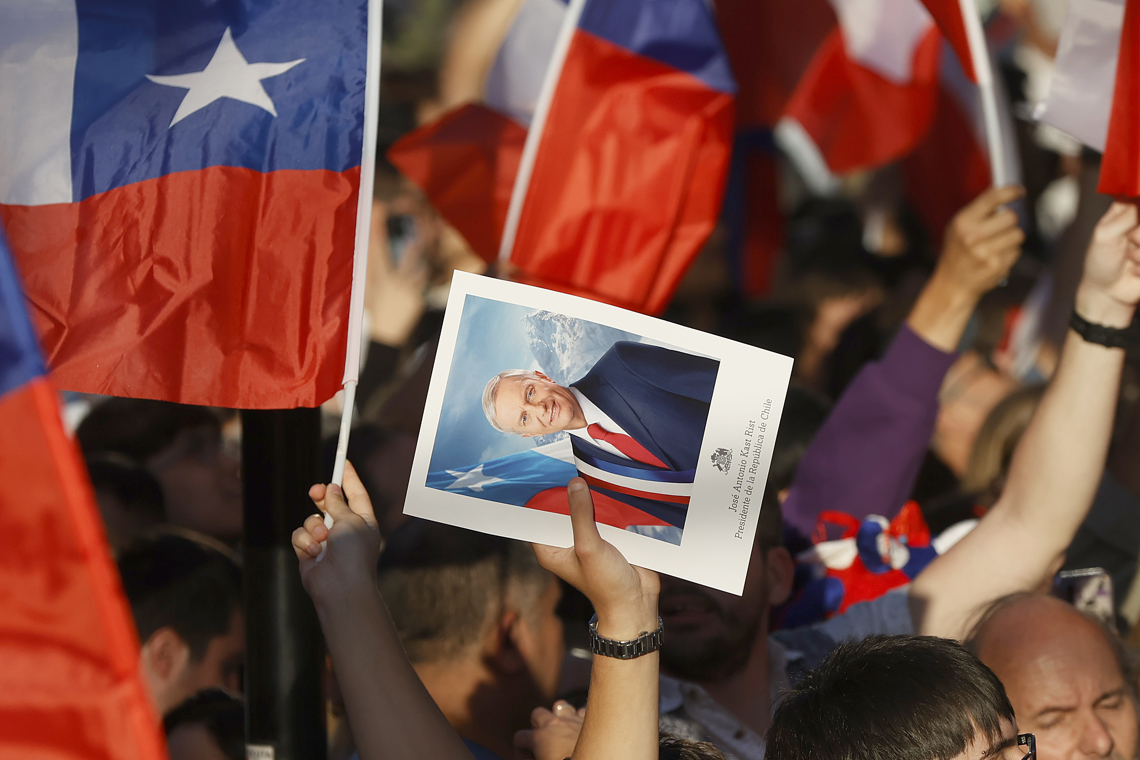
The far-right José Antonio Kast confirmed what the polls predicted and won this Sunday the second round of the presidential elections in Chili.
In his third attempt to reach the La Moneda palace, Kast achieved a large victory over the candidate of the center-left coalition, the communist Jannette Jara.
According to the preliminary official results, the founder of the Republican Party won in the 16 regions of the country and obtained 58.1% of the votes, above the 48.1% of his rival, who recognized his defeat and congratulated the winner.
Although Jara had won the first round of elections a month agothe support received by Kast from the rest of the right-wing candidates and the low popularity of the current left-wing Government of Gabriel Boric, gave him more than enough margin to succeed.
In this way, the descendant of Germans with a Nazi past brings the extreme right to La Moneda and becomes the first defender of the dictatorship of Augusto Pinochet (1973-1989) to reach power after the return of democracy to the Andean country. refers to the agency EFE.
Who is José Antonio Kast, the first Pinochetista to come to power in democratic Chile?
The leader of the Republican Party will implement a neoliberal program of mega-cuts and a tough crackdown on crime and irregular migration.https://t.co/huQR5MIbbu
— EFE News (@EFEnoticias) December 14, 2025
Kast and his government program
In his first speech after confirming his victory, Kast assured that he will be “everyone’s president, without exception,” but, in line with what was announced in his campaign, he assured that he will promote “real change” in Chile.
The elected president, who will take power in March of next year, promised to “restore respect for the law” and said that the changes “will begin immediately.”
“Without security there is no peace, without peace there is no democracy and without democracy there is no freedom,” said Kast, who campaigned for Pinochet in the 1988 plebiscite on his continuity in power, recalls EFE.
As “milestones” of his future administration he mentioned security, migration and economic progress, although he warned that “the results will not be seen the next day.”
Defined as an ultra-liberal in economic matters and a conservative Catholic, Katz is in favor of lowering taxes, establishing a drastic cut in public spending, confronting crime and drug trafficking through force, and expelling irregular migrants from the country.
After his electoral victory, he has been congratulated by governments in the region, including some with opposite political views, such as Brazil, Mexico and Uruguay.
Also by his already presumed main allies in the area, such as the Argentine president Javier Milei, the Ecuadorian Daniel Noboa, the Paraguayan Santiago Peña and the US Secretary of State, Marco Rubio.