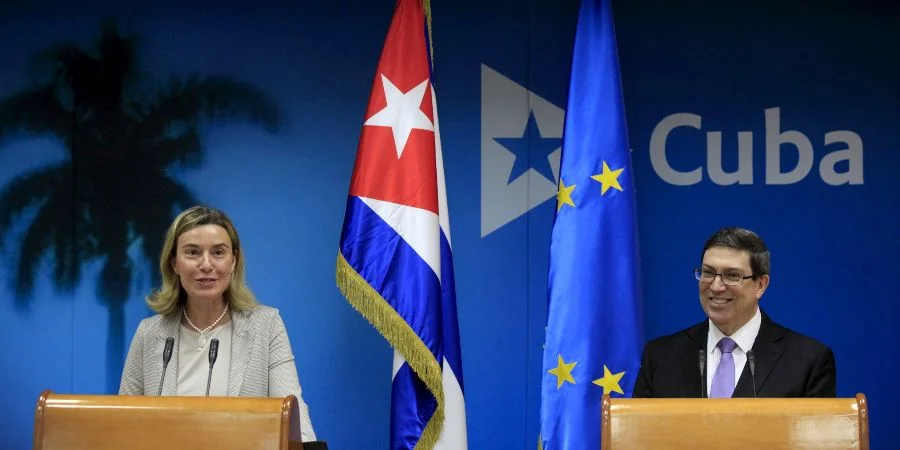
The current policy of the European Union towards the Cuban regime is wrong, inconsistent with the founding values of the EU itself and counterproductive even from the point of view of European interests.
MIAMI, United States. – After years of “constructive dialogue”, cooperation and political normalization between the European Union and Havana, the balance is unequivocal: there has been no real progress in human rights, fundamental freedoms or democratization. On the contrary, repression has intensified, the number of political prisoners remains high, and the regime continues to criminalize peaceful dissent.
1. A moral contradiction that erodes European credibility.
The European Union defines itself – rightly – as a community based on democracy, the rule of law and the defense of human rights. However, its privileged treatment of the Cuban regime flagrantly contradicts those principles.
The Cuban regime:
- imprisons peaceful opponents, journalists, activists and dissenting citizens;
- beats, tortures and subjects political prisoners to other cruel, inhuman and degrading treatment in prisons that have many similarities to Nazi concentration camps. Hundreds of common prisoners suffer from severe malnutrition and dozens die from diseases such as tuberculosis.
- represses legitimate citizen protests; and
- denies basic freedoms such as expression, free press, association, demonstration and political pluralism.
Persisting in a policy that does not demand real consequences for these violations turns European discourse into empty rhetoric and sends a devastating message to the victims of repression: that their rights are negotiable.
2. The EU ignores its own legal instruments
He Political Dialogue and Cooperation Agreement between the EU and Cuba explicitly establishes that respect for human rights is an “essential element.” It is not a decorative clause: it is a legal and political obligation.
The Commission’s systematic refusal to activate pressure or suspension mechanisms, despite the obvious deterioration of the Cuban internal situation, undermines the credibility of the European regulatory framework itself and sets a dangerous precedent for other foreign relations.
3. Cuba is not neutral: it is an ally of Europe’s strategic enemies
The Cuban regime is not a benign actor. He is a political ally of:
- Vladimir Putin’s Russia, whose invasion of Ukraine has been justified or relativized by Havana;
- the Chinese communist regime;
- the Iranian regime, responsible for brutal repression against its own population;
- the Venezuelan regime of Nicolás Maduro (especially now, that the Cuban military presence in Venezuela and the responsibility of the Castro regime in the antidemocratic policy of Chavismo have been confirmed).
Furthermore, there is clear evidence of the participation of Cuban citizens in the Russian aggression against Ukraine. Although the regime tries to justify itself, its political alignment with Moscow is undeniable.
Europe cannot defend independence and democracy in Ukraine while maintaining very normal relations with regimes that support the aggressor.
4. The economic argument is weak and unrealistic
This policy is usually explained by supposed European economic interests in Cuba. This argument does not stand up to serious analysis:
- EU-Cuba trade is limited and marginal in macroeconomic terms.
- Cuba is an unreliable trading partner, with a history of non-payments, financial restrictions and freezing of funds to foreign companies.
- The Cuban regime is highly indebted and has failed to fulfill financial commitments to European creditors.
The EU sacrifices principles, reputation and strategic coherence in exchange for low economic benefits and high risks.
5. The future cost: political memory and legitimacy
Every foreign policy has long-term consequences. A future democratic government in Cuba—representative of the popular will—will remember who was on the side of the Cuban people and who prioritized diplomatic comfort over justice.
Persisting today in a lukewarm or complacent stance could translate tomorrow into a loss of confidence, influence and opportunities for Europe vis-à-vis other partners that did show real solidarity.
6. What is required of the European Union
No ideological confrontation or collective punishment is requested of the Cuban people. Coherence, political courage and concrete action are required:
- Condition all cooperation with the Cuban State on verifiable advances in human rights.
- Activate selective sanctions against those responsible for repression.
- Directly support independent civil society, political prisoners and their families.
- Abandon the fiction that “dialogue without consequences” can transform a cruel dictatorship.
Europe must decide if it wants to be a moral and strategic actor or a comfortable spectator of oppression.
The Cuban people do not need more statements. It needs the European Union to live up to its own values.