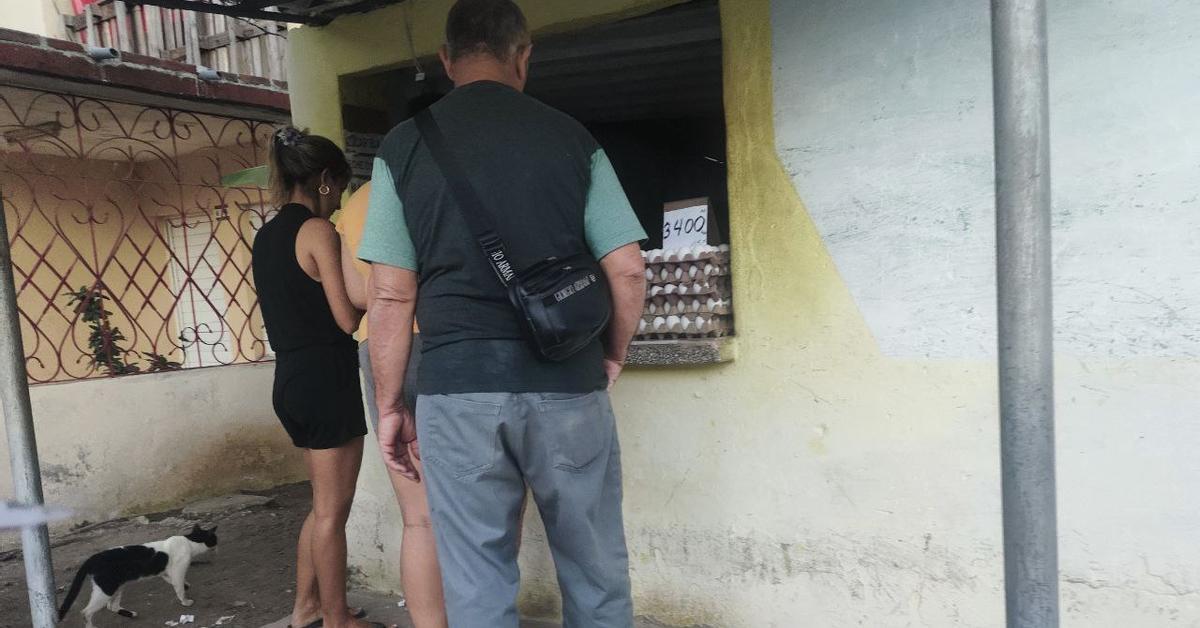
Sancti Spíritus/For months, in Sancti Spíritus it was said – with a mixture of resignation and hope – that the egg “could not rise any higher.” When the 30-unit carton rose to 3,000 pesos, many people from Sancti Spiritus assured that the product had reached its ceiling. “It doesn’t go from there,” they repeated in agricultural markets, improvised queues and WhatsApp groups. But this week, in a small private business in the Kilo 12 neighborhood, a handwritten sign dismantled that illusion of the limit reached: 3,400 pesos.
The scene in front of the establishment seems routine, but something in the atmosphere reveals that it is not. Three people wait in line – a young woman in flip-flops, a woman with a brief shorts and a large man carrying a briefcase across his back – none of them speak. Stillness has visible weight. Even the black and white cat that prowls near the peeling wall moves with some caution, as if it understood that an invisible barrier has been crossed in that corner.
The counter, made of rough granite, holds several cartons of eggs. Each is an expensive promise, a small privilege for those who can still afford it. In a country with an average monthly salary that does not exceed 6,500 pesos, taking one of these cards means giving up more than half of your income. A luxury for some, an urgency impossible to postpone for others.
Workers leaving their homes complain loudly, retirees stop to look at the sign in disbelief, and motorcyclists pass slowly.
The seller, safely inside the store, spends the day repeating the same phrase to those who approach: “Yes, they are already at 3,400.” In the neighborhood, news of the new price spreads quickly: workers leaving their homes complain loudly, retirees stop to look at the sign in disbelief, and motorcyclists pass slowly, as if measuring whether it is worth stopping. There are even those who clean their glasses for fear that the dust has affected the price.
In Cuba, the egg has always been a barometer of the crisis. It rose with inflation, with the lack of feed for birds, with the decline in national production and with the speculation of those who fill the gaps left by the State. But this jump of 400 pesos in a few weeks has another flavor: that of absolute lack of protection. “My pension is 3,000 pesos, I don’t even have enough for a cardboard,” says a man who observes the scene from a safe distance.
In the city, residents make complex calculations since many stores only sell the whole carton, not the eggs individually. “You want to buy it for half,” a neighbor shouts to another who is on the opposite sidewalk. Inflation forces us to resort to increasingly distressing arithmetic.