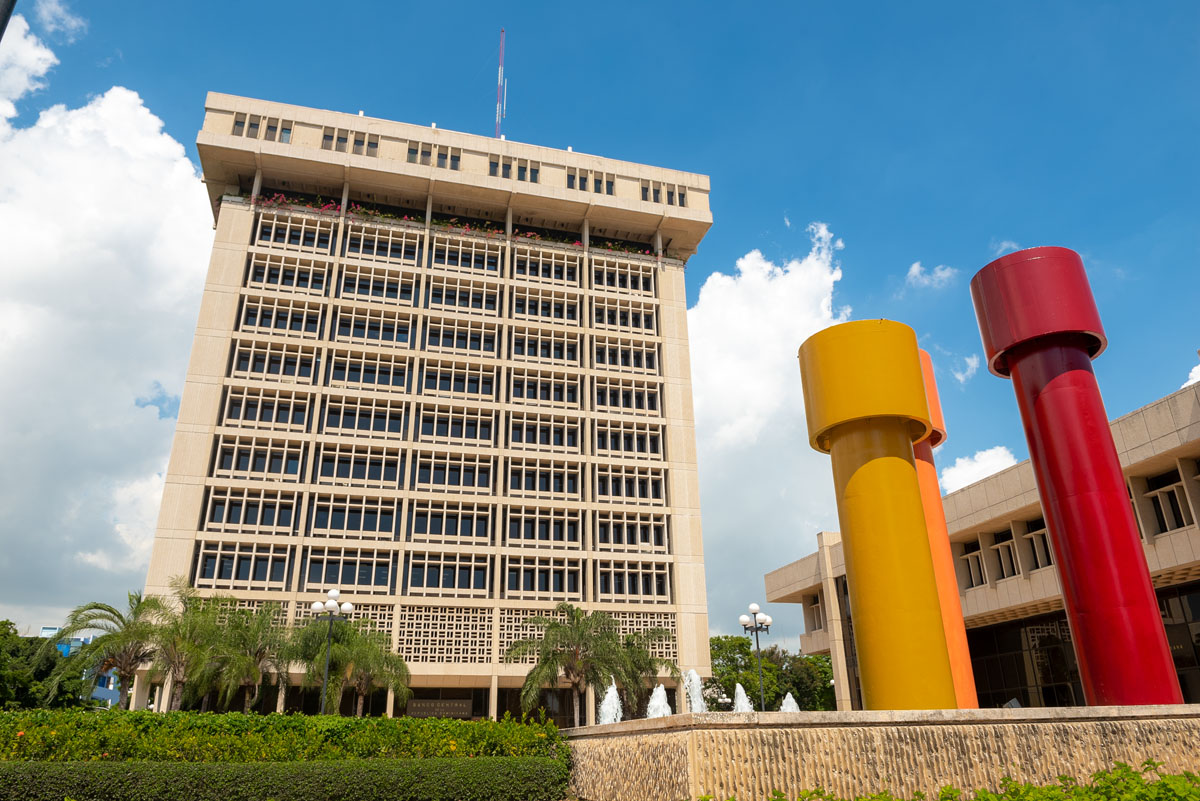
Santo Domingo.– He Central Bank revises downwards the growth estimate for the end of this year, as reported in the recent announcement in which it indicates that it will maintain the monetary policy rate at 5.25%. The regulatory entity details that the economy will have an expansion of 2.2%, when in October there was estimated growth of 2.5%.
He detailed that in his monetary policy meeting in December 2025, he decided to maintain his monetary policy interest rate (MPR) at 5.25% annually.
Likewise, the rate of the permanent liquidity expansion facility (1-day Repos) remains at 5.75% annually, while the rate of remunerated deposits (Overnight) continues at 4.50% annually.
For this measure, the levels of global uncertainty and recent inflationary pressures were taken into consideration, mainly associated with the impact of climate phenomena on food prices.
Likewise, it is expected that the monetary policy transmission mechanism would continue to operate efficiently, which will continue to contribute to favorable financial conditions.
In the international environment, the economy of the United States of America (USA) has remained resilient, with year-on-year growth of 2.3% in the third quarter of 2025.
Meanwhile, year-on-year inflation moderated to 2.7% in November, although it remains above the Federal Reserve’s (Fed) goal of 2.0%.
On the other hand, the unemployment rate increased to 4.6% in November. Considering the weakening labor market, the Fed reduced the federal funds rate by 25 basis points (bps) in December and is expected to make at least one additional cut in 2026.
In the Euro Zone, economic activity would grow 1.4% in 2025, affected by geopolitical conflicts and trade uncertainty. Meanwhile, interannual inflation stood at 2.1% in November 2025, close to the 2.0% goal of the European Central Bank (ECB).
In this context, after a cumulative decrease of 100 basis points during the current year, market analysts expect the ECB to maintain its reference rate unchanged during 2026.
In Latin America, an average growth of 2.2% is projected for 2025. As external financial conditions have become more flexible and inflation remains within the target range, most central banks in the region have reduced their monetary policy interest rates during 2025 to support domestic demand.
Regarding raw materials, the price per barrel of Texas intermediate oil (WTI) remained stable at around US$58 at the end of December, due to lower global demand and an increase in production.
On the other hand, the price of gold is at historical highs, around US$4,400 per troy ounce, being used as a refuge of value in a turbulent and volatile panorama.
The regulatory entity explains that the evolution of the prices of these raw materials represents an improvement in the terms of trade for the Dominican Republic, which would positively impact the current account of the balance of payments.
In the national environment, interannual inflation was 4.81% in November 2025, remaining within the target range of 4.0% ± 1.0% since mid-2023.
However, prices of the food component continue to be affected by the impact of climatic events, such as Storm Melissa and the intense rains that impacted the production and marketing of agricultural goods. On the other hand, core inflation, which excludes the most volatile components of the basket, stood at 4.74% year-on-year, also within the target range established in the Monetary Program.
Climate shocks
The BCRD forecasting system indicates that, although local inflation would continue to be affected in the short term by the effects of climate shocks, it is expected that their impact would gradually dissipate in the first part of 2026. In this way, general and underlying inflation are expected to be within the target range of 4.0% ± 1.0% in the monetary policy horizon. Likewise, inflation expectations remain anchored to the central value of the target range.
On the other hand, the monthly indicator of economic activity (IMAE) registered an improvement in the month of November, expanding by 3.2% year-on-year. In this way, the accumulated growth in the first eleven months of 2025 was 2.1%, driven mainly by the agricultural and mining sectors; as well as financial intermediation services and hotels, bars and restaurants, among others.
It is important to highlight that the BCRD reduced the MPR by 50 percentage points cumulatively since September, with the objective of promoting monetary conditions that contribute to boosting domestic demand.
At the same time, the BCRD implemented the RD$81 billion liquidity provision program approved by the Monetary Board to channel financing to the productive sectors under favorable conditions. Likewise, macroprudential measures were adopted with the objective of safeguarding the strength of the financial system, which has high levels of capitalization, liquidity, solvency and quality of its credit portfolio.
Credit cost
To the extent that the monetary policy transmission mechanism has been operating, a significant decrease has been observed in recent months in the interbank interest rate, going from a maximum of 12.6% in June to 7.1% in December of this year. Likewise, during the year 2025 the weighted average deposit rate of commercial banks has been reduced from 9.8% to 6.0% annually in December 2025; while the weighted average active rate has fallen from 15.1% to 13.2% annually during the current year.
Meanwhile, credit to the private sector in national currency would register year-on-year growth of around 8.3% at the end of the year, driven by loans for construction, home acquisition, commerce, and hotels and restaurants. Likewise, monetary aggregates have become more dynamic, growing at rates higher than the expansion of nominal GDP.
Additionally, public investment has accelerated in recent months, consistent with the State’s reformulated budget for 2025. In this way, the coordination of monetary and fiscal policies is expected to contribute to the gradual recovery of the Dominican economy, with a projected expansion of around 2.2% for the year 2025 and between 4.0% and 4.5% for the year 2026.
Regarding the external sector, foreign currency-generating activities are expected to maintain their dynamism with income of some US$46.8 billion during 2025, supported by the good performance expected for exports, tourism and remittances.
In that sense, a current account deficit of 2.4% of GDP is projected for 2025, which would be comfortably covered by foreign direct investment, estimated at about US$4.9 billion. In this context, the relative stability of the exchange rate is maintained, observing a cumulative depreciation of the Dominican peso of around 3% during the year 2025, lower than the 5% depreciation registered in the year 2024. Likewise, international reserves would be above US$14.55 billion at the end of the year, equivalent to more than 11% of GDP and 5 months of imports, exceeding the metrics recommended by the IMF.
It is important to highlight that the Dominican economy has strong fundamentals and a resilient productive sector, which are reflected in a better perception of country risk in relation to the average of Latin America and other emerging economies.