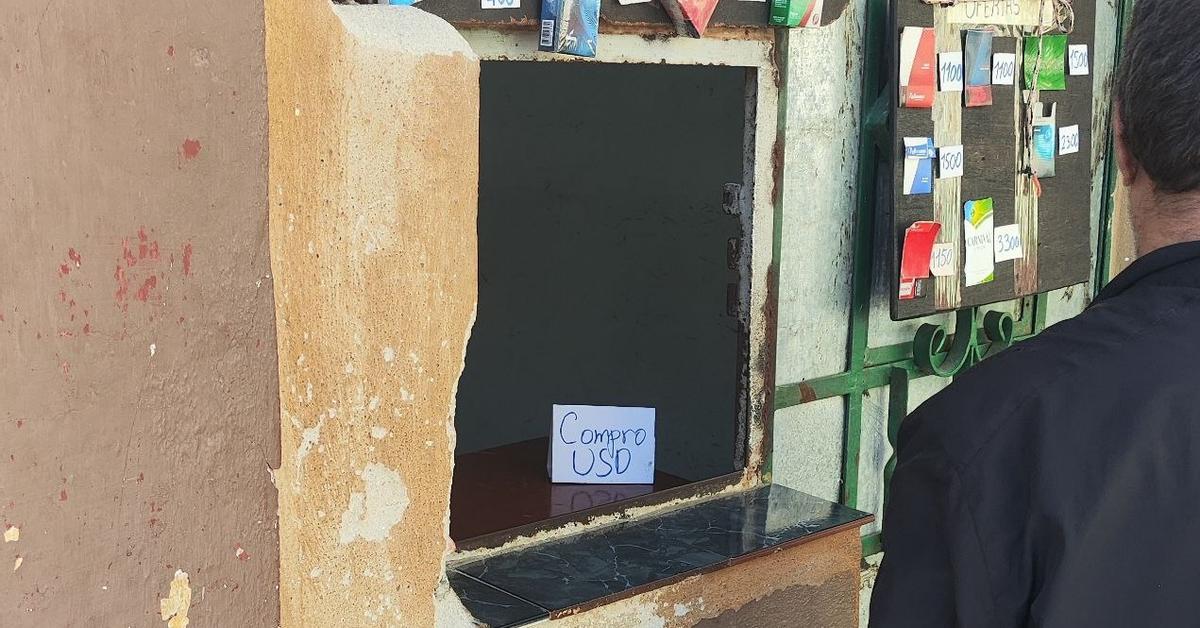
Havana/It had already happened in some places in Cuba, like Holguinbut it is the platform The Touch the one that sets the general tone and in its record the “symbolic mark” is already reflected: the dollar reached 500 pesos this Tuesday in the informal currency market. Increasingly further away from official floating ratedecreed almost two months ago, serves what the Government promised – to revalue the national currency – the data confirms the opposite trend, the unstoppable depreciation of the CUP. At a time, furthermore, when gasoline can only be purchased in US currency.
In January alone, the peso depreciated around 11.5% against the dollar on the black market, and the euro has also set historical highs (at 555 pesos, it is quoted today). This trend has been reflected in the official exchange market, with a rate of 482 pesos per dollar in the Cadeca (exchange houses) and the aggravating factor is that there is no availability of foreign currency.
As explained The Touch based on the analysis of its Cuban Currency and Finance Observatory (OMFi), the threshold of 500 pesos per dollar “It does not come as a speculative episode,” and that, unlike previous episodes of rise, “the demand for dollars has not grown explosively.”
For the OMFi, the behavior of the exchange market is similar to what they observed when, last August, the dollar reached 400 CUP
The informal market has remained moderate in the first weeks of the year, they indicate, “despite the severity of the macroeconomic scenario,” referring to the paralysis of oil shipments from Venezuela and Mexico due to pressure from the United States. The “strange calm” in the market, “even though the underlying trend continues to be clearly towards depreciation”, may be due, OMFi ventures, to the fact that the contraction of tourism has limited the supply of dollars but at the same time, due to “logistical uncertainty and productive paralysis”, demand has been reduced.
In any case, it is the “exceptional energy shock” suffered by the Island that is responsible for the situation. “The consequences are felt throughout the economy: interruptions in production, collapse of transportation, logistical difficulties for imports and a deepening shortage of basic goods,” he summarizes. The Touch.
The panorama “puts upward pressure on prices and further erodes the purchasing power of households that depend on income in Cuban pesos,” details the report, which asserts that the depreciation of the national currency is a “thermometer of the crisis.”
For the OMFi, the behavior of the exchange market is similar to what they observed when, last August, the dollar reached 400 CUP. At that time, he explains the note The Touchthe data “seemed like a psychological ceiling,” but it ended up being consolidated. The Observatory then interpreted the phenomenon as “the expression of structural imbalances – fall in GDP, collapse of tourism, partial dollarization and problems in the management of reserves – and not as an isolated speculative peak”, a diagnosis that is reinforced, emphasized, now that the currency is quoted at 500 pesos.
“Oil rose to 1,200 pesos per liter, bulk powdered milk to 1,000 pesos per pound and coal is completely lost”
It will also continue to rise. For February, The Touch It forecasts an estimated value of 530 CUP per 1 USD, within a range of “high uncertainty”, between 475 and 590 pesos. “The crossing of the dollar above 500 CUP is not an arrival point,” warns the platform.
The floating rate, which is added to the other two in force – that of 1 x 24 for centralized State allocations for goods and services considered essential and that of 1 x 120, for certain “entities with the capacity to generate foreign currency”, such as tourism – has not stopped rising since it was established last December, although always at a certain distance from the informal market. “The absence of accessible liquid reserves and credible instruments limits the State’s ability to compete in a sustained manner for foreign exchange,” argues OMFi.
There is no need for the independent media to declare that “the depreciation of the peso makes imported products more expensive, raises the price of the basic basket and deepens inequalities.” Cubans suffer it daily in their flesh.
Certain foods and items are beginning to disappear from the island’s markets. “The cigarettes I smoke no longer appear anywhere, and neither does the corn,” laments a young man from Sancti Spíritus, “and the liter and a half bottles of malt are also gone.” On his diminished shopping list, he notes: “Oil rose to 1,200 pesos per liter, bulk powdered milk to 1,000 pesos per pound and coal is completely lost.”