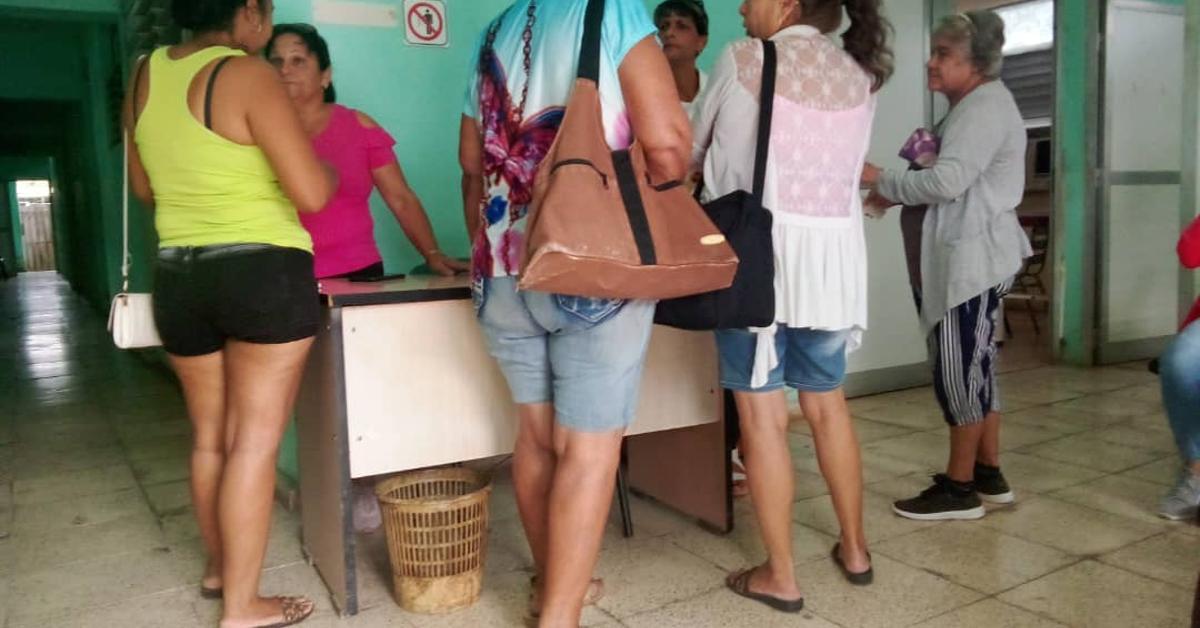
San José de las Lajas/The hallway of the Felo Echezarreta Polyclinic, in San José de las Lajas, echoes with low-voiced conversations, long sighs and the occasional cry that fades before reaching the end of the hallway. From early on, several people gather around a narrow bureau, an improvised information point, where a nurse hears the same thing over and over again without having any new answers.
The woman barely looks up when someone asks for the rheumatologist. You already know he won’t come. “Not today either,” his silence seems to say. In front of her, Adelfa, 74 years old, stands up with the help of a cane and a patience that is running out. “He gave me an appointment in October to follow up on my illness and since then I haven’t been able to see him,” he tells 14ymedio.
Every week, the old woman returns to this same hallway in the hope that the specialist will appear. Every week he returns home with the three pounds of rice that he has saved for the doctor, as if that small gift, which exceeds 600 pesos, a fifth of his monthly pension, could open the door to a consultation that never ends.
At the polyclinic they refuse to refer her to the provincial hospital. They repeat that their case can be attended to there.
According to the old woman, the polyclinic refuses to refer her to the provincial hospital. They repeat that his case can be attended to there, in the health area. But his corresponding doctor “lives in Güines and always has a different problem to come to,” he says, no longer hiding his anger. Nobody – he assures – seems to hold him accountable or look for a replacement. “If I can’t be treated today, I will try through a friend to see me at the Ameijeiras Hospital in Havana,” he laments, while adjusting the bag hanging on his shoulder.
In the so-called Polyclinic of the East, the wait begins to strain spirits from eight in the morning. Some people sit on dirty chairs; Others prefer to remain standing, leaning against the wall, as if time would pass faster. “The only specialties that are left here are Rheumatology and ENT,” says Agustín, a man with a firm voice who is already known for his complaints. He says he has written letters to the Public Health Directorate in the province, to the local newspaper and even to Minister José Ángel Portal. “In some cases they respond that there are no doctors available and in others, the only response I receive is silence.”
No one in the small waiting room dares to say last when someone asks if the doctor will arrive today. Maybe because everyone senses the answer. “When you say something, they immediately call it problematic and even worm,” Agustín says, lowering his voice. “So, who is responsible for the bone pain that keeps me awake? How do I get a specialist to see me and give me a reliable diagnosis? Are we or are we not a medical powerhouse?” His words are mixed with a notice that runs down the hallway: there is no electricity and it is impossible to start the plant.
“So, who is responsible for the bone pain that keeps me awake? How do I get a specialist to see me and give me a reliable diagnosis?”
The receptionist gets up, sits down again, looks over some papers. He no longer has any arguments left to ask for calm or excuses to justify the doctor’s absence. “The same thing happens with the ENT consultation,” intervenes a young woman who is waiting for news for her father. “When I need him to see him, I go directly to the doctor’s house. I bring him a little gift and resolve the situation, because if I wait for the outpatient consultation, my old man’s ears will rot.” While speaking, he takes the opportunity to ask the warehouse if medicines have entered the pharmacy. The answer does not come in words: the nurse’s face says it all.
At 10:30 in the morning, the clock finishes burying the few hopes that remained. The rheumatologist won’t arrive. “I understand that he is the only specialist of his type in the province,” says the young woman, resigned. “I will have no choice but to go with my father to Havana, because I think that not even in the hospital here we are going to solve it.” For those who do not have that option, the scene repeats itself like a weekly ritual: they will return again and again to the Eastern Polyclinic, with the minimal hope of obtaining at least a remission.
“This has become a vicious circle for me,” a woman murmurs as she gathers her things and leaves with other patients. In the middle of the comments, someone throws out an idea that mixes irony and desire: that after the capture of Nicolás Maduro by US troops, the Cuban doctors in Venezuela return to the Island and “go and resolve this chronic lack of doctors.” Nobody answers. The hallway is almost empty and the nurse adjusts her glasses, waiting for the next patients who will ask the same question again.