The Cuban government spent almost two decades denying that it sent military or security personnel to Venezuela.
MIAMI, United States. – Since the beginning of the close Cuba-Venezuela alliance in the early 2000s, the Cuban regime systematically denied having troops, intelligence agents, security personnel or military operations in Venezuelan territory.
But the United States operation to capture Nicolás Maduro and his wife, Representative Cilia Flores, on January 3, overturned 20 years of denials.
2005 – Fidel Castro denies presence of Cuban troops in the region
In August 2005, then-US Secretary of Defense Donald Rumsfeld accused Cuba and Venezuela of “destabilizing” South America (in particular, he hinted at interference in Bolivia’s political crisis). Fidel Castro responded publicly on the program Round Tablerejecting such accusations and denying that Cuba had a military presence or bases outside its territory. In his five-hour speech, Castro called it “ridiculous” to blame Cuba or Venezuela for the social upheavals in the region and declared emphatically: “It is not Venezuela or Cuba. [quienes desestabilizan]; They do not have bases or troops.” In short, it established the official line that the regime would maintain in the following years.
2000s – “Civil” Cooperation
Throughout the 2000s, Cuba-Venezuela cooperation deepened under Fidel Castro and Hugo Chávez, with tens of thousands of Cubans sent to Venezuela on social missions (doctors, teachers, sports coaches, etc.). In the face of recurring accusations from the Venezuelan opposition and international sectors about the infiltration of Cuban agents into the Venezuelan military and security apparatus, the official Cuban discourse maintained that their presence was limited to civilian collaborators.
State media such as Granma and Cubadebate They highlighted that the “vast majority” of the more than 20,000 Cubans in Venezuela were health professionals, who constituted an “army of white coats” and not soldiers. During the presidency of Raúl Castro (2008–2018), Havana maintained this position and continued to present its support for Venezuela as a gesture of solidarity between peoples and denying military interference.
February 2019 – Bruno Rodríguez rejects the accusation of “private army” in Venezuela
In the midst of Venezuela’s political crisis of 2019 (with the international recognition of Juan Guaidó and complaints of Cuban support for Nicolás Maduro), Washington intensified its accusations against the Cuban regime. On February 18, 2019, President Donald Trump, then in his first term, accused Havana of maintaining a “private army” in Venezuela to support Chavismo.
The next day (February 19), Cuban Foreign Minister Bruno Rodríguez Parrilla called a press conference in Havana to vigorously refute those allegations. Rodríguez described Trump’s accusation as “infamous” and challenged the US to present evidence: “Our government rejects this slander in the strongest and most categorical terms.”
Furthermore, he explicitly denied the presence of Cuban military personnel in Venezuela, clarifying that “more than 20,000 Cuban aid workers, all civilians, 94% of them from the health sector,” were working in Venezuelan territory. Rodríguez reiterated that Cuba only provided collaboration in areas such as health, education, sports and culture, not in military matters.
April 2019 – Regime insists on the absence of military personnel in Venezuela
As pressure increased from the US (which in March-April 2019 toughened sanctions against Havana and Caracas, and even threatened a total embargo if Cuba did not withdraw supposed forces from Venezuela), Havana issued an official statement in which he reiterated the denial of any military role in Venezuela. In the statement, Havana categorically stated that it did not maintain “military or security personnel in Venezuela” and that the United States was lying “blatantly.”
The text emphasized that the nearly 20,000 Cuban collaborators in Venezuela provided only “basic social services” (mainly medical). He even pointed out that the US intelligence services themselves “have more than enough evidence… that Cuba does not have troops nor participate in military or security operations in Venezuela.”
Although the regime stressed that it would have the right to cooperate in Defense with Venezuela, it made it clear that there were no military personnel from the Island in the South American country, nor did they participate “in any military or security operation.”
April 30, 2019 – Díaz-Canel rejects on Twitter the “lie” of the Cuban troops
On April 30, 2019, an attempted military uprising occurred in Caracas led by Juan Guaidó, after which senior US officials (including Trump via Twitter) doubled down on accusations of Cuban intervention. That morning Trump tweeted that it would impose a “total and complete” embargo on Cuba if the Cuban “military forces” and militias did not cease their operations in Venezuela. In response, that same day the Cuban ruler Miguel Díaz-Canel Bermúdez public messages on Twitter flatly denying the presence of Cuban soldiers. Díaz-Canel expressed Cuba’s “firm rejection” of Trump’s threats and publicly assured: “There are no military operations or Cuban troops in Venezuela.”


May 2019 – Johana Tablada: “There are no Venezuelan troops in Venezuela”
The then deputy director general for the United States of the Cuban Foreign Ministry, Johana Tablada de la Torre, quite angry, insisted: “There are no Cuban troops in Venezuela. There are no Cuban troops in Venezuela. There are no Cuban security troops in Venezuela. Cuba does not participate with troops or military personnel in military or security operations in Venezuela.”
He immediately described the accusations as “slander” and said that they constituted “an offense” against the people and the Government of Cuba and also “an act of disrespect towards public opinion, the international community, sovereign States.”
“To say that Cuba has 20,000 troops in Venezuela, that we are intervening in the internal affairs of Venezuela, is something that the United States Government knows perfectly well is not true,” he concluded.
April 25, 2019 – Bruno Rodríguez insists: “Cuba does not have troops nor does it participate in military operations”
Towards the end of April 2019, the US continued to accuse Cuba of supporting Maduro with a contingent of 20,000 troops. John Bolton, then US National Security Advisor, stated on April 17 that Cuba acknowledged having “tens of thousands” of Cubans in Venezuela. This provoked a strong response from Foreign Minister Bruno Rodríguez, who at a press conference on April 25 He again denied the presence of Cuban forces and called Bolton a “pathological liar.”
Rodríguez Parrilla described the accusation as “vulgar slander” and declared to the press: “Cuba does not have troops or military forces nor does it participate in military or security operations in the sister Bolivarian Republic of Venezuela.” He invited Bolton to present evidence of his assertions, reiterating “He lies… I invite him to present evidence.” In those days, the regime also denied that Cuban doctors conditioned the delivery of medicines to political support.
May 3, 2019 – Carlos Fernández de Cossío denies the Cuban military presence in Venezuela
In the midst of the diplomatic struggle of 2019, Cuba took its denial to international forums. On May 3, 2019, Carlos Fernández de Cossío, then general director for the United States of the Ministry of Foreign Affairs, granted an interview in Washington with the AP agency. In the most detailed response until then to Washington’s accusations, Fernández de Cossío reiterated that Cuba did not have “troops in Venezuela nor does it participate in security operations.” The diplomat acknowledged that some 20,000 Cubans were in Venezuela, but that “practically all” were “medical workers.” “There are no troops… Cuba does not participate in military or security operations in Venezuela,” he insisted.
However, he added that he could not completely “deny” possible intelligence cooperation (since he did not have that specific information), but he emphasized that if military or intelligence cooperation existed, it would be a sovereign right of Cuba and Venezuela. In any case, he insisted: “Despite this right, there are no military personnel [cubano] on the ground” in Venezuela.

2019 – Nicolás Maduro: “My security ring belongs to Venezuelans”
In an interview with María Elvira Salazar, Maduro himself denied the presence of Cuban agents in Venezuela. “That fable that there are thousands of Cuban soldiers in Venezuela is a lie. With Cuba we have cooperation agreements, and in Venezuela and in Cuba Cuban soldiers, Venezuelan soldiers, are trained, but Venezuela is defended by the Venezuelan soldiers by the thousands and thousands and thousands.”
When Salazar specifically inquired about the identity of the agents who made up his security ring, Maduro assured: “My security ring are these guys trained from the Bolivarian National Armed Forces. Venezuelan professionals. My security ring is made up of Venezuelans.”
January 3, 2026 – US captures Maduro and kills 32 Cuban agents
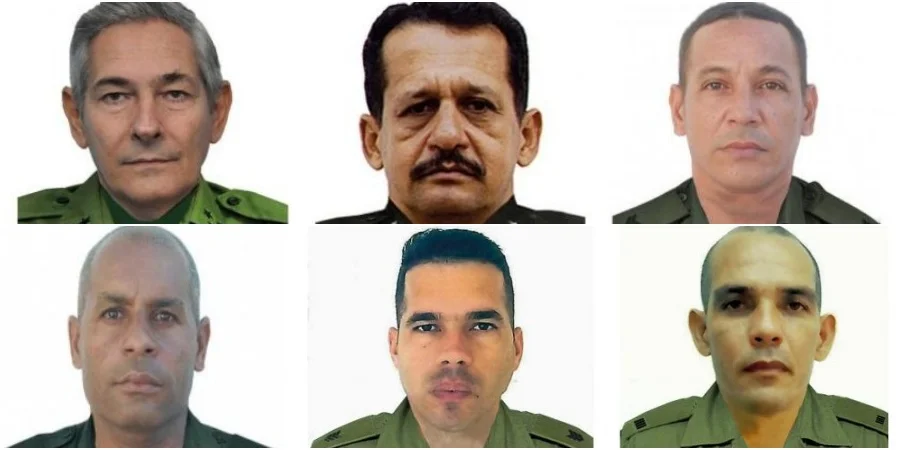
After more than 20 years of denials, on January 3, the Cuban regime finally had no choice but to accept the inevitable: Havana publicly admitted for the first time the presence of its fighters in Venezuela, confirming the death of 32 Cuban soldiers in the United States operation to capture Maduro. “32 Cubans lost their lives in combative actions, who were carrying out missions representing the Revolutionary Armed Forces and the Ministry of the Interior. [de Cuba]at the request of counterpart bodies of the South American country.”
Miguel Díaz-Canel decreed two days of national mourning for the fallen and explained that these soldiers were “carrying out missions” in Caracas at the request of the Venezuelan Government, a euphemism that tacitly confirmed the protection work that Cuba had always denied.