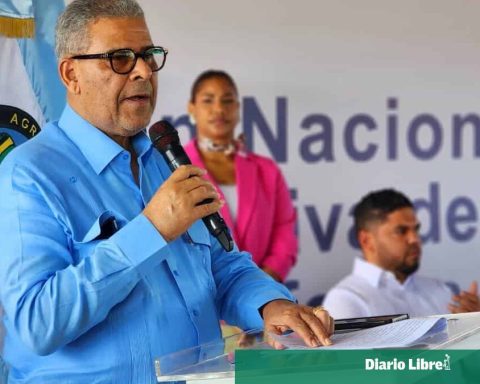
“He cement He is a silent and heroic protagonist of our modernity, “said engineer Pedro Delgado Malagón in the prologue of the work”Cement and nation “, from the architect Carmen Ortegawhich describes the trajectory of a material that forever transformed the urban and economic life of the Dominican Republic.
The researcher presented with the Dominican Association of Producers of Cement Portland (Adocem) his work, which travels the main milestones of this industry, from the first works in concrete armed until the expansion of the great modern cement.
Of wooden barrels to the law of concrete armed
The story begins with the first references to cement Portland, which was sold in the hardware stores of the main cities of the country in wooden barrels at the beginning of the 20th century. Between 1905 and 1907 the first structures of concrete armed in the country. Later, during the North American military intervention (1916-1924), iron and iron-based construction standards were introduced and concrete.
The breakdown came after the devastating cyclone San Zenón of 1930, when the government prohibited by decree any construction that was not concrete armed. From that moment on, the material became the “officer” of Dominican architecture, marking the beginning of a new stage in engineering and national urbanism.
The first national factory: 1947
In 1944 the construction of the Dominican Cement Factory In the western margin of the Isabela River, in charge of the company The Foundation Company. Three years later, on February 27, 1947, it was officially inaugurated within the framework of the commemoration of the 103th anniversary of national independence.
For Ortega, this fact was a watershed.
“Dominican development can be divided into before and after the installation of the first factory of cement. From there, the cement It ceased to be just an imported material and became part of our productive and social identity. “
Crisis, expansion and birth of Adocem
The factory was confiscated and nationalized in 1961, after the fall of the Trujillo dictatorship, but for years its productivity was limited by political instability. The rise of construction in the seventies brought with it the integration of the private sector with the foundation of National Cements in San Pedro de Macorís and Cement Cibao in Santiago, both in 1976.
In 1980, a group of entrepreneurs founded the Dominican Association of Producers of Cement Portland (Adocem), with the aim of strengthening the industry and turning it into the engine of the national economy. Since then, the guild has played a key role in the articulation of sectoral policies and in competitiveness.
Multinationals and modernization
The nineties marked the entry of foreign capital. In 1996, Cemex, one of the ten largest cement companies, acquired rational cements with an investment of more than 600 million dollars. That same year, the Argos Group, Colombian investors, bought shares from the state cement Cementos Colón with Swiss partners and the Corripio group.
Later new actors emerged: Cement Santo Domingo in Azua (1999), Domicem in San Cristóbal (2005) and Cement Panam in San Pedro de Macorís (2013).
A pillar of progress and sustainable future
Today, the cement industry is a pillar of Dominican growth. It generates thousands of direct and indirect jobs, promotes the construction of housing, schools, roads, and accompanies the Urban modernization.
“Talk about cement It is talking about development and future, “Ortega said in his book, highlighting that the sector now faces the challenge of moving towards sustainability, with cleaner practices, in line with international environmental commitments.
-
The first works in reinforced concrete in the country are lifted.
1905-1907
-
North American military intervention introduces constructive standards in iron and concrete.
1916-1924
-
After the San Zenón cyclone, the government decrees that every building must be done in reinforced concrete.
1930
-
The construction of the Dominican Cement factory is announced, on the western banks of the Isabela River.
1944
-
On February 27, the first cement factory in the country is officially opened, coinciding with the 103th anniversary of National Independence.
1947
-
After the fall of the Trujillo dictatorship, the factory is nationalized and delivered to the Industrial Development Corporation.
1961
-
National cements (San Pedro de Macorís) and Cibao cement (Santiago), with strong private investment arise.
1973-1979
-
On December 18, the Dominican Association of Cement Producers Portland (ADOCEM) is founded.
1980
-
Foreign capital arrives: Cemex acquires rational cements (investment exceeding US $ 600 million). Swiss arcs and partners buy Cementos Colón next to the Corripio Group.
1996
-
Santo Domingo cement arises, which starts operations in April 2007 in Atillo, Ocoa.
1999-2007
-
It is inaugurated in Palenque, San Cristóbal, with an investment of US $ 113.5 million.
2005
-
On July 16, Cement Panam opens, from the star group, in Villa Gautier, San Pedro de Macorís.
2013