Long before Cubans accessed Facebook and Twitter, communicating “mouth to mouth”, marched against state violence.
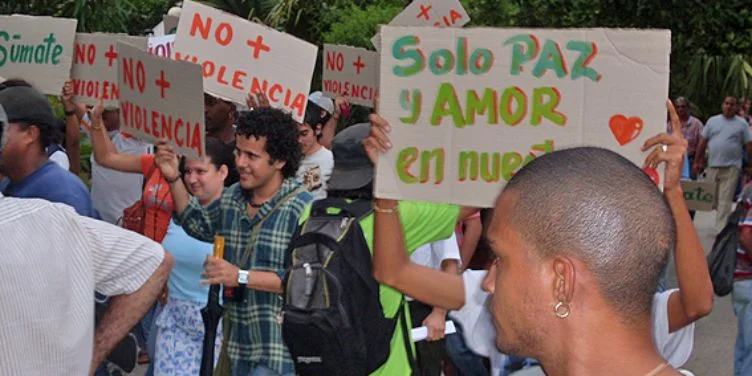
Miami, United States. – On November 6, 2009, before Cubans could connect to the Internet and have access to social networks, a peaceful march on 23rd Street, from 23 and G to Coppelia and back, gathered between 150 and more than 200 young people and activists outside the official structures, according to testimonies and reports of the time collected by Cubanet.
A report of Cuban journalist Iván García published by the Spanish newspaper The world, He says that “around 150 people, mostly young,” toured the streets of Habanero Vedado “with songs and posters against violence, in favor of the union of Cubans, dialogue and tolerance.”
The same media documented that, after the march, state security agents Yoani Sánchez and Orlando Luis Pardo arrested and attacked bloggers. Own Sanchez He declared: “Blood blows. We were kidnapped in a black car, from Chinese brand, by hard types of the Political Police, who at no time identified.”
On the call and its technological limits, Dener stressed in An interview with Cubanetthis Thursday, which was “supernatural, [con] Zero social networks, from mouth to mouth. “He also stressed that” there were more than 200 young people gathered “and that everything was when Cubans still did not have access to the Internet.
The protesters left on a sidewalk from 23 to L (Habana Libre Hotel), crossed in front of Yara cinema and, on the sidewalk of Coppelia, returned to G. Dener summarized it like this: “We went down from 23 and g to Coppelia. Round trip.”
Although the report of The world He indicates that “there was no act of violence by the authorities” during the walk, he said that a few blocks, near the Calixto García hospital, “State security agents introduced into one of their cars (…) to the bloggers Yoani Sánchez and Orlando Luis Pardo” and that in a patrolman they climbed the blogger Claudia Cadelo and the bride of Pardo.
The march was organized by the OMNI Zona Franca project and the Aldeanos Aldeanos Contestatory group, among other groups of independent artists. The friendship movement recalled in 2019ten years after the march, which, “for the first time in the history of Cuba (…) the march was made in Havana for non -violence”, “not convened by the Government”, with the participation of “more than 200 young people” and “a dozen independent cultural groups and projects.”
Dener, on the other hand, listed the concurrence of projects and groups such as generation and, OMNI Free Zone, Matraca and Porn for Ricardo, among others, and recalled that the preparation included posters made the night before.
The immediate context, according to Dener, was an official campaign that labeled the calls of “criminals”, which led them to explicitly choose the “non -violence” as motto. “We said, we go to a march for nonviolence,” he said, while recognizing learning on the march in an environment without civic training or digital tools: “We were zero, we did not have any political culture, or how to make a movement.”

Likewise, the activist, who now lives exiled in Norway, linked the protest with a broader cultural activism stage – consistently, Performancesexhibitions – and with the mobilization of headwaters of artistic projects that “dragged a lot of youth.” He also pointed out a subsequent, “less known” attempt, “with the people of Omni within the endless poetry festival”, which “was a march to the corner.”
The repressive cost for the organizers of the march was swift: Dener said that after 2009 he faced “two and three weekly interrogations” by State Security Officers, as well as the expulsion of the school where he worked and family pressures that forced him to exile.
Ten years later, the Cuban Observatory of Human Rights also evoked the spirit of that dayciting Dener’s own statements: “We thought we could change the country, for the simple fact that we were right and good intentions. ‘Of course we can win!’, We said. ‘Martí is on our side. Don Quixote is on our side,’ We said. Of course we can! ”