He First rise from the Cuban sugar industry dates from the 18th century, in which it is possible to define the economic function of the island with respect to other colonies of the continent. In the mid -nineteenth century, After the arrival of the railroad in 1837 and the construction of new commercial ports for loading and downloading, A bonanza period for the sugar sector begins which makes the country the largest world producer in this area.
The two wars of the second half of the nineteenth century had a negative impact on the sector. The recovery will begin just from independence and during the American occupation period (1898 and 1902). It will remain with the advent of the Republic (1902) in which Cuba will begin to benefit from a commercial reciprocity treaty with the United States (December 1902) and a very advantageous tariff relationship.
During the first two decades of the twentieth century large sugar colossi are built that are authentic locations that change the physiognomy of the traditional Cuban bat in “model towns” such as Hershey (Havana), Joronú (Camagüey), Chaparra and Preston (East) with a new architectural and urban conception, in addition to exemplary infrastructure. In this eagerness for economic growth, both Cuban and American capital participated very often. The aforementioned landscape lands at the corporate company of multiple national and foreign investors. The stage “of fat cows” or “dance of the millions” in which, due to World War I, the price of Cuban sugar reached levels never before experienced.
With high and low during the three decades that followed the great depression of the 1930s, the Cuban sugar industry continued to develop and constituted an undeniable source of livelihood not only for Cubans, but for emigrants (Haitians and Jamaicans fundamentally) that came to the island as braceros during the harvest.
This economic heritage suffered the first great onslaught and declines from 1960 with the nationalization of the first American capital plants, followed by all the remaining ones in the country. The gigantic failure of the so -called “Zafra de los Ten million” (1970) already announced a decadent and unrecoverable sugar economy. The fall of the Berlin Wall (1989) and the end gives Soviet assistance, the coup de grace to the largest national industry. With the so -called “Álvaro Reynoso” task, which sought to “reorganize” the sugar sector since the special period began, most of the country’s sugar plants were deactivated leaving after their dismantling the living stamp of ruin and desolation that we can see today in the fields of Cuba.
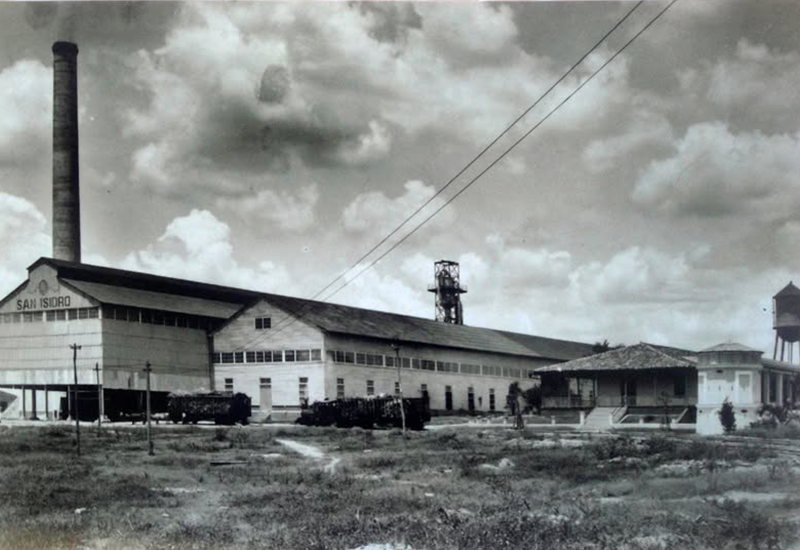
Central San Isidro


Ancient name: San Isidro (expropriated in 1960, Cuban capital)
Posterior name: Panchito Gómez Toro
Current state: In operation
Location: Burned Municipality of Güines, Villaclara
Owner: Gustavo Manuel German Beguirinin (married to the American Clara G. Higgins, Parents of Gustavo, Clara, José María, Raquel, Antonio and Rodolfo Beguiristain Higgins, of which Gustavo was the treasurer of the central San Isidoro). They resided in Fifth Avenue, No. 3007, Corner 32, Miramar, Havana.
The company’s vice president was his brother Juan F. German Beguirinin (married to Ursulina Sáez de Medina, parents of Ofelia and Teresa Beguirinin Sáez de Medina). Luis Beguiristain Rodríguez (son of his brother Rogelio Beguiristain German) was the general superintendent and Ignacio Beguiristain Masses (another nephew, married to Florinda González Clatell) the field superintendent.
History:
Central San Isidro had been founded in 1864 and belonged to the Count of Casa Moré, José Eugenio Moré de la Bastida, one of the so -called “Condes del Sugar”, who had arrived poor in Cuba in 1810 from Colombia, becoming a successful businessman and owner of 6 mills, refineries, warehouses and railroads.
The San Isidro buys it in 1914 José María Beguiristain, the pater familiesto the succession of the count of Casa Moré. It produced at the end of the 1950s about 250,000 sugarcane arrobas and the estate occupied the 17th position regarding the extension of land belonging to the industrial and agricultural company of burning of Güines.
The Beguiristain was a family of industrialists descended from the Biscayo José María Beguiristain and the Cuban María Josefa Alemán, who had 7 children among whom they also appeared Alberto German Beguirinin (manager of the Hell Distillery and resident in Sagua la Grande with his wife Ignacia Sampedro), José María German Beguirinin (President of the San Juan Distillery and manager of the distillery El Hell, married to María Luisa Rivero) and Arthur German Beguirinain (owner of the Porcelain Ceramic Company Isla de Pinos SA, married to Carmen Goyena). Very active in Sagua La Grande, the town of Las Villas in which José María had been president of the Spanish casino. In addition to the distillers El Hell (Sagua la Grande) and San Juan (Matanzas) bought in 1947 the central results from Jorge López-Oña Robot. In its distilleries the King of Gold, the Coñac Century, the San Jacobo Licor and the Aguardiente San Cristóbal, among other drinks were manufactured.
Central results
Ancient name: Results (expropriated in 1960, Cuban capital)
Posterior name: Antonio Finalet
Current state: Dismantled in 1995
Location: Sagua La Grande municipality, Villaclara (2 km from the city)
Owner: Initially belonged to Joaquín Alfonso And brothers until in 1895 it became the property of Juan de Dios Oña, who developed it, to the point of creating a railway line that communicated it with the beach El Uvero, for the export of sugar. Then in 1916 he was inherited by Jorge López Oña Ribot who presided over it until 1947 when he sells him to the Beguiristain family (see previous card for this family, also owner of Central San Isidro).
Morón Central
Ancient name: Morón (expropriated in 1960, Cuban and North American capital)
Posterior name: Round Ciro
Current state: In operation
Location: Populated by Pina, Morón Municipality, Camagüey (13 km from Morón)
Owner: Founded in 1912 was the second largest sugar central in Cuba with a production that in 1952 came to ascend to the million daily sugar cane arrobas. Founded by Colonel José Miguel Tarafa who placed the majority of the general Faust Local and Stewart). It belonged to the Consortium formed by North American Capital (Sullivan and Cronwell CIA) and Cuban (succession Falla Gutiérrez SA, chaired in 1958 by Miguel A. Falla Álvarez). Since 1944, Central Morón had its own distillery and airport.
Central Mercedes


Ancient name: Mercedes (expropriated in 1960, Cuban and North American capital)
Posterior name: August 6
Current state: Dismantled in 1993
Location: Manguito, Matanzas Province
Owner: Founded as Central Carrillo in 1855 by the Cuban Antonio Carrillo de Albornoz Arango, and then called Mercedes in honor of his wife Mercedes Hernández Aloy. Then he belonged to Andrés Carrillo de Albornoz Hernández, son of these and husband of María Josefa Benítez Cantera, who in 1901 sold it to the Cuban company Central Mercedes, owned by a consortium formed by Miguel Arango, Regino Truffin and Ignacio Almagro. Finally, it was bought in 1915 by the Cuban Cane Sugar Corporation, the largest sugar company in the world in its time and, subsequently, passing under control of the Gulf Atlantic Sugar Company, a consortium formed by US capital (Sullivan and Cronwell CIA) and Cuban (succession Falla Gutiérrez SA, chaired in 1958 by Miguel A. Falla Álvarez). He occupied the 49th position at a national scale in production capacity.
Toledo Central
Ancient name: Toledo (expropriated in 1960, Cuban capital).
Posterior name: Manuel Martínez Prieto
Current state: Dismantled in 2002
Location: Barrio de los Quemados, province of Havana, in the perimeter of the capital
Owner: It is one of the five oldest centrals in Cuba and was founded in the seventeenth century with the name of San Andrés. It was owned by the couple formed by Antonia de Otamendi and Francisco Durañona who appointed him toledo when buying it in 1856 and sells it in 1909 to Juan Aspuru Isasi, a native of Arreudiaga, Basque Country, married to Clara San Pedro Polo. Aspuru began to constitute his fortune in Cuba from a hardware store that established in 1880. The marriage had children to children Juan Antonio (married to María Estela Plasencia Piedra), Clarisa (married to Dr. Felipe García Cañizares), Maria and Manuel Félix Aspuru San Pedro.
In 1959 he was owned by Manuel Félix Aspuru San Pedro (Havana, 1892 – Palm Beach, 1982), son of Juan Aspuru Isasi. Married to María Antonia Alonso Heymann, she lived with her wife on Fifth Avenue, No. 2807, Corner 30, Miramar, Havana. They were his children María Antonia (Married to Manuel Santeiro Rodríguez, whose parents had leased in 1957 the Ambassador of Italy their house on fifth Avenue and Calle 60, Miramar, still occupied by the Italian Embassy), Julia (Married first with Enrique Rousseau Sánchez and, in second, with Charles Minot Amory, who died in Palm Beach in 2007 where she was a fashion creator) and Lourdes (married to Carlos Musso Baró). He also owned the Perseverance Centrals (in Güines) and Fajardo (in San Antonio de los Baños).
History:
The central had its own stadium and baseball team. Manuel Aspuru Santeiro also owned the Licorera Cuba, located in the neighborhood of El Cerro, which produced several brands of liquors such as anise of the devil, anise Águila, Superfino Aldabó, Coñac 1866, Ron Hatuey, Ron Paloma, among about ten more drinks. The Licorera was administered by its son -in -law Manuel Santeiro Rodríguez, Carlos Musso Baró and Enrique Rousseau Sánchez.