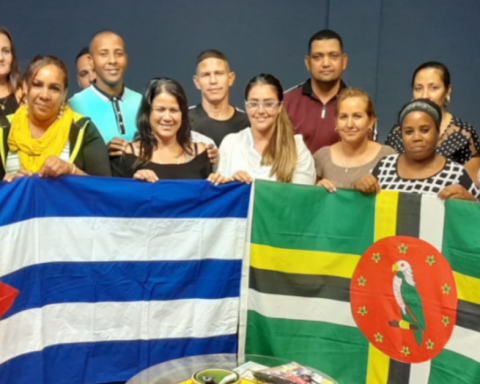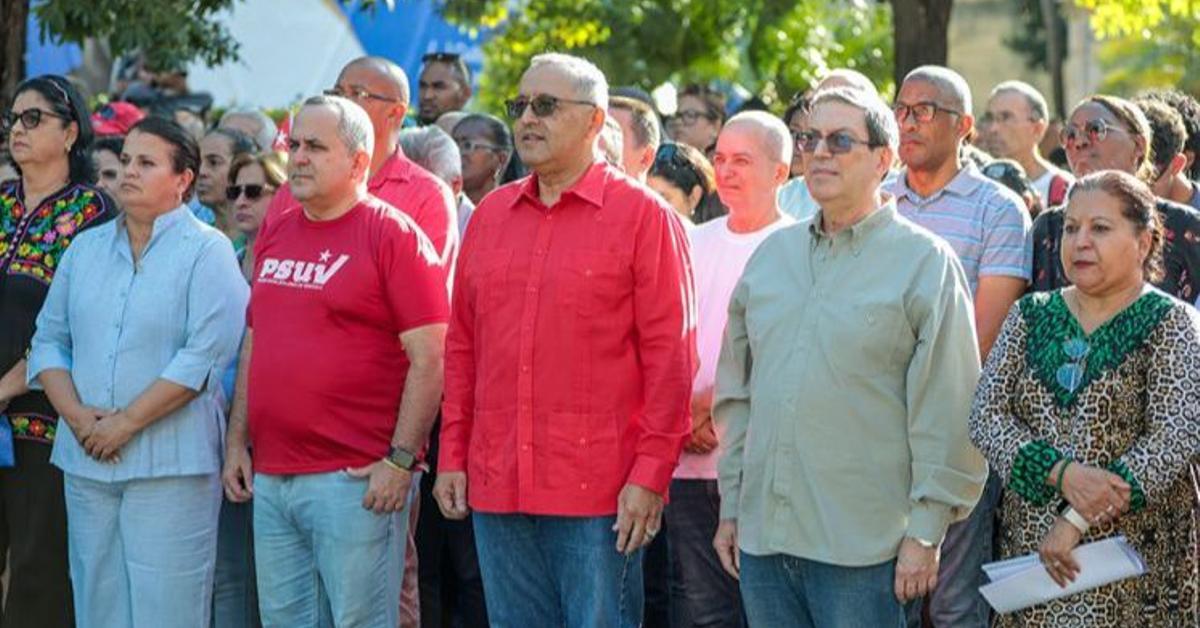
Havana/Havana woke up this Saturday with an official event on 17th Street, in El Vedado, called hastily and with a discretion that contrasted with the massive demonstrations of Venezuelans spread throughout Latin America in support of María Corina Machado, Nobel Peace Prize 2025. While in Bogotá, Lima or Panama, tricolor t-shirts, flags and posters celebrating the opposition leader predominated, in Havana the event organized by the The Cuban government repeated its condemnations of Washington, the accusations of war threats and its unqualified support for Nicolás Maduro.
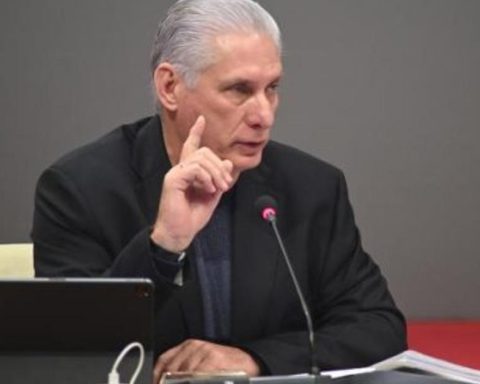
The absence of the ruler Miguel Díaz-Canel – whose presence has been constant in international propaganda events of the ruling party – marked a minor tone from the beginning. instead the chancellor was there Bruno Rodríguez, accompanied by the secretary of the Federation of Cuban Women, Teresa Amarelle Boué, and the Venezuelan ambassador in Havana, Orlando Maneiro Gaspar. None mentioned the versions that have been circulating for days about alleged conversations between Havana and Washington about Maduro’s uncertain political future.
Anonymous sources cited by Reuters indicated this Saturday that “some members of the Cuban regime” would have initiated discreet contacts with US officials to explore possible scenarios should Maduro leave power. According to the report, among the options discussed is a “world without the Maduro regime,” which reveals that in certain circles of Cuban power the viability of a change in Caracas is already being analyzed in the face of the escalation of sanctions, international pressure and military operations.
After more than a quarter of a century of “rape, death and misery”, the country finds itself “on the threshold of freedom”
In contrast to the cold official event this Saturday in Havana, the streets of Latin American cities gathered thousands of Venezuelans called by Machado to march “for peace and freedom”, four days before officially receiving the Nobel Prize in Oslo. In Bogotá, Mauricio Vaquero, from the Venezuelan Command in Colombia, summed up the feelings of many by pointing out that, after more than a quarter of a century of “violations, death and misery,” the country is “on the threshold of freedom.” Vaquero’s words, far from the defensive tone of the speeches in Cuba, reflected the conviction that the international distinction for Machado is a symbolic blow to Chavismo.
In Panama, dozens of Venezuelans walked from the Cinta Costera to the Plaza de la Democracia. “We are proud to have a Nobel Prize winner who has fought for the freedom of an entire region,” said Ricardo Contreras, one of the organizers. The march, which many described as “full of light and hope,” had nothing to do with the rigid atmosphere of the event in the Cuban capital, where each intervention seemed like a rehearsed repetition of the panic in the Castro leadership in the face of the possible loss of its main ally in the region.
Lima was also the scene of a rally in front of the Venezuelan Embassy, where the diaspora – 1.5 million migrants in Peru – carried replicas of the Nobel medal, flags and posters with phrases such as “The Nobel belongs to those unjustly detained” or “The Nobel belongs to those who have given their lives for this fight.” Verónica Durán, from the New People Global Alliance, stated that the award “is a victory for all of Venezuela.”
Venezuelans have reacted with indignation to the death in custody of Alfredo Díaz, former governor of Nueva Esparta, after a year of isolation in Sebin. His death joins a chain of at least six opponents who have died in prison since November 2024 and a history that, according to Foro Penal, includes 17 political prisoners who have died since 2014. Both the NGO and María Corina Machado denounced that these deaths respond to a pattern of torture, isolation, denial of medical care and paralyzed trials, while the country maintains 887 political prisoners.
Today, the calls from Havana lack force, overshadowed by the internal crisis and a population increasingly less willing to validate official spectacles.
Meanwhile, the official event on 17th Street in Havana took place amid predictable slogans and speeches that insisted on a narrative of “imminent aggression” by the United States. Dr. Idalmis Rodríguez, chosen to speak as “representative of the forces defending peace,” criticized the awarding of the Nobel Prize to Machado, calling it a “grotesque contradiction” and accusing her of calling for foreign military intervention. That rhetoric – already worn out – was heard among a small audience, made up mostly of mobilized militants and state officials.
The ambassador of the Caracas regime, Maneiro Gaspar, for his part, repeated the speech that his country has faced “a real threat” since August and denounced “murders in the Caribbean Sea,” referring to the US attacks against twenty vessels linked to drug trafficking. Even so, he allowed himself to announce an “exponential growth of 6%”, an economic optimism that contrasts with the crisis that the country is experiencing and the lack of enthusiasm of Venezuelan emigrants to return home.
Amarelle Boué returned to the sanctions as “collective torture”, the denial of links between the Venezuelan regime and criminal structures, and the demand to “hands off Venezuela.” But neither she nor the other speakers alluded to an issue that persists in the background: what role does Havana play in the diplomatic moves around Maduro’s political future?
For decades, Cuba was the natural setting for large “anti-imperialist” events, but today its calls lack force, overshadowed by the internal crisis and a population increasingly less willing to validate official shows. That the Government has opted for a modest act and that Díaz-Canel remained on the sidelines reinforces the impression that the priority at this moment is not Venezuela, but the political survival itself on the Island.