Madrid/Economists have been warning for days, in the middle of the regime’s new propaganda war: “Now, with the hunt for remittances, the dollar will become more scarce.” With the attack on The Touch As context, the ruling party gave the starting signal last Thursday with the announcement of the arrest of 13 people for “theft of remittances” and continues today to report the existence of three open investigations for the same cause.
“For some time it had functioned as a silent cog in a circuit that moved millions inside and outside the country, part of a phenomenon that, according to the authorities, continues to reproduce itself, despite the ongoing criminal proceedings and public alerts,” reads one published note in Cubadebate. Not very silent, since it is nothing more than the usual mechanism for the entry of foreign currency that reigns on the Island since emigrants began to bypass the channels of the Gaesa military conglomerate, first out of obligation and then out of convenience.
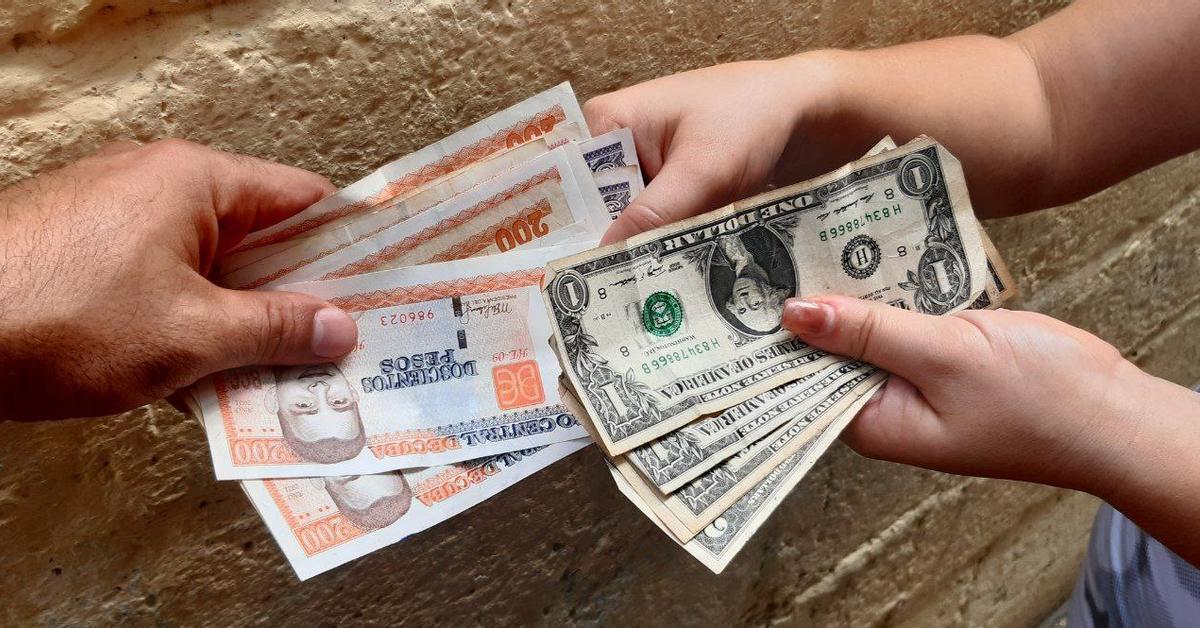
The first case mentioned is being investigated in Villa Clara, although the “currency trafficking” also extended to Sancti Spíritus and Las Tunas. He modus operandi He refers to “two financiers”, one in the United States and the other in Spain, whom he accuses of “capturing” remittances from Cubans residing in those countries with which they financed private imports. Individuals paid in national currency and dollars to “an organizer and his messengers” who distributed the money to relatives in the three provinces.
‘Cubadebate’ indicates that “financial compensation operations were carried out abroad, retaining cash in foreign currency in favor of third parties”
Cubadebate points out that “financial compensation operations were carried out abroad, retaining cash in foreign currency in favor of third parties to make purchases and pay suppliers”, which, in its opinion, complicates the operation and aggravates the crime “taking into account the continuous nature, the existence of organization and roles in the criminal chain and the double retention of cash (national currency – foreign currency) outside the control of the National Banking System.”
Lieutenant Colonel Yisnel Rivero Crespo, head of the Department of Economic Crimes of the Ministry of the Interior, affirms that the two operators based abroad also benefited from a commission that was between 6% and 8% for carrying out the import, in addition to the profit margin – not determined – for managing the consignment. According to the authorities, the Cuban side had been carrying out these activities since 2023 and handled 20 to 30 million pesos per week (about 45,500 to 68,100 dollars at the current exchange rate).
The five people involved in this case – who distribute the money two days a week, Friday and Monday – were arrested about seven days ago, including two wholesale recipients in Sancti Spíritus and Las Tunas. Additionally, there are at least four private businesses “involved.”
To this we must add two open cases in Pinar del Río and Havana, both relating to people who carried out the purchase and sale of large amounts of currency within the country. “Here an internal circuit designed to inflate prices and obtain quick returns was used,” warns Rivero Crespo, who specified in more detail the number of those investigated.
In Pinar del Río there are four people involved, a “ringleader” who coordinated two couriers buying foreign currency in the informal market “with funds that he provided them” and a young woman who managed a Facebook group to promote and manage the operations.
In the case of Havana, it was just an “unemployed citizen, resident in the Diez de Octubre municipality, who managed a high volume of operations. According to the authorities, his house had become a point of reference for those seeking large amounts in a short time.”
The Penal Code provides for sentences of between two and five years for crimes of illegal trafficking of national currency and foreign currency.
The note includes several paragraphs intended to warn the population that there are “a hundred” open investigations of this type and that they involve “hundreds of millions of pesos” moved every week. “Such practices generate additional pressure on inflation, reduce the State’s collection capacity and end up affecting the economic actors themselves who try to operate within the law,” he emphasizes, while at the same time attributing to this type of practices the worsening of the Cuban crisis and insisting that the situation “requires a sustained confrontation.”
He Penal Code provides penalties of between two and five years for the crimes of illegal trafficking of national currency and foreign currency, as well as for anyone who “carries out financial operations abroad, by themselves or through an intermediary person, without prior authorization from the competent state body.”
The scheme for entering foreign currency into the country that now scandalizes the Ministry of the Interior so much is not only vox populi among the population, but the independent media – such as 14ymedio– they carry counting from at least 2023. Countless Cubans – in a general way – have resorted to this system that solved two problems in one fell swoop.
On the one hand, it lowers the profit margin of US remittance companies that were still operating in Cuba, reduced or forced to look for alternatives since in 2017 the first Trump Administration began to penalize the companies that were in charge of it. On the other hand, it solves the problem of private companies, forced to import without having access to a foreign exchange market.
The method, along with that of sending money through applications on-linebecame so universal that the Cuba Siglo 21 study center carries two years warning of a loss of State control over remittances, which reached 95% only in 2024. The State implemented partial dollarization of the economy to recover the foreign currency lost to its coffers and, now, it is in full offensive to dismantle parallel financial circuits. This is a desperate attempt – and doomed to failure according to experts – to stop the unstoppable depreciation of the national currency.