Madrid/The Cuban Foreign Ministry describes as “gross lies” the information published by Reuters this weekend according to which the Cuban regime is holding talks with the United States to evaluate possible scenarios in the event of a possible departure of Nicolás Maduro from power in Venezuela. In a statement released by the Ministry of Foreign Affairs The news is attributed to an attempt to “break the unity of the Venezuelan government and people against external aggression, as well as involve Cuba in the construction of falsehoods and pretexts to justify its aggression.”
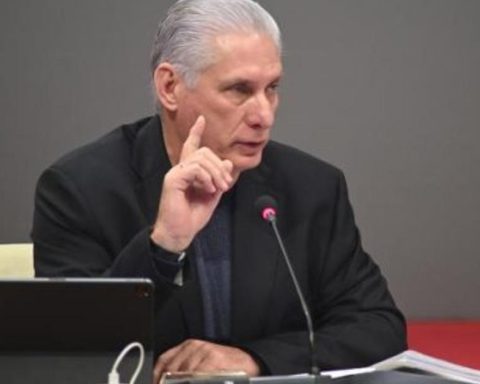
The text was published this Monday on the Foreign Ministry’s website with the title Statements by the Vice Minister of Foreign Affairs Josefina Vidal Ferreiroalthough according to the American agency Associated Press it is a response to its request for information regarding what was disclosed by Reuters. The British agency cited two sources with direct knowledge of the matter according to those who “some members of the Cuban regime” spoke with their American counterparts about what “a world without the Maduro regime” would be like.
“Cuba rejects as absurd and false the press reports that claim alleged contacts between Cuban officials and the United States Government to address internal matters that only concern the Government of Venezuela,” underlines Josefina Vidal. According to their statements, these are “warrior sectors” that act in the context of “aggression and threats of war” against the “sister” Republic.
“Cuba rejects as absurd and false the press reports that claim alleged contacts between Cuban officials and the United States Government to address internal matters that only concern the Government of Venezuela”
The statement does not miss the opportunity to also deny “the attempts to stain its clean record of fighting for peace in Latin America and the Caribbean and against drug trafficking.” Without mentioning it, it is clear that it refers to Hugo’s testimony The Chicken Carvajal, former head of Venezuelan intelligence and currently imprisoned in the United States, who in a letter written last week accused the Cuban regime of being involved in a drug trafficking strategy against the United States.
“United States specialized agencies know first-hand the effectiveness of Cuba in combating drug trafficking, since they directly benefited, until the Secretary of State, Marco Rubio, ordered to unilaterally cut off dialogue and cooperation in matters of migration and law enforcement,” argues Vidal.
Since Washington and Havana resumed bilateral relations in 2015 during the mandate of Presidents Barack Obama and Raúl Castro, the parties began to have bilateral dialogues on drug trafficking, conversations that were held during the first terms of Donald Trump and that of Joe Biden. This event had as a precedent the Liaison of the Coast Guard in the United States Interests Section in Havana in June 1999, when the cooperation began. Despite the disagreements and ruptures in other areas, the exchanges continued to be held until just a year ago, in December 2024.
Carvajal, in the letter addressed to Donald Trump himself, accused Chavismo of having organized together with Havana decades of narcoterrorism operations, cooperation with guerrillas and electoral manipulation, going so far as to maintain that the plan “was suggested by the Cuban regime to Chávez in the mid-2000s.” In addition, he stated that Cuba was key in the construction of the so-called Suns cartel – whose existence Venezuela denies – and said that the Island has provided strategic advice, also in the creation of criminal groups such as the Aragua Train.
Carvajal fled Venezuela in 2017 and spent several years in Spain, from where he was extradited to comply with US justice, where he is accused of four criminal charges that he has admitted, including narcoterrorism.
As soon as the content of their accusations became known, officials from the Ministry of the Interior and Justice appeared at a press conference before the international media last Thursday to deny any involvement. “Cuba is neither a producer nor a transit country for drugs,” they stated, without referring to Carvajal’s letter.
Juan Carlos Poey, head of the Interior’s anti-drug body, described the United States military presence in the area as “a serious threat to the security and sovereignty of Cuba” and accused the neighboring country of being responsible for “the synthetic drugs that circulate today” on the Island.
In a calmer tone, the second chief of the Border Guard Troops recalled the years of collaboration between the Governments on both sides of the strait. “We exchange information in real time with the US Coast Guard. We give them the position, course and characteristics of the drug vessels,” he alleged.
In this case, the retired general does not add anything new about Cuba, of which he limits himself to saying that his intelligence has trained Maduro and influenced his activities.
Now, another former Venezuelan soldier imprisoned in the United States for drug trafficking, Cliver Antonio Alcalá Cordones, has chosen to follow Carvajal’s strategy and has written a second letter in which he provides his version of the events. In this case, the retired general does not add anything new about Cuba, of which he limits himself to saying that his intelligence has trained Maduro and influenced his activities.
Alcalá Cordones, who in 2024 was sentenced to 260 months in prison for providing material support to the Colombian FARC guerrilla in relation to arms trafficking and the protection of cocaine shipments, defends that the Delcy brothers and Jorge Rodríguez, vice president and president of the National Assembly, respectively, are the real brains of the Soles cartel.
In addition, he adds that conversations and negotiations took place in Venezuelan prisons between senior officials of the regime and gang criminals, including the Tren de Aragua. Ties to the Lebanese terrorist group Hezbollah, illegal mining to launder drug money and electoral manipulation are also cited in the letter.
The Foreign Ministry’s statement now comes as a reinforcement of what was said at that press conference, which occurs in a context of maximum pressure from Washington on Caracas. “Any attempt to use the current scenario against the Bolivarian Revolution to question the invariable and firm support of our people and Government in these dangerous circumstances for Latin America and the Caribbean will be useless,” the text closes.