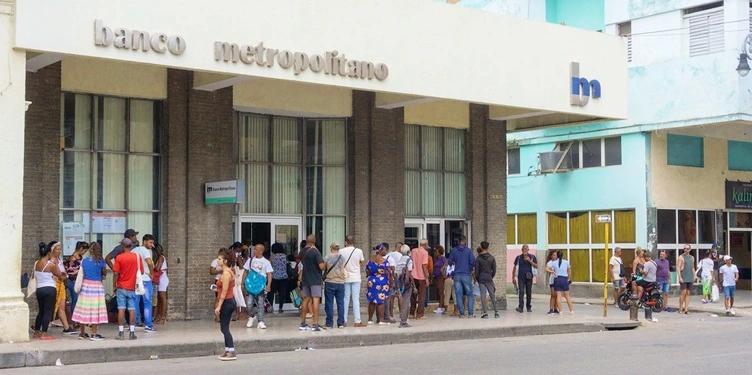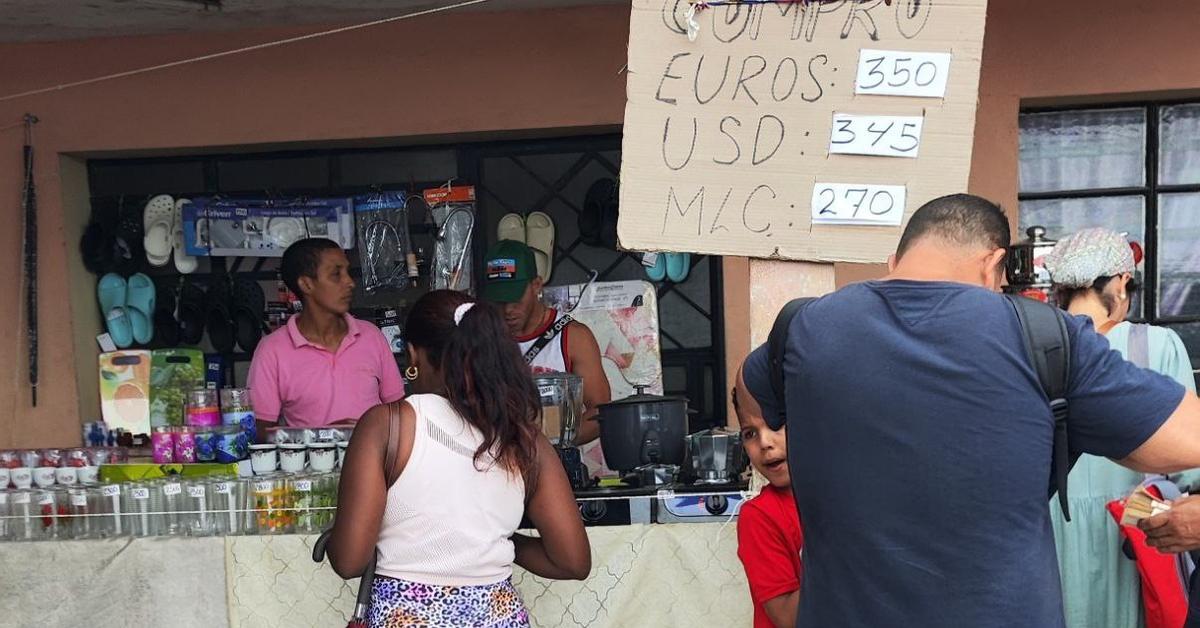
Madrid/Most Cubans had only one doubt this Thursday when they found out that there was a new legislation which deepens the “partial” dollarization of the economy. How is the exchange rate? That question, the one that mattered most, remains unanswered for the moment.
The Minister of Economy Joaquín Alonso Vázquez admitted it in a Round Table to explain the measurements. “A recurring question is whether the rate is at 120 or at what rate. So, before you ask it to me, I think the people need to know that we are also working in that direction,” he rambled, ending by saying that “as the prime minister has explained in other events, they are working on a reorganization of the exchange market that takes into account all the peculiarities and problems and distortions that the economy has, as part of the Government Program.”
This new Ordering Task, which does not say its name, is in practice an amendment to the entire previous one decreed in January 2021. It is the opinion, among others, of the Cuban economist Pedro Monreal, who this Thursday made the first dissection of the documents published a few hours before. “A preliminary reading suggests that the Cuban Government categorically ignores the monetary unification of the ‘system’ and self-mutilates its function of defending the Cuban peso,” the expert reproaches. Its first assessment is almost a quick look at the changes in the standard, although its title could not be more revealing: More dollarization as a steroid for a collapsed Cuban economy.
“A preliminary reading suggests that the Cuban Government categorically ignores the monetary unification of the ‘system’ and self-mutilates its function of defending the Cuban peso”
This is the idea also supported by his colleague Mauricio de Miranda Parrondo, who considers disdain for the Cuban peso “harmful to national sovereignty.” The expert relies on the statements he has made throughout his career regarding other experiments in “monetary duality”, a practice that goes – he highlights – against the very principles of the Revolution, as it creates two social classes.
Miranda Parrondo defends – as was evident – that the ordering task did not reflect the market conditions and, furthermore, it only served to “skip” those who had their currencies deposited in CUC. Now, this new plan is reached by appealing “once again” to dollarization with “new bureaucratic mechanisms aimed at continuing the policy of rent extraction.”
The economist considers that this time the ruling is not only economic, but political, as it is “a death blow to the Cuban peso as a national currency”, by abounding in the depreciation of the CUP to the extent that dollarized spaces increase. Centralization and discretion do the rest. “Cuba has never had a leadership so incompetent, so irresponsible and so mediocre, but which has also exceeded all limits of insensitivity with the tragedy that the country and especially the working people and retirees are experiencing,” he laments.
Pavel Vidal, researcher at the Observatory of Currencies and Finance of Cuba (OMFi), signs a monthly bulletin this Friday in which he issues his considerations on the matter. “The Government seeks to weaken the structures of the informal market, but without yet launching an alternative for the formalization of exchange operations of remittances, imports from MSMEs and other currency flows,” he highlights. Among the aspects with which he is most critical is the discretion of the measures – through “special authorizations” –, the extraction of income that, in his opinion, is carried out on private individuals and, of course, the doubts that it does not clear up.
“It will be necessary to see if the Government provides any information on the functioning of the foreign exchange market and the future floating exchange rate: whether the new rate will start from levels close or not to the informal market; the degree of flexibility and discretion of the Central Bank in the management of the rate; if banked exchange operations are going to be enabled for the population (or only in cash); if they will impose quantitative limits on the purchase and sale; the collection objectives pursued by the Government; the degree of transparency that they will offer; and if the launch of the scheme is accompanied by other coercive measures against the informal market,” he summarizes.
The consulting firm Auge, run by Oniel Díaz Castellanos, which advises companies and self-employed workers, is thinking about it. For this Friday, he has called a meeting on-line in which how the changes affect the sector will be discussed. Also from Havana, entrepreneur Yulieta Hernández is clear: “It’s more of the same.” In his opinion, there is discretion in the measures, in the absence of further clarification, but the biggest problem is that the number of businesses in foreign currency will increase. “This creates an uneven terrain and pushes even more towards the informality of the exchange market,” he emphasizes, since there is a shortage of currencies that will be more in demand. The co-founder of the virtual platform Te Enteraste predicts “more poverty for families” and wonders, like so many, at what price the bank will buy the currency.
The regulatory package comes into force on the 17th, just one before the shortened version of the ordinary session of the National Assembly is held. The parliamentary event has been reduced – in the image and likeness of that of the Central Committee of the Party and following, for once, citizen demand – to a single day in which there could be clues about the famous floating rate that Marrero promised for 2025 and that, today more than ever, the people demand to know.
The minister’s explanations last night on Cuban Television did not offer more light than the reading of the document itself, although Alonso gave compelling reasons for approving it, ranging from the need – undisguised – to collect foreign currency to facilitating the chaining and legalization of foreign currency accounts for MSMEs – prior authorization – to acquire raw materials and deposit the income obtained from the export of their products.
The regulatory package comes into force on the 17th, just one before the shortened version of the ordinary session of the National Assembly is held.
However, the new measures are applied differently depending on the ownership of the company. “For actors in the external sector,” including mixed capital companies, “the rule is that they retain 100% of the foreign currency they generate or contribute.” On the other hand, state companies, which receive subsidies from the State, will have “self-financing schemes on a case-by-case basis, which allow them to retain the foreign exchange necessary for their simple reproduction, that is, to maintain their production cycle and continue exporting.”
“The general rule for forms of state management is that they can retain 80% of foreign currency income from exports or productive chains,” adds Alonso. MSMEs and the self-employed, who do not receive financing from the State, will only be able to keep 80% of the foreign currency received and must deliver the balance in exchange for national currency, at a rate that has not yet been defined.
The minister also pointed out as a triumph of the new regulations how much it can help private businesses with an example. “If a foreigner without pesos wants to pay in dollars, the restaurant, not being authorized to operate in currency, must deposit those dollars in its bank account, where the equivalent in pesos will be credited at the corresponding official exchange rate. This, although at the current time it may be less profitable for the owner than accepting dollars at an illegal market rate, seeks to establish discipline,” he noted, without taking into account, among other issues, the population’s distrust of a Government that has corrected itself in so many failed economic experiments.