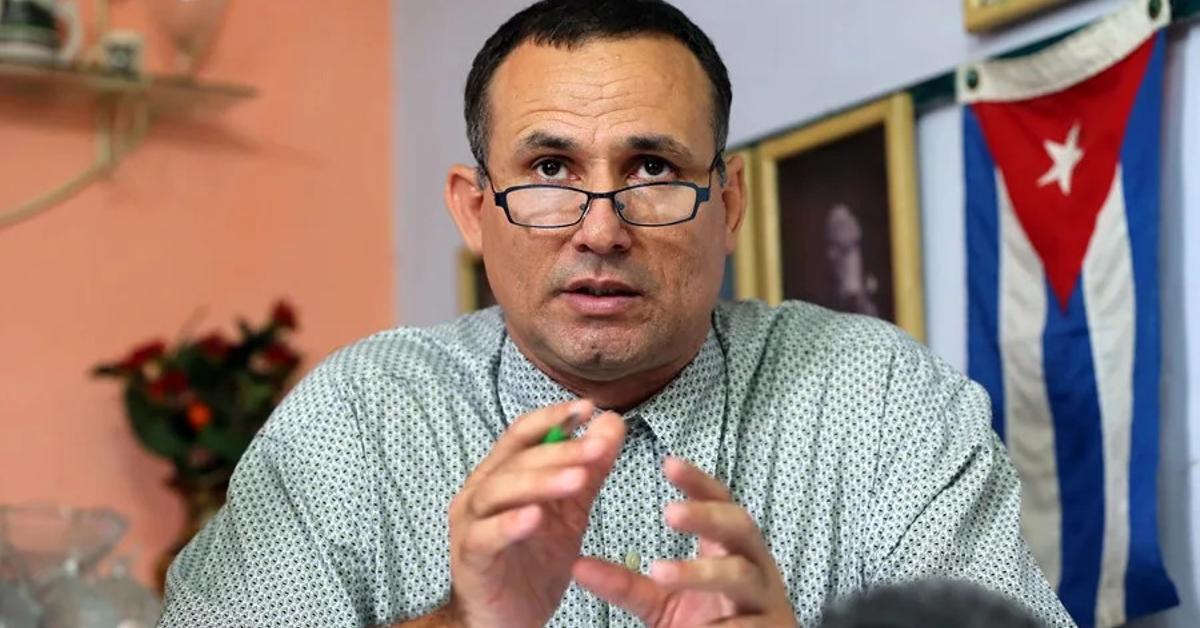
Havana/The Council for the Democratic Transition in Cuba (CTDC), one of the main articulation platforms of the Cuban opposition, announced this Monday the election of a new Executive for the period 2026-2028, in an internal process that marks the replacement of its historical president, José Daniel Ferrer, who he went into exile in Miami last October.
The new leadership is headed by the opposition Manuel Cuesta Morúa as president, accompanied by four vice presidents also residing within Cuba – Osvaldo Navarro, Juan Alberto de la Nuez, Marthadela Tamayo and Félix Navarro, the latter currently in prison – and two vice presidents abroad, Iris Ruiz and Elena Larrinaga. The management will formally assume its duties on January 10.
Ferrer confirmed to EFE that he will not be part of the new leadership of the CTDC, after having requested the call of internal elections and presented his resignation “from all his positions” within the organization. The opponent explained that his decision responds to the need to prevent his political activities from exile – which he defined as “non-violent in a broad sense” – from contradicting the profile of the Council, focused fundamentally on legal and institutional proposals.
Although he is leaving the presidency, Ferrer stressed that he will continue to be a member of the organization and support its initiatives. “We continue to be brothers and I support the actions of the Council,” he stated, in an attempt to convey continuity and avoid a reading of a formal break with the platform he presided over until now.
Ferrer also stated that his opposition activity is now focused on creating a census of dissidents on the island and in exile.
In a statement spread on Facebookthe CTDC Electoral Commission highlighted that the voting took place between December 11 and 15, “in difficult conditions of communication” and in a general environment that does not favor, from the regime, “free citizen expression.” Of a register of 46 voters – including organizations and independent people – 63% participated, a figure that the Council described as an achievement given the circumstances in which the opposition operates within the Island.
The statement emphasizes that the process was “organized, plural, democratic and legitimized” and that it responds to one of the founding aspirations of the Council: to allow its members to express, through voting, diverse priorities and concerns within the same political space.
The change in the presidency coincides with a new moment in the career of Ferrer, 54, who left Cuba more than two months ago for the United States after spending several years in prison for his opposition activity. During that time he was considered a prisoner of conscience by Amnesty International. From Miami, the leader of the Patriotic Union of Cuba (Unpacu) assured that his priority would be to work for the unity of the Cuban opposition, both inside and outside the country, a historically elusive objective, marked by deep internal divisions.
Ferrer continues to lead Unpacu, one of the opposition groups with the most recognized trajectory within the country.
In his statements to EFE, Ferrer also stated that his opposition activity is now focused on “mobilizing political, social and humanitarian activity” within Cuba, as well as creating a “census” of dissidents on the island and in exile. This record would serve, as he explained, as a basis to try to organize opposition primaries and move towards the formation of a “common front.”
Ferrer’s departure from the presidency of the CTDC also highlights the difficulties faced by the Cuban opposition. Those who act from inside the country are subject to strong repression; and those who do so from exile, with greater room for political maneuver, tend to have less capacity to directly influence the daily life of the Island.
Ferrer himself assumes this tension by justifying his resignation with the need not to interfere with the work of the Council, whose agenda includes projects such as a proposed amnesty law and decriminalization of dissent, initiatives against violence and the organization of citizen assemblies for political dialogue. The CTDC has also tried, without visible results, to promote Vatican mediation in relations between Cuba and the United States.
Ferrer continues to lead Unpacu, one of the opposition groups with the most recognized trajectory within the country. In Cuba, it should be remembered, the only legal political organization is the Cuban Communist Party, which turns any attempt at opposition confluence into a precarious, monitored and permanently criminalized exercise.