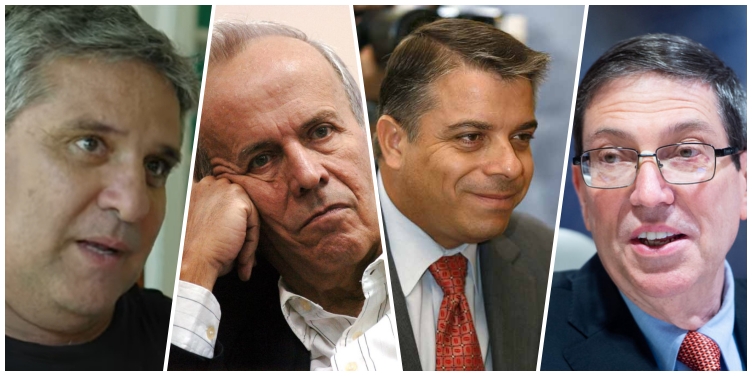
From Raúl Roa to Bruno Rodríguez, the foreign ministers of the Cuban regime since 1959 have been infamous characters in their own right.
HAVANA, Cuba – Raúl Roa was the only chancellor worthy of that title that the Castro regime has had. None of his successors – Isidoro Malmierca, Ricardo Alarcón, Roberto Robaina, Felipe Pérez Roque, Bruno Rodríguez Parrilla – has managed to even remotely measure up to him.
Roa, whom Fidel Castro called “the Chancellor of Dignity,” had a difficult time, including the Bay of Pigs and the Missile Crisis. Despite his outbursts when he defended the Castro regime like an upside-down cat, he was a brilliant diplomat. What did it matter that on a memorable occasion, at the UN, he described his opponents as “hidewhores” if Khrushov, in the same scenario, took off his shoe and banged on the table? These were things from the Cold War.
Roa held the position of Minister of Foreign Affairs until 1976, six years before his death, in 1982, at age 75. He was replaced by the grayish veteran of State Security Isidoro Malmierca. In 1992 Ricardo Alarcón took over. But Alarcón lasted less than a year in office. According to what they say, Fidel Castro disliked him, and preferred to send him to direct the fine and always unanimous choir of the National Assembly of People’s Power.
In 1993, Roberto Robaina, whom Fidel Castro affectionately called Robertico, was appointed Minister of Foreign Affairs. Robaina was anything but boring. With his appearance as a salsa singer, he performed the staging for a representative of the new man of “socialism with pachanga” that Roa said with his pungent humor.
During his time as leader of the Young Communist League, in the midst of hunger and blackouts during the Special Period, Robaina tried to make the official discourse drinkable for youth, translating it into popular slogans that filled walls, t-shirts and banners. He organized massive troubadour concerts and timberos in the Plaza de la Revolución. He gave the unusual spectacle of seeing the big body of the Maximum Leader jump, with tape on his forehead like Bruce Springsteen, the stands shaken by his boots, to Robertico’s shout of: “He who doesn’t jump is a Yankee!”… But as Minister of Foreign Affairs, Robaina fell short. They say that he became involved in episodes of corruption and ended up in shock, in his pajamas, as a painter, selling his paintings in dollars.
Robaina was replaced at MINREX in 1999 by a zocotroco: Felipe Pérez Roque. He was chosen by the Maximum Leader, who called him Felipito and claimed that he was the one who best interpreted his thoughts. It would be because, like a talking robot, he did not deviate a line from the original script that the dictator wrote.
In his duties as chancellor, Pérez Roque, even though he wore expensive suits, was reminiscent of one of the pigs from “Animal Farm.” In the absence of arguments, he made faces and lavished epithets and insults. Once, he snorted and grabbed his fly because some journalists questioned him in Paris about the 75 prisoners of the repressive wave of the spring of 2003, which, according to what he never tired of repeating, were “mercenaries who conspired in the service of a foreign power.”
The greatest success of Pérez Roque’s thuggish diplomacy was getting the European Union to raise the Common Position in exchange for nothing, or almost nothing, because that was what the promises made to Spanish Chancellor Moratinos were reduced to. Pérez Roque did not make much effort to deceive the European Union, which, eager to believe in his few promises, enrolled in a constructive commitment to the Cuban dictatorship.
Pérez Roque’s biggest nonsense was when he announced his willingness for Cuba to join Venezuela in a Bolivarian Confederation under joint aegis. by Fidel Castro and Hugo Chávez.
In 2009, Pérez Roque fell from grace, was accused of being “intoxicated by the honey of power” and was dismissed. He was replaced by Bruno Rodríguez Parrilla, who has been in the position for 16 years, making him the longest-serving head of MINREX after Roa, who served for 17 years. And it doesn’t seem like he’s going to be replaced at the moment, because you shouldn’t change horses in the middle of a swollen and troubled river.
With his tired anti-American singsong, Rodríguez Parrilla has turned out to be the most boring and monotonous of the Castro regime’s foreign ministers. And also the most blatant liar, to the point of denying that there are political prisoners and people who are hungry in Cuba.
The chancellor of the late Castro regime continues to present resolutions every year at the UN on the need for the United States to lift the embargo, making a rare account of the several hundred million dollars that, he claims, Cuba has lost due to the blockade, and advocating that the State Department withdraw Cuba from the list of countries sponsoring terrorism. The rest of the time he dedicates, whether it is relevant or not, to expressing the solidarity of the regime he represents with the worst causes: Hamas, the Iranian ayatollahs, Putin, Maduro, Daniel Ortega.
Paradoxically, the improvised and botched diplomacy of Robaina, Pérez Roque and Rodríguez Parrilla has reaped more triumphs than that of Raúl Roa. Roa’s times were those of Cuba’s isolation from the international arena. Under his successors there have been majority votes in the UN against the North American embargo, the dictatorship has managed to weather international condemnation and, most incredible, Cuba was admitted to the UN Human Rights bodies.
This has been due more than to the questionable diplomatic skills of the Cuban foreign ministers, to the open complicity of other dictatorships and left-wing politicians, investors and intellectuals, many bribed, blackmailed or influenced by Castro’s agents of influence, in addition to the passive complicity of the naive and indifferent.