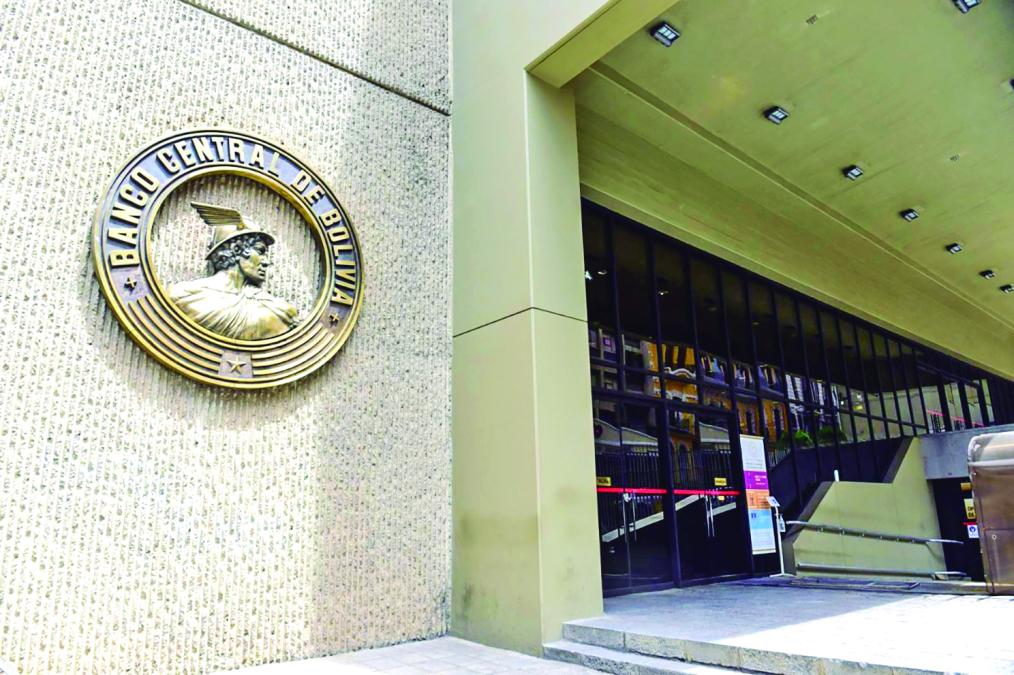
In a context of currency shortage and with a parallel dollar already consolidated in the market, The Central Bank of Bolivia (BCB) maintains commitments to private bank for more than US 2.7 billion (Bs 18,773 million), of which only US 100 million liberated (Bs 700 million), that is, only 3.7%.
In theory, these resources – constituted as legal guarantees or lace – serve as a mattress against emergencies or financial imbalances. However, A significant part has remained immobilized, even at a time when financial institutions face difficulties to meet the demand for dollars of your customers.
It is only enough to remember that, in May 2024, The Private Banks Association of Bolivia (Asoban) asked the issuing entity with the return of part of these funds “Originally entered into currencies,” to respond to the public. In 2023, the figure owed by the BCB reached $ 2,856 million.
In response to this medium, The BCB clarified that these operations do not represent a debt of the entity, but an obligation of financial intermediation entities (EIF) that took BCB loans and delivered guarantees in dollars.
“When EIF pays the resources provided, The BCB will return the committed guarantee, in line with the legally established expiration”, Said the entity. According to its 2024 balance, the financial system maintains a debt to the BCB for Bs 14,607 million (US 2,098 million).
These operations are linked to four valid liquidity loan funds: productive and social interest housing credits (CPVIS II and CPVIS III); Incentive to the use of electrical and renewable energy (Fiuseer) and credits for the productive sector (CPRO).
The BCB said that These instruments were created between 2017 and 2023, with resources arising from a reduction in legal lace and voluntary contributions from the banks themselves.
On the deadlines, the issuing entity confirmed that the returns are scheduled until March 2026, a term set since July 2023, with the purpose of giving the banks enough time to honor the loans they took.
The recent return of BS 700 million was presented by the BCB as an “liquidity optimization”. However, in practice it represents a minimum fraction of the compromised resources and arrives at a time when the demand for foreign exchange exceeds the offer.
To this is added another key measure: The BCB modified the “change position regulation”, reducing the dollar limit from 50% to 40% that banks can have in relation to their heritage. It also expanded the use of instruments in UFV, a account unit in Bolivians adjusted by inflation. This strategy, according to the BCB, seeks to strengthen the stability of the financial system and the national currency.
The issuing entity report also warns that the year 2024 was especially difficult, marked by extreme climatic phenomena, international conflicts and internal blockages, all factors that affect both foreign trade and currency flow.
Despite this, the official reading is optimistic. The resistance tests carried out by the BCB conclude that the system can support “extreme shocks”, although without offering details on how scenarios were faced such as a run for dollars or greater restrictions on currency access.
Analysis
Economist Carlos Aranda warns that the Central Bank of Bolivia (BCB) will be forced to obtain external financing in dollars If you want to avoid a liquidity crisis in the financial system. As he explains, the BCB must return around $ 2,500 million to the financial entities, amount that corresponds to legal lace, voluntary deposits and investments in instruments issued by the entity itself.
“Yes or yes, to lift restrictions in the financial system, especially in dollars, the BCB has to return that money to commercial banks,” said Aranda. If not, he warned, an eventual exchange unification – for example, at Bs 15 per dollar – could cause a massive withdrawal of deposits and put the stability of financial entities at risk.
At the moment, Fixed term deposits have been falling before unattractive interest rates against inflation. According to the analyst, banks do not have enough liquidity to face a massive retirement of funds. This situation has increased the distrust of savers and given what many call a “financial corralito” in dollars: customers who cannot freely dispose of their money.
Aranda estimates that Bolivia will need at least $ 7,000 million in 2026 to cover key obligations such as: $ 2,500 million for the return to commercial banking, $ 2 billion for fuel importation. In addition, $ 1.9 billion in external debt payments, and between $ 1,000 and 1.5 billion to cover the tax deficit of the next government.
“It is very difficult to get that amount of money in a single year,” he said, and warned that the next government must prioritize a credible tax adjustment program, accompanied by external financing.
Obligation
The economist Germán Molina warns that the situation of illiquidity in dollars that affects the financial system has its origin in the improper use of legal lace deposited by commercial banks in the Central Bank of Bolivia (BCB). But its judgment, the issuing entity does not face a debt as such, but a “monetary obligation” derived from a policy that today compromises the confidence of the depositors.
“The legal lace is not a debt, it is a monetary disposition of the BCB. When a client deposited, for example, US 100 in a bank, he had to leave a percentage – let’s say 12% – as a guarantee in the central bank. That accumulated and Today it represents between $ 2,000 and 2.5 billion that the BCB has not been able to return when banks require it To fulfill your customers, ”he explained.
Molina said that when customers go to banks to withdraw their deposits, these entities must ask the BCB to return the corresponding legal lace.
But the Central Bank does not have these funds, since it would have used them in other expenses, whose destination has not been transparent.
As a consequence, Banks can only return small weekly quantities, between 50 and 100 dollarswhich has fed distrust in the system.
To solve this situation, Molina argues that the BCB must be capitalized with dollars. “The only exit is for the Central Bank to receive external resources to replenish those amounts to the banksand so these can return the money to their customers. Only then can trust and credibility be restored in the financial system, ”he warned.
For Molina, President Arce’s current government does not have the ability to implement a solution, due to the lack of currency. “A return policy will hardly be adopted in what remains of its management. Everything indicates that this must be resolved as of November 8, when the new president assumes,” he said.
Molina also explained that the legal lace policy is common throughout the world and serves as support in case of liquidity problems. In the Bolivian case, the non -transparent use of these resources by the BCB has generated a bottleneck.
“It is not known with certainty what the funds were used,” he said.