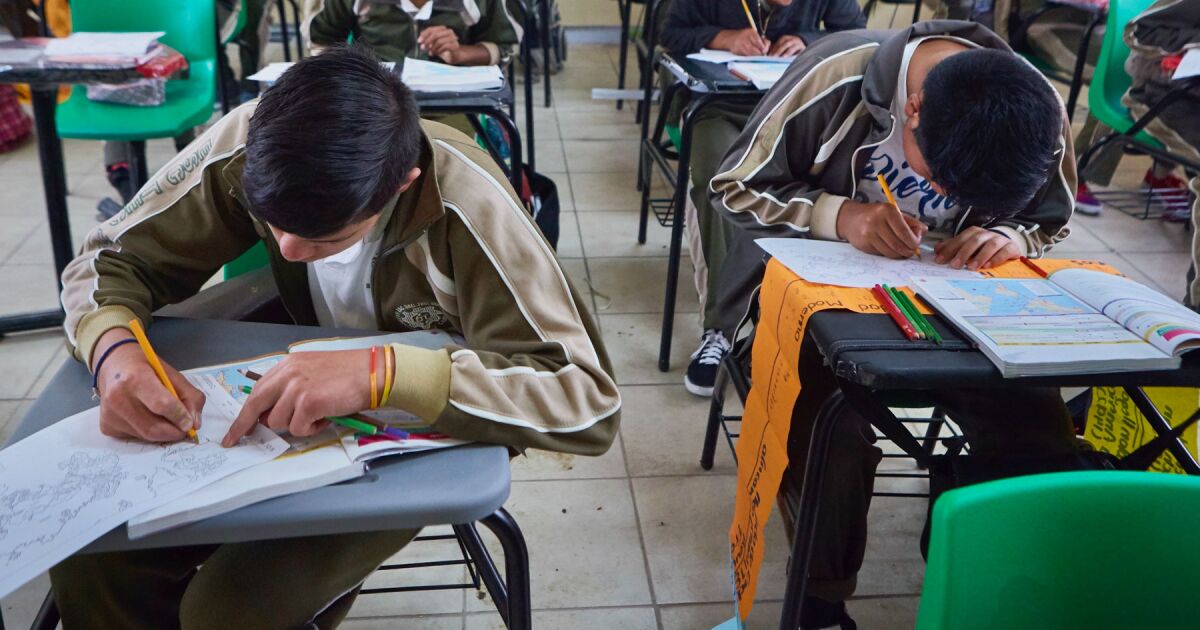
Between 2024 and 2025, 2.5 million young people were left out of high school. The main reason for dropping out is the need to look for a job, so the provision of scholarships here has been essential for young people to stay in school.
“Government scholarships have contributed to improving results at this educational level, since terminal efficiency—percentage of students who enter and manage to complete the educational level—increased from 66.7% in 2019 to 76.3% in 2024,” notes the IMCO.
But it is necessary to implement greater efforts to ensure that coverage in upper secondary education is 66% and terminal efficiency reaches 85%, as the federal government has set a goal.
Higher education spending
This educational level will have a budget of 181,000 million pesos in 2026, 4% less than in 2025.
“In 2026, more resources will be allocated to scholarships than to higher education,” says IMCO. Thus, higher education will reach the lowest level since (the year) 2000.”
However, the budget for scholarships at all levels will amount to 201,000 million pesos, that is, 10% more than the amount allocated to higher education.
Large public universities, such as UNAM, IPN and UAM, will have budget cuts of between 2 and 8%; while state universities, which already operate with shortages and few resources, will have 7% less budget.
In contrast, spending doubled for the Rosario Castellanos University, created in 2019 by President Claudia Sheinbaum, when she served as head of Government of Mexico City. 0.4% of students graduate from it.
“The goal of Plan Mexico will be difficult to meet without a budget. To add 150,000 additional graduates each year, it would be necessary to increase enrollment by 229,000 more students per school year. The lack of resources is reflected in the stagnation of enrollment and lower terminal efficiency, since for every 100 students who enter the university, 65 complete their studies,” explains the IMCO.