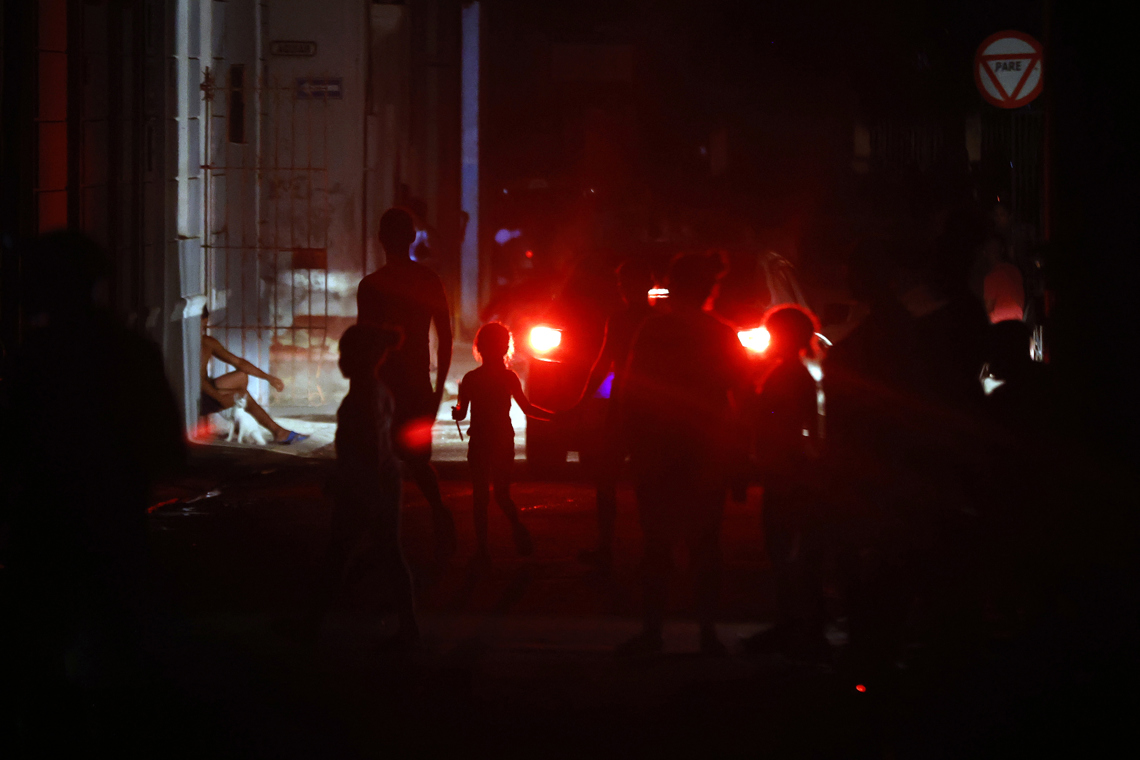
This Tuesday, Cuba will once again face prolonged blackouts throughout the national territory. During the hours of greatest demand, in the afternoon and evening, power outages will simultaneously affect 54% of the country, according to data from the Electrical Union (UNE).
With this scenario, the island resumes impact levels above 50%, a trend that marked a good part of 2025 and that at its most critical point reached 62%, after a few days at the end of the year with less severe service interruptions.
According to the UNE, attached to the Ministry of Energy and Mines, for peak consumption a generation capacity of 1,533 megawatts (MW) is expected compared to a maximum demand of 3,300 MW, which represents a deficit of 1,767 MW. The estimated impact—the energy that will be disconnected to avoid disorderly blackouts—will amount to 1,797 MW.
The situation responds, fundamentally, to the State’s shortage of foreign currency to import fuel and the deterioration of thermoelectric plants, many of them obsolete. Currently, seven of the 16 thermoelectric units are out of service due to breakdowns or maintenance. This source contributes around 40% of the country’s energy mix.
Added to this is the fact that 97 distributed generation plants, based on engines, remain inactive due to lack of diesel and fuel oil. The outlook is aggravated by uncertainty following the recent US attacks that led to the capture of Nicolás Maduro, president of Venezuela, Cuba’s main fuel supplier.
Independent experts point out that the energy crisis is a consequence of chronic underfinancing of a sector that has remained under state control since 1959. External estimates estimate that between 8 billion and 10 billion dollars would be necessary to rehabilitate the national electrical system.
The Cuban Government, for its part, attributes the situation to the impact of US sanctions and accuses Washington of promoting “energy asphyxiation” against the island.
Prolonged blackouts continue to weigh down the Cuban economy, which has contracted 11% in the last five years and will close this year again in negative numbers. Furthermore, they have been one of the main triggers of the most significant social protests of the last five years.
EFE/OnCuba