By Alicia SintesProfessor of theoretical Physics and principal investigator, University of Les Illes Balears
On September 14, 2015, it dawned like any Monday, but ended up changing our way of observing the universe.
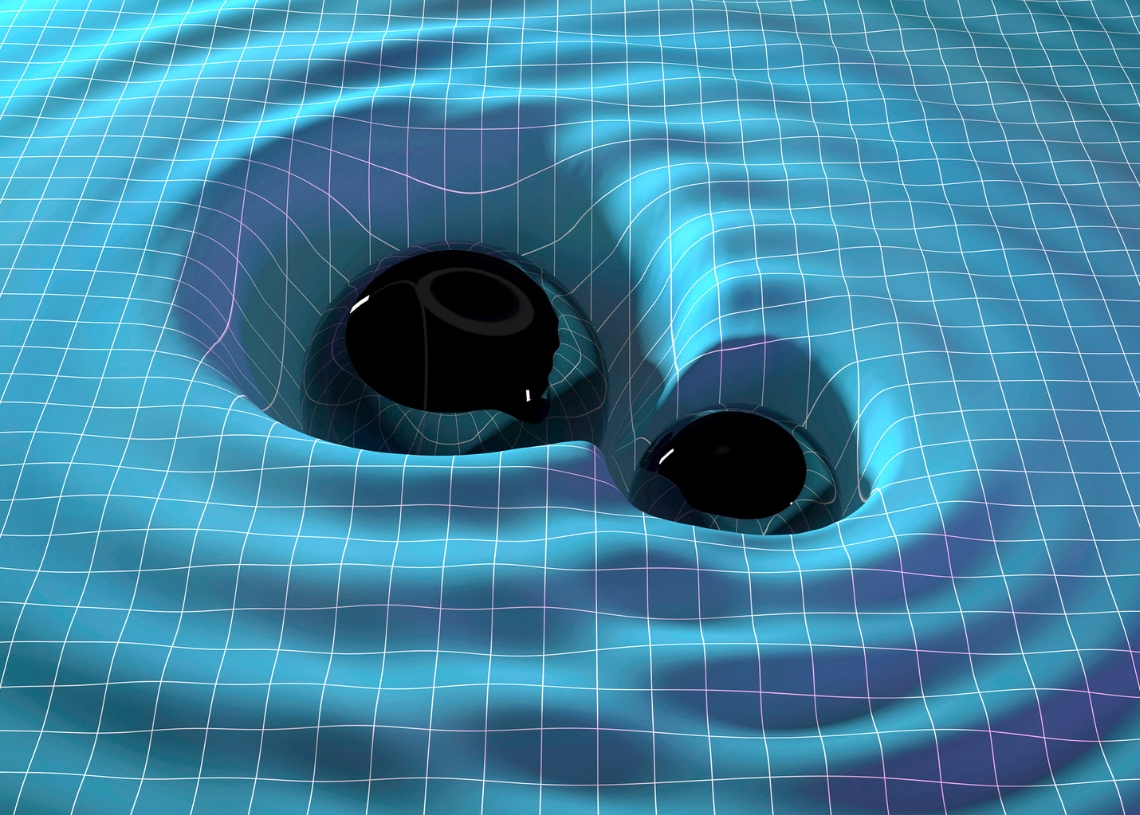
That morning, the two detectors Ligo (Laser interferome gravitational-wave observatory)in the United States, they first registered an unequivocal signal of gravitational wavescaused by the collision of two black holes. The signal, very short and crisp, was as surprising as expected. After decades of search, an echo of just two tenths of a second was enough to open a new era in astronomy.
The gravitational physics group (Gravity) of the University of the Balearic Islands participated in this historic success for astrophysics, of which a decade is fulfilled. The finding surprised us all: expected, yes, but also unusual in its forcefulness.
https://www.youtube.com/watch?v=C-2xiunfgd0
Einstein’s prediction
The weeks that followed were intense emotion and frantic work for those who participate in their analysis, aware of living a historical moment. Beyond confirming A key prediction of Albert Einstein’s general relativity theorythe detection opened an unpublished window to the cosmos: the astronomy of gravitational waves, which allows us to listen to invisible phenomena for traditional telescopes. Einstein never knew if these waves could be detected one daybut its existence was confirmed a hundred years after its prediction.
This advance was comparable to milestones as the demonstration of the Expansion of the universe through optical astronomy or the Microwave cosmic background discovery Thanks to radioastronomy. In each case, a new “window” has allowed us to discover unsuspected aspects of the cosmos.
What are gravitational waves?
Gravitational waves are tiny undulations in space-time tissue, generated by accelerated matter. They are born in some of the most extreme stages of the cosmos: mergers of black holes, collisions of neutron stars or explosions of supernovas. Even Big Bang himself He could leave his echo in the form of these waves.
Unlike light, which can be absorbed or blocked by dust and interstellar gas, gravitational waves cross the universe practically without altering. They are direct messengers of the phenomena that originate them.
But capturing them is extraordinarily difficult. The distortions they produce are so small that they modify the distances in less than a fraction of the size of a proton, even after traveling for billions of years.
To detect them, instruments of unprecedented precision are needed: Laser interferometers like Ligo and Virgocapable of measuring tiny variations in the distance between mirrors separated by several kilometers.
The first milestone: GW150914
As we said, the first signal, baptized as GW150914was detected on September 14, 2015. Its origin was the fusion of two black holes of about 30 solar masses each, located at 1,300 million light years from the earth. In just a fraction of a second they released as much energy as the one that would result from converting three soles into gravitational radiation. The signal lasted 0.2 seconds, but it was enough to revolutionize physics.
https://www.youtube.com/watch?v=157rfaqypcc
After months of rigorous analysis and verification – in which we participated from the University of the Balearic Islands – the discovery was announced on February 11, 2016 and held covers worldwide. It was celebrated as the birth of a new scientific discipline: gravitational wave astronomy.
Reasons for a Nobel Prize
In 2017, the Nobel Prize in Physics recognized this historical achievement, granting it to Rainer Weiss, Kip Thorne and Barry Barish. Weiss, who died last Augustit was a key figure: he devised the concept of the laser interferometer that would make detection possible and dedicated his life to convince the scientific community and the financing agencies of the importance of betting on this search. His vision and perseverance were decisive for Einstein’s dream to come true a century later.
The Nobel honored both these pioneers and the collective effort of hundreds of researchers who worked for decades to make it possible. Thanks to them, today we have a powerful tool to explore the cosmos. Weiss’s legacy transcends awards: his impulse has inspired new generations to be interested in physics, astronomy and technology. That his death coincides with the tenth anniversary of the first detection and the publication of new results gives this moment a special symbolism.
A new astronomy
In less than a decade we have gone from celebrating a first detection to register hundreds of signals. International collaboration Ligo-Virgo-Kagra He has observed above all mergers of black holes, but also collisions of neutron stars.
The most famous case is GW170817, detected in 2017: For the first time, the same phenomenon was observed simultaneously in gravitational waves, light, gamma rays and other signals. It was again a historical moment: the birth of multimailed astronomy, which allows us to look and listen to the cosmos at the same time, combining different windows to understand the same event from complementary perspectives.
https://www.youtube.com/watch?v=e8yt7O7bluc
Each detection has brought us a little closer to fundamental questions. We have tested general relativity in the most extreme limits, explored how black holes are born and evolved, and we have even encountered surprises, such as the Black Intermediate Masses Holesthat challenged what we thought about knowing about stellar evolution.
At the same time, the field has grown in an extraordinary way: today there are thousands of researchers and students from all over the world who work in this area, attracted by the emotion of participating in a young science that is redefining our way of exploring the universe.
This growth has brought with it a flowering of new ideas. Increasingly sophisticated analysis techniques have been developed – many of them based on artificial intelligence – and international collaboration has become an example of the power of global science. Not only have we opened a new window to the Cosmos: we have also promoted technological innovations and working methods that transcend their own fundamental research, with unexpected benefits for society.
The horizon is even more exciting
Terrestrial detectors – Ligo, Virgo and Kagra – continue to improve their sensitivity, which will allow weaker and weaker signals. In parallel, new generation projects are prepared as Einstein Telescope and Cosmic Explorertogether with the space mission Lisa (laser interferometer space antenna). With them we can study supermassive black holes, explore the first moments of the universe and even discover still unknown phenomena that could transform fundamental physics.
Our group at the University of the Balearic Islands will remain fully involved in this adventure. We do it with the accumulated experience of several decades, but also with the illusion and the new ideas that young researchers contribute each year. Participating in this global collective effort is a privilege and a constant source of emotion: we know that the best is yet to come.
A decade after that discovery that changed astronomy, gravitational waves continue to remind us that the universe has a lot to tell. And we have learned to listen to it.
Alicia Sintes He is a professor of theoretical physics and principal investigator in the University of Les Illes Balears.
This article was originally published in The conversation. Read the original.