Violence in demonstrations
Starting in 2021, episodes of violence intensified during various demonstrations in Mexico City, particularly around the protection of the National Palace and other historical buildings.
On March 8 of that year, the irruption of hooded people – identified as part of the so-called “Black Block” and unrelated to the feminist contingents – led to riots. On that occasion, the capital government identified several men who participated in the excesses, causing damage to businesses and Metro facilities.
The protests over the Ayotzinapa case, held every September 26, as well as the commemorative marches on October 2 for the Tlatelolco massacre, also recorded episodes of violence at different times.
(Photo: Cuartoscuro)
During Clara Brugada’s administration, one of the biggest crises occurred on July 4, when members of the “Black Block” joined the protests against gentrification and caused damage to businesses in the Roma–Condesa corridor.
After these events, the government issued a new protocol for handling demonstrations that included accompaniment by personnel from the Government Secretariat and the Human Rights Commission, in order to establish dialogue with the contingents and publicly demarcate the presence of hooded people or groups unrelated to the protests.
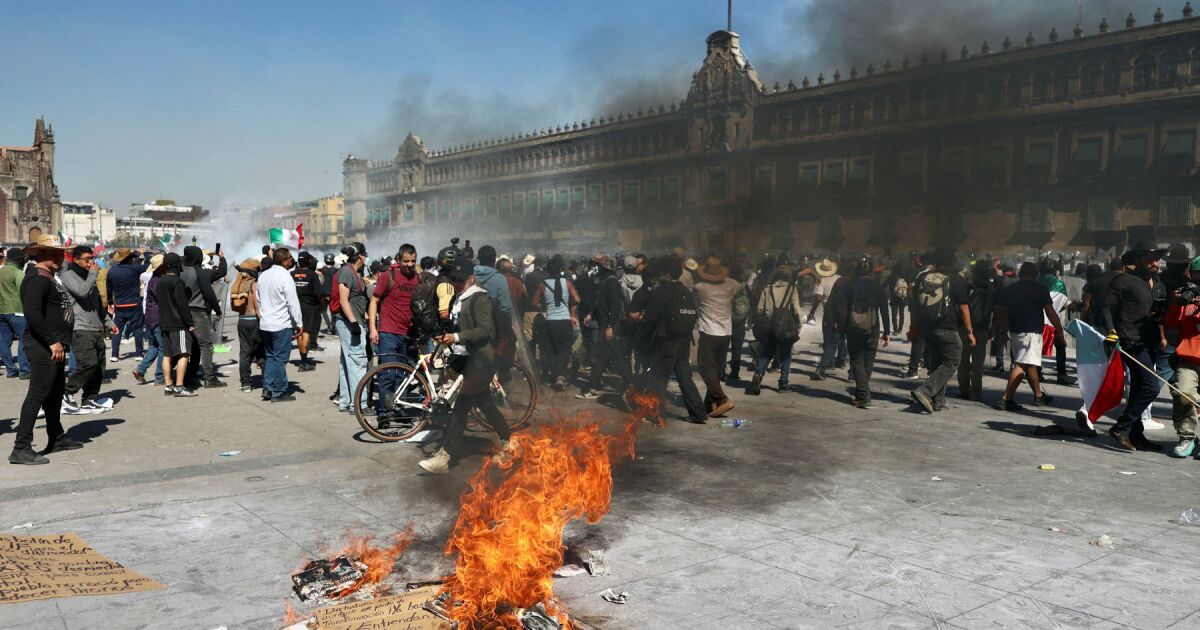
On October 2, during the march for the anniversary of Tlatelolco, riots and looting were again recorded in convenience stores, self-service stores and jewelry stores in the first square of the city. The confrontation between the so-called “Black Block” and police elements left 123 people injured, including civilians and agents.
The head of government announced that she will soon release relevant information about the participation of the “Black Block” in the demonstrations and the violence generated in this movement.
“Different types of violent groups that were acting have been identified. So, we want to make that very clear and take the opportunity to say that this is precisely the narrative that the opposition is proposing. Because their narratives were two: creating a false vision that there was a great movement of Generation Z, against the governments of the 4T. It is false, it is a lie,” he noted.
Sheinbaum eliminates grenadiers
On December 5, 2018, during her inauguration as head of government, Claudia Sheinbaum announced that one of her first administrative decisions was to order the Secretariat of Citizen Security to disappear the grenadier corps, then made up of nearly 3,000 elements.
Sheinbaum argued that this group, specialized in tasks of containment and reaction to protests, had been used for more than five decades to repress social movements, including the student movement of 1968 and the “falconazo” of 1971. Therefore, he stated that its dissolution represented a historical debt to the victims of those episodes.
“The elements of the grenadier corps will become part of other groups or a new group that will be created to help citizens in civil protection tasks, to care for the most vulnerable and to be trained in citizen protection tasks,” he said before former president Andrés Manuel López Obrador, deputies, senators and special guests in the Congress of Mexico City.

(Photo: Graciela López Herrera/ Cuartoscuro)
For the commemoration march for the massacre of October 2, 2019, Sheibaum announced the “Belts of Peace” which was a deployment of thousands of officials and employees of the Mexico City government, dressed in white, to protect the march from Tlatelolco to the Zócalo. Despite this, there were graffiti and some acts of vandalism.
Later the strategy changed, since the demonstrations were not accompanied by police with some type of protection, but by traffic elements.
After criticism, the president rejected that behind the violence of last Sunday’s demonstration were groups linked to Morena, a movement that, she said, was fought peacefully.
“Those groups do not belong to our movement (…) So no, it has nothing to do with that, it is part of this rhetoric that they want to do, but those groups have nothing to do with our movement. I repeat, we fight peacefully, peacefully,” he added.