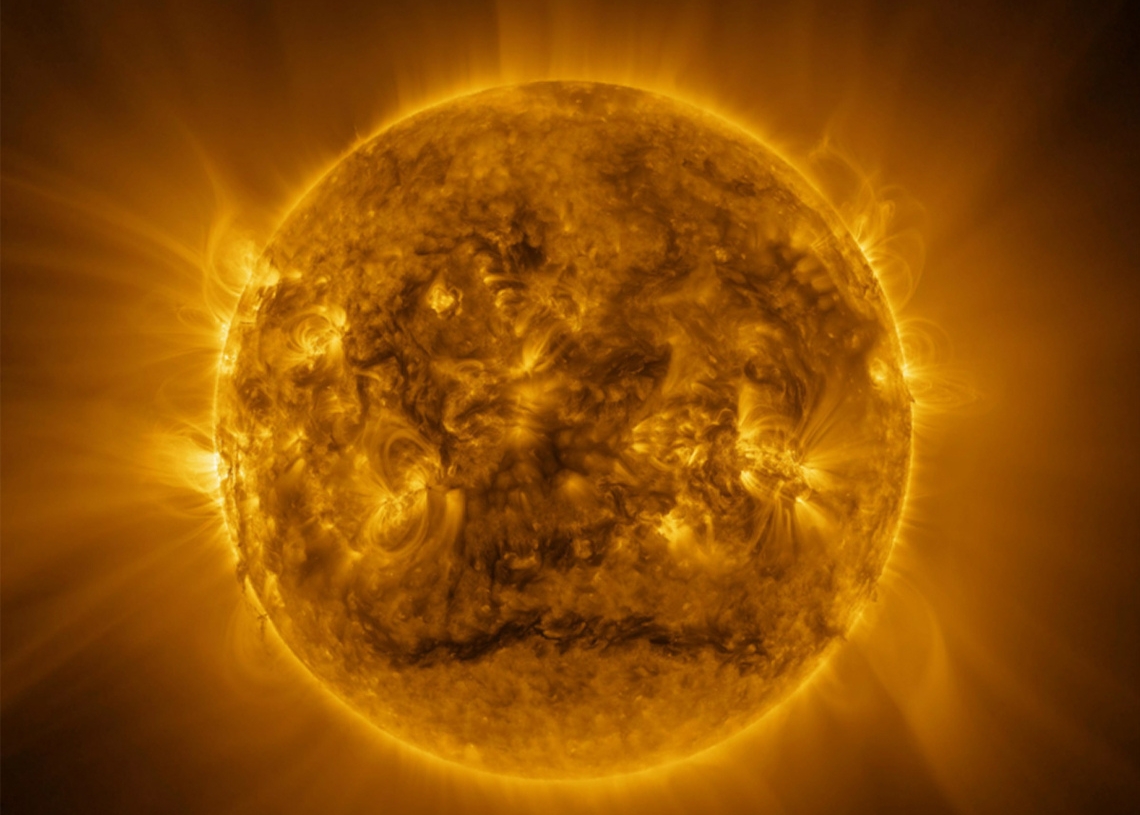
Last Tuesday, November 11 a geomagnetic storm cataloged as level G4, the most intense recorded so far in the current solar cycle, was perceptible in the Earth’s atmosphere. The phenomenon, which also occurred during the night of Wednesday and early Thursday, has caused some unusual events to be observed in the skies of the northern hemisphere.
The origin of the event is located in an active region of the Sun that produced multiple ejections in the previous days. The last of them moved at estimated speeds of 1,500 km/s, according to the European Space Agency (ESA), and impacted the Earth’s magnetic field between the night of Wednesday the 12th and the early hours of this Thursday, according to the newspaper. The Country.
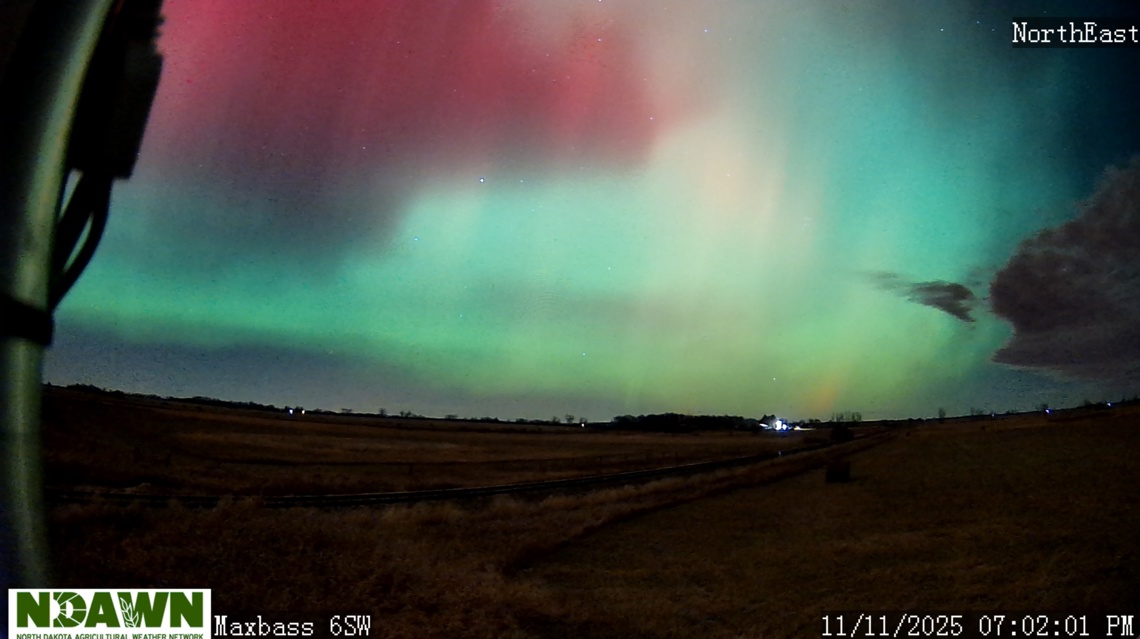
On Earth, the effects were visible: Northern lights were detected in latitudes such as northern Mexico and southern states of the United States, scenarios where this spectacle is usually extremely rare.
The specialized authorities have issued alerts in this regard: NOAA has classified the storm as G4 (severe) and warns of possible repercussions on satellites, navigation and electrical networks. In Spain and in middle latitudes, although Specific interferences were expected in GPS and high-frequency radio systems.no major damage to key infrastructure was reported.
This episode is part of the climax phase of solar cycle 25, which increases both the frequency and intensity of flares and coronal mass ejections from the Sun in the coming months.
However, it is not the first time it has happened nor has it been the most intense. In 1858 it happened the solar storm that until today is considered the strongest in history since the phenomenon has been monitored. The event, known as the “Carrington Event,” was so intense that the northern lights, known as the “aurora borealis,” could even be seen in Cuba, according to National Geographic.
Experts have warned that if a solar storm of that magnitude were to impact our current level of technological development—in which the Earth seems wrapped in a delicate cybernetic cocoon of electromagnetic waves—we could face a major electrical and satellite blackout, with significant consequences for communications, transportation and other essential services.
What are solar storms
According to the United States National Oceanic and Atmospheric Administration, solar storms —also called geomagnetic storms— are disturbances in the Earth’s magnetic field caused by coronal mass ejections (CMEs) or flares that occur on the surface of the Sun.
According to Brazilian astronomer Anderson Ribeiro, specialist in Solar System Astrophysics and professor at the Geraldo di Biase University Center in Brazil, “everything begins in the heart of the Sun.” The star, he explains, “is not a solid body, but a gigantic sphere of plasma in constant motion. Its differential rotation—the equator rotates faster than the poles—and the convective movements of the plasma feed an enormous internal dynamo that sustains the solar magnetic field.”
That field, however, is not stable: “it twists, tangles and stretches like a cosmic elastic until it finally abruptly connects. This reconnection releases a gigantic amount of energy and gives rise to the two phenomena that make up a solar storm: solar flares and coronal mass ejections (CMEs).”
“Eruptions are authentic explosive flashes that cover the entire electromagnetic spectrum, while CMEs are colossal “bubbles” of plasma — with billions of tons of charged particles — thrown into space at speeds that can reach millions of kilometers per hour,” the expert noted.
“When a CME is headed towards Earth, it interacts with the Earth’s magnetic field. If the CME’s magnetic field is oriented opposite to that of the Earth, magnetic reconnection occurs: a ‘gap’ opens in our natural shield and part of the Earth’s field is dragged towards the tail of the magnetosphere, storing energy. When that energy is released, enormous amounts of high-energy electrons are channeled toward the magnetic poles. As they spiral down and collide with oxygen and nitrogen atoms about 100 km high, they excite those atoms and produce light. Auroras are, precisely, that resulting glow: green and red tones of oxygen, and blue and violet tones of nitrogen, depending on the altitude and density of the atmosphere,” Ribeiro concluded in an interview via WhatsApp.
The intensity of a solar storm is measured on a scale ranging from G1 (minor) to G5 (extreme), according to the NOAA (National Oceanic and Atmospheric Administration of the United States) classification. Those of level G1 can cause slight electrical fluctuations. Those at level G4 or G5, like the current one, can have a significant impact on technological systems.
These storms are part of the normal solar cycle, a period of approximately 11 years in which the Sun’s activity waxes and wanes. Currently we are close to the solar maximum of cycle 25, which explains the increase in the frequency and intensity of these phenomena.
Aurora borealis out of place?
Beyond the spectacle of luminous color that we can see with the naked eye, the northern and southern lights are, in physical terms, the result of the interaction between charged solar particles and the Earth’s magnetic field. Normally, this phenomenon is concentrated near the Earth’s magnetic poles, which explains why they are mainly seen in Alaska, Canada, Scandinavia or southern Chile and Argentina.
When severe solar storms occur, such as the one perceived this November, the intensity of the particle flow can extend the “auroral oval” towards lower latitudes. This means that places where auroras are rarely seen — such as southern states in the United States, Mexico, and even some regions of Europe — can experience this spectacle.
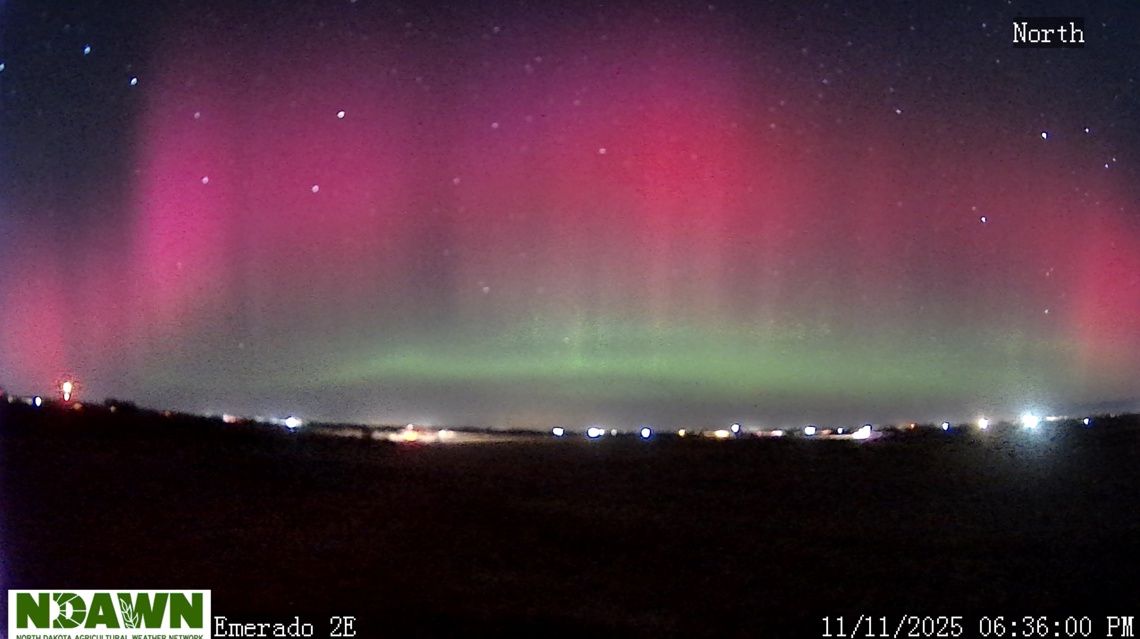
According to the Brazilian physicist and cosmologist Anderson Ribeiro “the resulting auroras [de las tormentas solares] They are brighter, faster, more agitated and have extremely vivid colors, including intense reds from oxygen at high altitude. Furthermore, the auroral oval expands and allows the phenomenon to be visible in mid-latitudes: Europe, the United States and, in especially strong episodes, even southern Brazil.”
Although they have some physical causes in common that make them similar, the expert consulted by OnCuba argues that the northern lights produced by solar storms are distinguishable from their counterparts visible at the poles. “The basic physics is the same, but the scale and intensity change completely. The usual auroras are generated by the ‘background’ solar wind, a constant and relatively smooth flow of particles at about 400 km/s. They produce weak, diffuse curtains, almost always confined to the auroral ovals near the poles, and many times they are so faint that they go unnoticed. In a solar storm, on the other hand, what arrives is not a wind, but a plasma wall: a CME with billions of tons of matter and a very intense magnetic field, traveling at speeds that can exceed 2000 km/s. Magnetic reconnection becomes violent, accelerating a massive flow of electrons towards the atmosphere,” highlights Ribeiro, whom the International Astronomical Union honored with his name on asteroid 31412 Andersonribeiro for his outstanding work in the field of solar astrophysics.
For skywatchers, these geomagnetic storms are a unique opportunity to see the polar lights without traveling to the extreme north or south. However, the phenomenon is not as harmless as it seems. Ultimately, the “displaced” northern lights that we were able to observe recently carry a warning message:
“The same geomagnetic disturbance that causes auroras to be seen at unusual latitudes is what represents a risk to our technological infrastructure. The aurora is only the visible symptom of an altered space environment. Its presence in mid-latitudes indicates that highly energetic particles are penetrating deep into the magnetosphere and reaching denser regions of the atmosphere. The problem is not the light in the sky, but the associated electromagnetic conditions: disturbances in satellites, interference in communications, overloads in electrical networks and errors in navigation systems, among other potential impacts,” Ribeiro told OnCuba.
A particularly active solar cycle
According to the Doctor in Astronomy from the National Observatory of Brazil, we are going through a particularly active moment of the Solar cycle 25. “Everything indicates that we are entering – or are already fully immersed – in the solar maximum, the most intense phase of the cycle. During this period both the frequency and the power of solar phenomena increase: eruptions of class M and class X and visible auroras even in Brazil, is a typical example of this stage.”
The climax phase of the cycle in which we find ourselves is the main responsible, according to the expert, for extreme events such as the geomagnetic storms that we saw recently occurring more frequently than usual.
“In fact, a G5 storm was responsible for the spectacular auroras observed in May. Even in the absence of CMEs, the so-called “coronal holes”—regions of open field in the solar corona—multiply and produce currents of high-speed solar wind that generate recurring geomagnetic storms. As a consequence, the Earth’s magnetosphere is under almost continuous bombardment and auroras begin to appear “out of place” with greater frequency. It is not an everyday occurrence, but it is not impossible either. see auroras in mid-latitudes during this phase of the cycle,” he said.
Despite the unusual nature of these storms, the astronomer believes that it will not be impossible for us to see other similar northern lights in mid-latitudes during this phase of the solar cycle. “In particularly intense events, even regions in southern Brazil can experience the phenomenon again,” he noted.
Note:
To prepare this text, OnCuba It included the authoritative opinions of astronomer Anderson de Oliveira Ribeiro, physicist, astronomer and university professor specialized in Astrophysics of the Solar System. Doctor in Astronomy from the National Observatory of Brazil, he has researched the dynamics of small bodies and photometric analysis, with research stays in Argentina. He was honored by the International Astronomical Union with the asteroid 31412 Andersonribeiro, which bears his name. He currently teaches at the Geraldo Di Biase University Center, coordinates its graduate program and is a substitute professor at the UFF. His recent research focuses on the dynamical evolution of resonant asteroids of the Hungaria group.