The Ombudsman of Colombia warned that mace Of 600 municipalities in the country have different levels of risk ahead of the legislative elections on March 8, 2026 and the first presidential round on May 31.
The Ombudsman, Iris Marín Ortiz, presented in Bogotá the ‘Early Electoral Alert 2025-2026’, a preventive report based on 14 risk variables and the territorial presence of the institution in the more than 1,100 municipalities of the country.
(See: #ElectoralPeace Digital Marathon: 12 hours of dialogue for democracy).
The document identifies 62 municipalities that require immediate action, 162 with urgent action, 425 with priority action and 216 under permanent observation.
To explain the different levels of care, Marín used a medical metaphor: “There are municipalities in intensive care that can be saved with intensive institutional action; others must go to the emergency room, to priority appointments or to monthly check-ups, but none can be neglected,” he stated.
Early warnings are the main prevention and early warning instrument of the Ombudsman’s Office to prevent armed conflicts, organized crime or political violence from leading to human rights violations.
“This alert is not a call to fear, it is a call to action“said Marín during the presentation, in which he emphasized that the timely coordination of State institutions can “save municipalities in intensive care” and guarantee free and peaceful elections.
(See: Electoral Peace Marathon: commitments for the 2026 elections).
Iris Marín, Ombudsman
Greater attention in the southwest
The southwest, which encompasses the departments of Cauca, Nariño and Valle del Cauca, “It is the most critical subregion of the country“as it concentrates 24% of the municipalities in need of immediate intervention, followed by northwest (Antioquia, Córdoba and Chocó) and Catatumbo, in Norte de Santander, bordering Venezuela.
(See: Electoral panorama 2026: how is the perception in networks which candidates are leading?).
Among the main armed actors that influence these regions are the dissidents of theas Farc —including the Central General Staff and the Second Marquetalia—, the guerrilla of the National Liberation Army (ELN), the Clan del Golfo, the largest criminal gang in the country, and other organized crime groups.
The alert, issued six months earlier than usual, included 20 recommendations addressed to different State entities, focused on prevention and protection with a human rights focus.
Among them he asked Ministry of the Interior to improve institutional coordination, the Ministry of Defense to reinforce security in the highest-risk rural areas, and the National Protection Unit (UNP) to prioritize the safety of candidates, journalists and peace signatories.

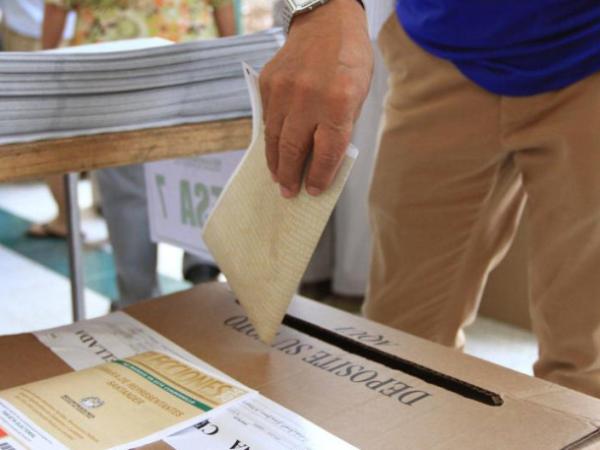
Elections in Colombia.
Democracy Plan and institutional presence
The Minister of Defense, Pedro Sánchez Suárez said that The Government will activate the Democracy Plan to guard the political activities of the 2026 electoral process with a deployment of 20,000 members of the Army and Police.
The head of the Interior, Armando Benedetti, warned that There are electoral risks in 104 municipalities, mainly in coca-growing areas and with the presence of armed groups such as Catatumbo, Cauca, Nariño and Chocó.
Benedetti, however, criticized the studies of the Ombudsman’s Office and other organizations, which he said “make risk maps based on complaints and not on the presence of armed groups.”
“The Ombudsman’s Office is very wrong, it seems that there was an interest; Sometimes you don’t know if it is due to malice or lack of knowledge of the country.“added the minister, who assured that the authorities are evaluating mechanisms to improve institutional coordination.
(See: Digital voting in Colombia: how far has it advanced and why is it needed?).
Different political parties in Colombia have expressed concern because the electoral climate has been soured by the murder of senator and presidential candidate Miguel Uribe Turbay, who died on August 11, two months after being seriously injured in an attack in Bogotá.
EFE