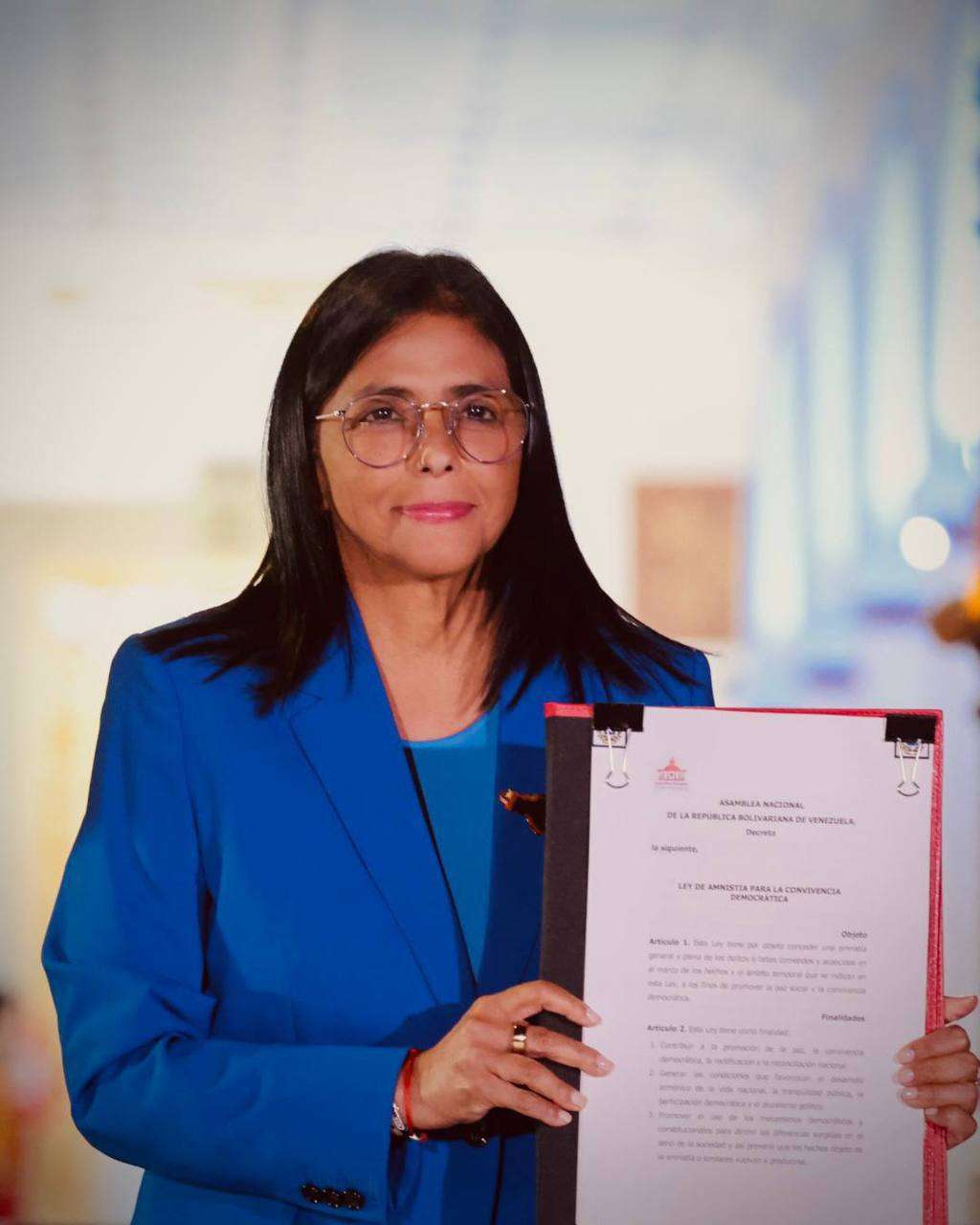
In 20 days the National Assembly approved the Amnesty Law for Democratic Coexistence, so called when read in the extraordinary Official Gazette 6,990 of last February 19. The idea was presented on Friday, January 30, by the acting president Delcy Rodríguez during the Opening session of the Judicial Year held in the main auditorium of the Supreme Court of Justice. In that same act, Rodríguez entrusted the drafting of the bill to the Presidential Commission for the Judicial Revolution, created in 2021 and chaired by Minister Diosdado Cabello, as well as the Program for Democratic Coexistence, recently founded and of which Ana María San Juan, Carmelo Borrego and Elsie Rosales, among others, are part.
“Let it be a law that serves to restore the wounds left by the political confrontation due to violence,” the President explained at that time in front of the 20 judges of Venezuela’s highest court and other officials. “Let it serve to redirect justice in our country,” Rodríguez concluded when describing the motivations of the legal instrument.
The president (e) called on Venezuela not to impose revenge, revenge or hatred and, instead, to embrace coexistence “and above all things, with respect for the law.” Precisely that spirit is present in the four purposes projected by the law in its article number two, and the first seeks to “contribute to the promotion of peace, democratic coexistence, rectification and national reconciliation.”

The other three purposes are summarized as follows: generate conditions that favor the harmonious development of national life, public tranquility, democratic participation and political pluralism; promote the use of democratic and constitutional mechanisms to resolve differences that arise within society; prevent the events that are the subject of the amnesty or similar from being repeated as well as favor the reintegration into public activity of the people benefited by the law, as read in its second article.
The project was presented for its first discussion last Thursday, February 5, the day it was approved unanimously. From there it went to a national consultation and returned to Parliament on Thursday, February 12, for its second discussion, article by article. The debate ended in article 7, which provides that the beneficiaries of the amnesty must bring themselves to justice before the competent court. Deputy Luis Florido, from the opposition bench, rejected the way the article was worded, because, in his opinion, it violates the law that states that “we are all equal before the law.” Some deputies explained that deep down Florido was thinking about the opponents who are outside of Venezuela and their fear of being imprisoned when they set foot on their homeland.
In this regard, the Chavista representative Iris Varela replied to what Florido said and maintained that “standing up” was a step enshrined in the Magna Carta. At that point in the debate, opposition representative Nora Bracho, vice president of the Special Commission for the Amnesty Law, asked to speak, who requested to postpone the second discussion of the project, which was approved by the plenary session of the National Assembly.
The second discussion was resumed last Thursday, February 19. There they presented a new wording of article 7, which opens the possibility that those who are outside Venezuela and want to benefit from the amnesty can, exceptionally, be represented by a lawyer for the initial procedures. But they must appear personally before the court for the purposes of granting the amnesty, says the approved rule.
Facts and dates
The events for which amnesty will be granted include those that occurred between April 11 and 12, 2002 until 2025, the latter related to the holding of the elections for mayors and governors on May 25, 2025. That is, a block of 23 years whose events are broken down in article 8 of the Amnesty Law, which begin with the coup d’état perpetrated on early morning of April 12, 2002 against then-president Hugo Chávez, who was “held” by a group of soldiers for 48 hours. Later the TSJ would say that these soldiers were “pregnant with good intentions.”
Those people who committed crimes during the demonstrations and violent events for political reasons that took place between July and September 2009 will also be subject to amnesty. The clashes between police and students of the Central University of Venezuela, within that university, stand out.
The law also offers amnesty to the 112 opposition deputies from the 2016-2020 period, who, among others, approved a Statute for the Transition that ignored President Nicolás Maduro and ended up validating the self-swearing in of a deputy (Juan Guaidó), as interim head of the Venezuelan State.
Likewise, the amnesty covers politically motivated violent events that occurred between January and April 2019. That is the stretch where the self-proclaimed Guaidó tried to invade Venezuela from Colombia, governed at that time by Iván Duque. This occurred on February 23, 2019 on three bridges that connect Táchira with Colombia located between San Antonio and Ureña.
During that period, the alleged coup d’état of April 30 also took place in the Altamira distributor, with the appearance on the scene of Leopoldo López and a group of soldiers. But that article excludes those prosecuted for the crime of military rebellion from being amnestied.
The first beneficiaries
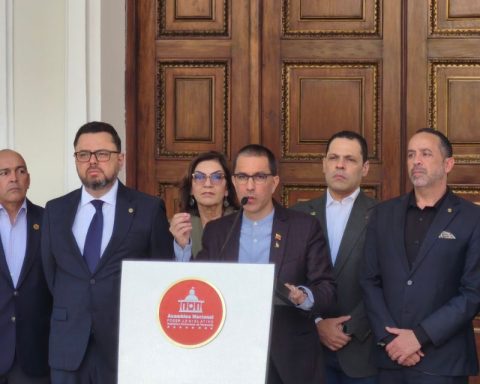
- On the night of Thursday, February 19, the special commission for the Amnesty Law, chaired by Congressman Jorge Arreaza, appeared at the Miraflores Palace to deliver the new legal instrument to President Delcy Rodríguez. The president went out to the external areas of the presidential palace accompanied by the president of the National Assembly, Jorge Rodríguez, and the Minister of the Interior, Diosdado Cabello, to sign her signature and thereby execute the law. “You have to know how to forgive and you have to know how to receive forgiveness,” Rodríguez said in front of Chavista and opposition deputies.
- Five days after the aforementioned law came into effect, Deputy Arreaza offered an assessment of its application. He said that 100 hours after the law was enacted, 3,231 full freedoms had been granted; Among them, 3,052 were under house arrest and 179 were confined.