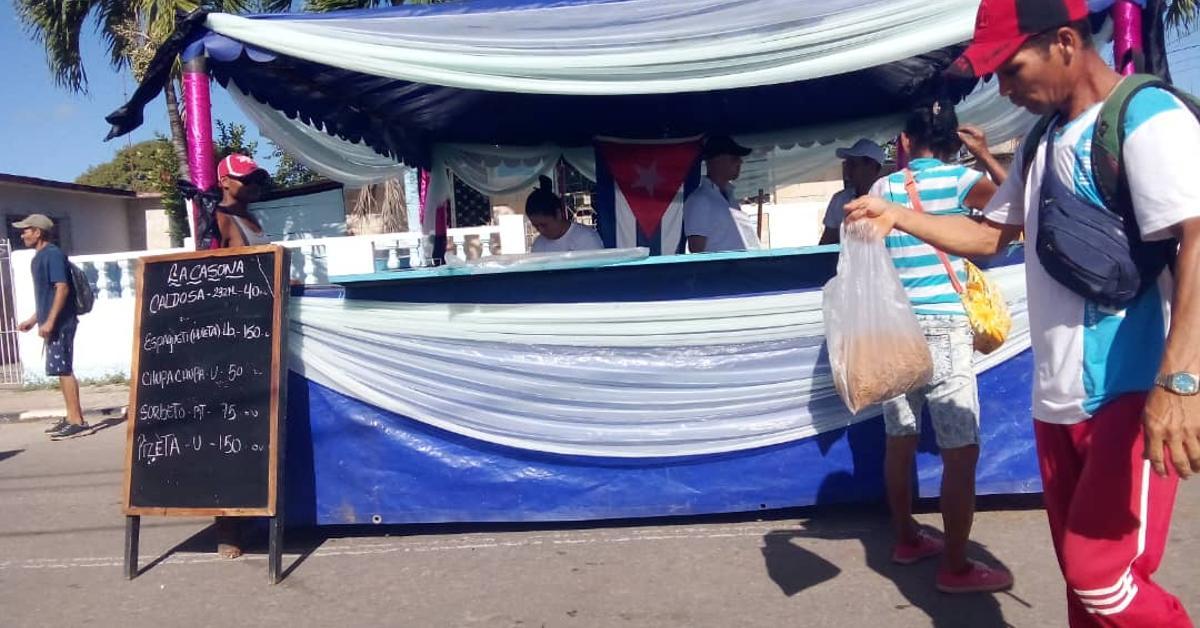
San José de las Lajas (Mayabeque)/The sun beats down on Avenida 40 in San José de las Lajas, Mayabeque, where a row of colored awnings tries to provide shade from the scarcity. Under the tarps, sellers fan themselves with pieces of cardboard and buyers advance slowly, carrying bags, umbrellas and bottles of water. It is the third Saturday of the month, the day of the Provincial Agricultural Fair, although at first glance no one would say that the word “provincial” is too big for it.
The balloons tied to the tents cannot hide the poverty of the scene. At one end, a blackboard announces the offers at the La Casona kiosk: broth for 40 pesos, pizza at 150, a pound of spaghetti already boiled and without any addition at 150. Behind the counter, the Cuban flag serves as a background and a small fan strives to move the thick air.
“Whoever wants to buy something good has to come early,” he assures 14ymedio Víctor, a man who already leaves with just a few yuccas and a bunch of bananas. “At ten in the morning this is a desert,” he adds. “There is only what nobody wanted.”
Years ago, he remembers, the fair occupied six or seven blocks, from the Camilo Cienfuegos school to the Joven Computing Club. Now two are enough to cover the entire area. “Before there were trucks full of food, pallets with fresh food, even pork. But with the price caps, the farmers no longer bring anything. They come to deliver,” explains the university professor while wiping the sweat with a handkerchief.
/ 14ymedio
An agricultural fair with anemia, in one of the most agricultural provinces of Cuba, is a painful irony. But in San José de las Lajas they have been learning, through empty platforms and sky-high prices, that it is not enough to select a space, give a bombastic name to a commercial day and proclaim in the local media that there will be “a multitude of options” for the food to appear.
In another tent of the depressed venduta, blue tarps flutter over an empty table. The woman who answers sighs. “If we at least had power, we could sell cold soft drinks.” The phrase is lost among the murmur of recorded music that comes out distorted from a speaker. The neighbors approach more out of routine than out of hope.
Nixa, a Mayabequen housewife, examines some yuccas with a look of distrust. “At 17 pesos a pound, it’s not bad… if they were good,” he says and adds, after taking a look at the surroundings: “No rice, no beans, no oil. And this is a provincial fair? Here the only thing there is pumpkin and fruitbomba, and all from the same Güines truck.”
A few meters away, a man on a bicycle makes his way through the crowd. In the rear rack he carries an empty plastic box: he will use it if he can get eggs. “I went to have a beer in the El Chino restaurant tent,” he says, “but it wasn’t even cold.” “When I came to see, the eggs were already gone. There is no fix for this.”

/ 14ymedio
It’s eleven o’clock and the heat forces us to look for shade. People protect themselves with umbrellas, some rest on the edge of the sidewalks. The air smells of stale frying and overheated broth. The sellers, resigned, begin to collect. A cargo truck, parked in front of a house, sells the last bunches of donkey bananas while a group of women discuss the price. Behind, a girl holds an empty bag, watching as everything ends.
Five blocks closed to traffic, yet two would be enough to contain the entire fair. The music keeps playing, but no one dances. “This doesn’t feed anyone,” Felix says before walking away. “People come looking for food, not reggaeton or rum. What is needed is not for sale.”
As the sun sets, 40th Avenue regains vehicle traffic. The balloons hang limply, the awnings are dismantled, and the smell of burnt grease mixes with the dust. The fair fades away, like so many other things in Cuba, leaving behind an echo of fatigue and a handful of empty bags.