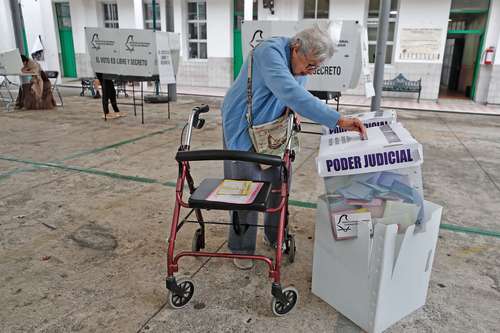
▲ In last June’s exercise, only 13 percent of the voters voted.Photo Marco Peláez
Fabiola Martinez
La Jornada Newspaper
Tuesday, December 30, 2025, p. 6
On Sunday, June 1, 2025, in an unprecedented event at the national and international level, 881 judges were elected by popular vote in Mexico, with imperfect and contradictory constitutional and legal rules, said by those responsible for preparing and qualifying the contest.
In the end, these elections were also held in the face of fierce opposition from members of the Judiciary itself.
The second episode of this exercise will be in 2027, to elect the second half of the federal judges and magistrates, and the local judicial structure in 13 states of the Republic.
In principle, counselors and electoral magistrates propose that the contest for judges should not take place on the same day as the election of the other powers because that year there will not only be renewal of the Chamber of Deputies, but also in the 32 federal entities, including 14 governorships.
And for the rest, the organizational challenge would be huge for the electoral authorities and would contribute to citizen fatigue, they consider.
Given this, they suggest legal and logistical changes, in order to motivate voters, since in the first judicial election only 13 percent of the voters voted and there was an avalanche of challenges against all stages of the extraordinary process, precisely due to the errors of the regulatory framework.
Felipe de la Mata, magistrate of the Superior Chamber of the Electoral Tribunal of the Judicial Branch of the Federation (TEPJF), rapporteur on core sentencing projects of this new election, promoted its holding under the argument that the constitutional mandate had to be complied with, but at the same time pointing out criticism of the original preparation.
“The court delivers good accounts to the citizens because the mission was completed; there was no reference point in the world for an election of this size and this complexity in the case of judicial positions.
“It was done with many things going against it, having extremely imperfect legislation, constant gaps and gaps that the only thing they did was show that the people who wrote it do not know the electoral right,” he said in an interview.
He regretted, however, that the responsibility for decisions had been transferred in this way to the National Electoral Institute and the TEPJF, whose members were advancing as they could, without having a national or international point of reference. Likewise, in the face of opposition from “a good part” of Mexican legal opinion, because many of the judges and magistrates were going to lose their judicial careers, their life projects, as well as members of bars and universities.
–What are the main flaws of the standard?
–There were many; We would have to write a book about it. For example, it was a bad idea to create three evaluation committees, each with its own eligibility rules (for aspiring candidates); The raffle was also a bad idea because it did not give anyone certainty and generated the idea that judges and magistrates were going to be selected by chance and not by merit. Perhaps it would have been reasonable for the candidates to take an exam at the Judicial Training School and, based on that, those with a certain score would advance to the next round.
–What other element would you highlight?
–As the system is designed in the Constitution and in the respective law, it was going to be almost impossible to carry out the election because in Mexico City, for example, we would vote for 200 district judges, and if there were going to be nine candidates for each one, imagine a ballot with 1,800 names. It was crazy! The electoral geography was not compatible with judicial circuits.
“Another point was the issue of the preparation of unpublished ballots; what was possible was done with what was available. This was the election with the largest number of ballots, 600 million were printed, which made the vote more complex.”
He stated that the election was carried out satisfactorily, in accordance with the law, “but it leaves us with many doubts because the legislation was passed very quickly, without resting the ideas, without seeking better solutions through dialogue. For example, how could someone apply to be a collegiate magistrate without first having been a district judge?”, he noted.
–What priority should be adopted for an eventual electoral reform, towards the 2027 election?
–Much of this needs a constitutional reform to be able to improve; Politicians believe that since they are running they already know about electoral law, it is as if I said: ‘I know about cardiology because I have been going to the cardiologist for 30 years.’
–What did the Upper Room manage to modify?
–Making that quite imperfect rules could have application. The INE and the TEPJF faced with contradictions, errors and imperfections, with gibberish on the issue of (gender) parity, we made the election in a satisfactory manner, and I believe it was achieved; However, I trust that this experience will help make 2027 a better choice.