The history of the Tenochtitlan Foundation is wrapped in a mythical narrative where they combine, the space of the gods with the time space of human beings. The historical sources of the 16th century narrate the original history that the Mexicans chose to tell the world. It is said that they left the mythical Aztlán and, after a migration of around 200 years, full of vicissitudes, they found on a small island in the middle of Lake Texcoco, the land that had been divinely promised. Upon reaching it, everything around became a total whiteness: the willows, the tules, the reeds, the frogs, the fish, all in the likeness of the mythical Aztlán. The Mexica also said that Huitzilopochtli, their guardian God, had indicated the precise place where they had to establish their temple and, around it, to draw the big city, in order to become the most powerful empire ever known in this latitude. The portent of the eagle on a cactus with which the divinity revealed before its eyes the chosen site, seems to have occurred in a year 2 house, 1325. This suggests, like some documents after the conquest, the Teocalli of the Sacred War, a Mexican sculpture found under the foundations of the National Palace.
Tenochtitlan really became the promised dream. It began as the small settlement of a town of Mexican vassals submitted by the Tepanecas of Azcapotzalco, until becoming a magnificent amphibious city located on that small original islet that its inhabitants expanded building a large number of Chinampas. After several generations, the city reached an extension of 13.5 km² and 250,000 inhabitants; It was built with such perfection, that when the newly arrived Iberian soldiers knew her, they said that what they saw with their eyes, could not understand it with the understanding. The metropolis was connected to the mainland by means of a complex system of high footwear on the lake, with bridges and gates that, in addition to communicating to the people, regulated the passage of water and contained the saline water of the Texcoco lake.
To the south, Iztapalapa’s road communicated with Coyoacán; To the west, the one that carried Tacuba and also held the aqueduct that brought drinking water from the springs of Chapultepec; To the north of the islet, they connected the Tepeyac and Tenayuca road. These were some of the main ones, however, they connected in turn with other secondary roads that led to the other populations around the lake. People could scroll, the same walking down the roads and the crowded streets, than sailing in their canoes and parking them in the designated piers.
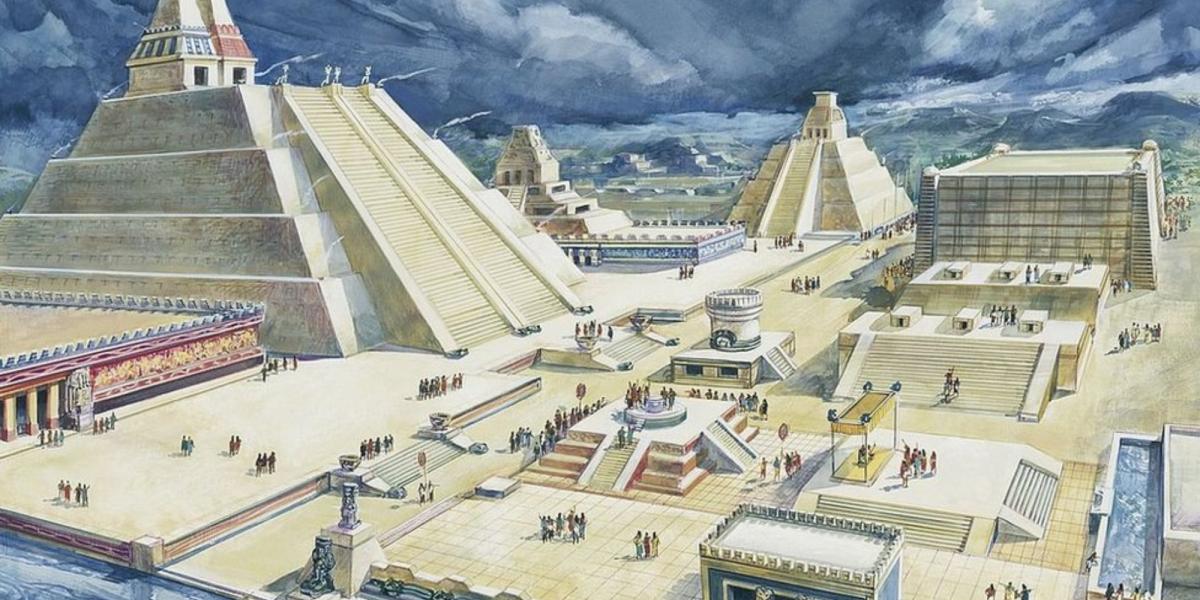
The city stood out for its impressive urban organization, drawn with a deep symbolic burden. In the center the sacred enclosure was built, a ceremonial space that housed 78 temples, among which was the main temple, the most important of all, dedicated to Tlaloc, god of rain, fertility and agriculture, already Huitzilopochtli, a nascent sun and god of war. Here the most important religious celebrations were carried out according to the calendar and a careful liturgy was followed.
The city was divided into four partialities arranged around this sacred space following the four directions of the universe, while the Templo Mayor, marked the fifth course, the center of the world. The quadrants of the city were made up of 80 neighborhoods or Calpulli, with their temples, schools and markets; All its inhabitants shared relationship, a common trade and a employer deity that protected them.
The common houses of the Tenochcas families were one floor and were built on a chinampa that also had space to cultivate the milpa for self -consumption. In the center of the settlement, noble families inhabited luxurious palatial sets that included gardens and direct water shots. Among them, the Huei Tlatoani, the supreme ruler of the city and representative of the God on earth, stood out.
The inhabitants lived in a markedly stratified society, in which the commoners or macehuals worked hard performing any of the 200 trades of which we have news. There were, for example, goldsmiths, lapidarians, pen, weavers, potters, barbers, dentists and merchants. The nobles, meanwhile, carried out bureaucratic works: judges, tribute collectors, priests and very high -ranking military. Education in Tenochtitlan was integral and structured according to social origin. The children of the nobility attended Calmécac, where they formed as future rulers and priests, receiving teachings in philosophy, history, religion, astronomy, mathematics and the calendar. The rest of the children went to Telpochcalli, where they trained in agricultural tasks and military skills. In the afternoon, they attended Cuicacalli where music, song and dance was learned for the praise of the gods. The girls, meanwhile, learned from their mothers domestic work, especially the art of spinning, knitting and embroidering; Although they were daughters of the nobility, they could attend the Ichpochcalli, where they received instruction on domestic tasks, sexual relations and spinning, embroidery and fabric.
The Mexica were supplied in the multiple markets of the city, being the one in this Zocalo, one of the main ones; However, the largest and busiest, was that of Tlatelolco, a sister city that occupied a third of the islet, north of the capital. The variety of products and services that merchants offered with great organization is immense, there were foods such as pumpkin, tomato, mamey, avocado, fish, lake birds, frogs and insects; There were also blankets, medicinal herbs, skins, petates, tamales, honey sweets with nuts or tools, and services of workers and teachers of specialized trades were offered, all in an orderly and bustling commercial system.
Tenochtitlan allied with the cities of Texcoco and Tlacopan to form the triple alliance, an expansionist imperial confederation that allowed them to make a great empire. United, dominated a territory of approximately 200,000 km², with 38 tax provinces and a population close to 6 million inhabitants in an area that went, from the Tarasca region, to the current border with Guatemala, and from coast to coast. The submitted provinces delivered delicious taxes in kind, such as feathers, cotton blankets, jade, wild animals, warrior costumes, gold or cocoa, which generated great wealth to the empire and contributed to the metropolis becoming consecrating as an exemplary city.
The Mexicans inherited from civilizations such as Teotihuacán a sophisticated urban and architectural tradition, deeply linked to astronomy and religious thought. The Mexican architects trace Tenochtitlan so that phenomena such as solstices, equinoxes, the beginning of the rains or the days of the zenith passage of the sun, were clearly indicated by the position of the main temple and its alignments with this star in the landscape throughout the year. This allowed them to carry a precise time, essential to coordinate planting, war or religious festivities. One of these key phenomena in their celebrations, were the days of the zenith of the sun, when the star reaches its highest point in the sky and passes vertically over the city, as occurs around July 26.
The old Tenochtitlan was a monumental creation where architecture, engineering, astronomy, politics and religion joined to materialize the worldview of the Mexican people. His memory remains in the vestiges that today, they survive thanks to the work of archaeologists, historians and restorers of the National Institute of Anthropology and History; His greatness was inscribed in the word of his former poets, as in these verses of Mexican songs:
Keep it present, oh princes, don’t forget it. Who can besiege in Tenochtitlan? Who can move the foundations of heaven? With our arrows, with our shields, there is the city. Mexico-Tenochtitlan subsists!
* The author is an archaeologist and researcher at INAH; A brief version of this text was read at the 700 -year commemorative ceremony of the Tenochtitlan Foundation on July 26, 2025; It reproduces here with authorization from the author.