The so-called tax cashback – a novelty created by tax reform which establishes the return of taxes paid by the poorest people ─ should have different impacts on the income of this part of the population, depending on the region of the country in which the taxpayer resides.
The benefit can increase the income of the poorest families by 10% on average, with the Central-West (12%), Southeast (11%) and South (10.1%) regions having greater expansions than those in the North (8.32%) and Northeast (7.76%).
However, the measure is still an instrument to combat income inequality. Calculations and evaluation are in a study by researchers Rafael Barros Barbosa, Glauber Nojosa and Francisco Mário Martins, published by the Brazilian Institute of Economics (Ibre) of the Getulio Vargas Foundation (FGV).
The explanation for the difference between regions is the level of family consumption. As the North and Northeast have lower incomes and consumption, they benefit less than families in other regions.
>> Follow the channel Brazil Agency on WhatsApp
Who is entitled?
The tax reform, sanctioned in January 2025, created cashback as a way of making the tax collection system more progressive, that is, making the poor pay, proportionally, less taxes than the richest.
For example, the tax charged on the water bill is the same for all consumers, but it weighs much more on the budget of a poorer family. With cashback, this amount paid is returned to the poorest, providing them with tax relief not extended to other families.
That’s why, One of the criteria to be eligible for cashback is to be registered in the Single Registry for Social Programs of the Federal Government (CadÚnico)which allows monthly income per person in the family of up to half the minimum wage. Today, the minimum is R$1,518, and CadÚnico has almost 95 million subscribers.
How much is the cashback?
The cashback is 100% of the amount paid in Contribution on Goods and Services (CBS) and 20% of the Tax on Goods and Services (IBS)present when purchasing goods and services considered essential, such as water and sewage, energy, telephone, internet and cooking gas bills.
For other products consumed by these families, reimbursement is 20% of the CBS and IBS. These two acronyms are the new nomenclature of taxes that were unified (ICMS, ISS, IPI, PIS and COFINS) by the reform.
CBS cashback is expected to start in 2027; and IBS in 2029.
>> Understand more about tax cashback

Gas cylinders are among the products that may have tax cashback – Marcello Casal/Agência Brasil
Consumption level
In an interview with Brazil Agencyresearcher Rafael Barros Barbosa, professor of applied economics at the Federal University of Ceará (UFC), details that Families in the North and Northeast have lower income and, consequently, a lower level of consumption ─ therefore, the tax refund also ends up being lower than in other regions.
“The poor in the Northeast consume less than the poor in the Southeast and the poor in the South, that’s a fact, there’s not much we can do against it when we look at the data”, he states.
To measure family consumption behavior, the researchers used data from the Family Budget Survey (POF), from the Brazilian Institute of Geography and Statistics (IBGE).
The researcher also points out another factor: informality, which is greater in the North and Northeast.
These families spend proportionally greater amounts in informal commerce than in the Southeast, for example. However, Cashback can only be earned on formal purchases, with the issuance of an invoice.
“This fact can exclude a large part of the consumption of low-income families, carried out in informal businesses, such as open-air markets, street vendors or small unregulated businesses, which are crucial in the daily lives of the population with lower purchasing power in these poorer regions”, says an excerpt from the study.
With information from IBGE, the authors point out that, while the informality rate in the country was, on average, 40.9% of the population in 2022, in the North and Northeast it was 60.1% and 56.9%, respectively.
Encouragement of formality
Rafael Barbosa believes that one of the effects of the tax reform will be precisely to reduce informality in the country. The reason is that the reform determines that a company, to benefit from tax credits, must have legalized suppliers. This would force a formalization of the production chain, from raw materials to the final good.
“With this chain procedure, this forces the agent, at the end, to require its suppliers to be formal”, he says.
Another incentive would come from the interests of families themselves, who would tend to prefer shopping in formal establishments to receive cashback.
“A poor person can have two options, either buy in the informal market, where there will be no cashback, or in a formal market, where there will be cashback”.
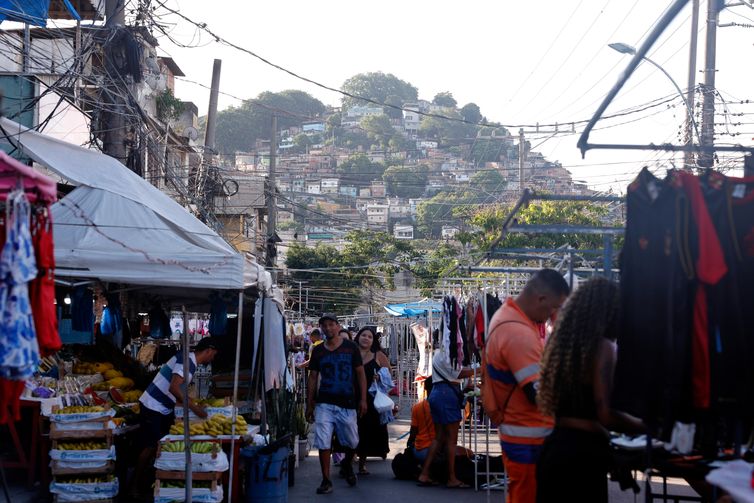
Fair on Rua José Rucas, in Complexo da Penha, north of Rio de Janeiro. Photo: Tânia Rêgo/Agência Brasil
Income distribution
Despite the regional difference, Ibre/FGV researchers reinforce that tax cashback is a tool that favors better income distribution.
“What we show is that, in general, looking from a national point of view, cashback will increase the income of the poorest population by approximately 10%, so there will be a reduction in inequality”, says Barbosa.
The Ibre researcher adds that targeted policy, such as cashback, can be more effective than linear tax exemption, such as exemption from the basic food basketanother item of tax reform.
“Cashback is money that returns to a specific group of people. The exemption does not distinguish social classes. Whether I am poor or not poor, if I go to the supermarket to buy this item, I will benefit.”
No migration pressure
The professor at the Federal University of Ceará does not expect that the difference in income growth between regions will intensify internal migration in the country.
“The effect is too small to force a migration. Migration, in general, is more for reasons of job opportunities, and not necessarily to have access to a greater benefit”, he assesses.