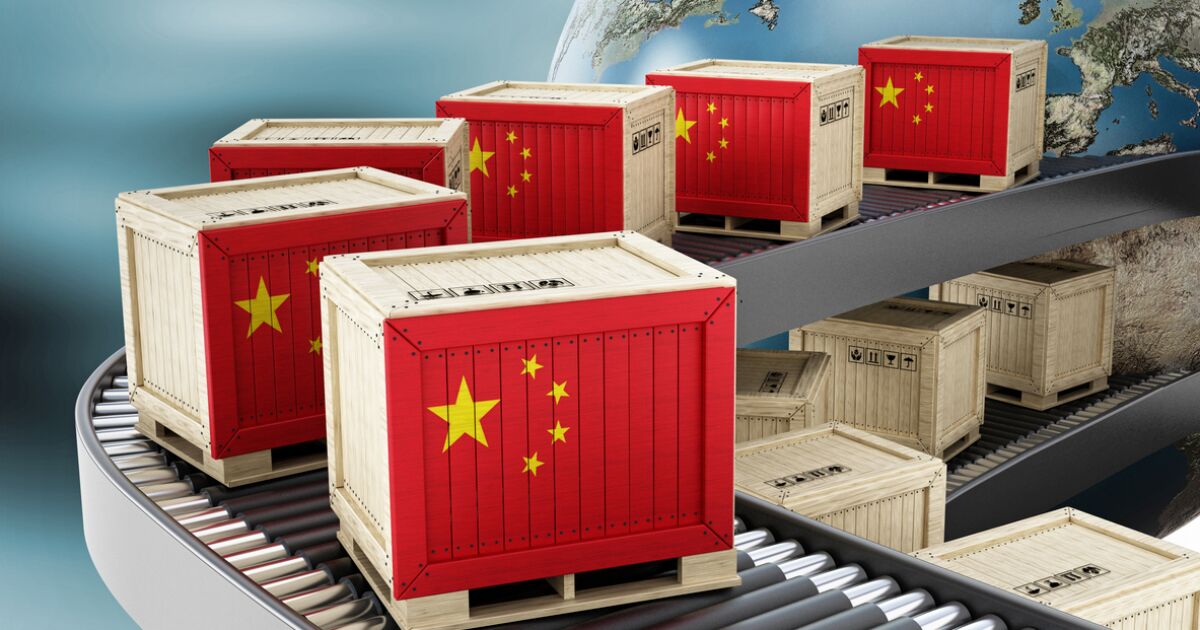
Sergio Huerta Pantoni, general director of the Mexico-China Chamber of Commerce and Technology, indicated that the Asian giant concentrates almost 58% of the goods that Mexico buys without a treaty and, for that reason, the measure affects manufacturing segments that support production, employment and exports.
For Huerta, the risk is profound, because without electrical, electronic inputs and critical components, the value chain loses pace. This disruption is reflected in higher prices for families and less competitiveness for the country.
The approved proposal raises 1,463 tariff fractions for sectors such as automotive, textile, clothing, plastic, household appliances and footwearamong others, with an impact focused on products of Chinese origin.
The original initiative, presented in September by President Claudia Sheinbaum, proposed rates of up to 50%, although most were reduced to levels between 20 and 35% during the legislative process.
The Mexican government maintains that the measure responds to the wave of Chinese imports that displace national industries through unfair competition practices. In 2024, purchases from Beijing reached a record close to 130,000 million dollars and everything points to a new mark this year, since until October they total more than 109,000 million.
The director of the Chamber stressed that when it comes to combating unfair practices, Mexico already has tools to investigate. A tariff sweep does not distinguish between sectors or chains and activates an inevitable reaction.
The Asian giant evaluates mirror measures
China announced that it is evaluating mirror measures. If Mexico pays more to enter the Chinese market, national exports become more expensive and lose access to sectors where the country wishes to consolidate.
In his vision, Mexico aspires to an advanced industry. He talks about semiconductors, electromobility and technology. Those goals require reliable suppliers and an integrated global ecosystem. China participates in this network and is willing to transfer technology and expand its industrial presence. For that to happen, he said, the country needs clarity, non-discrimination, national treatment and stable rules.
The Chamber requested a reasonable period to organize the discussion, and take the World Trade Organization standard as a reference. A period of six months would allow an in-depth analysis of real import substitution and availability of inputs.
The sector considers that the haste in implementation generates uncertainty and leaves no room to evaluate alternatives that maintain industrial activity without problems, but Congress ignored this request.
Less formal employment
Octavio de la Torre, president of CONCANACO SERVYTUR, stated that the sector that contributes 66% of the GDP did not receive consultation when the Executive presented the initiative. He explained that the approach occurred just a few days ago, during the consultations of the Commerce, Competitiveness and Economy Commission of the Chamber of Deputies, and warned that Decisions without technical diagnosis already cause a contraction in industrial and service segmentsin addition to a decrease in formal employment.
De la Torre described significant wear and tear in key regions for productive integration. He explained that on the northern border there is an unusual availability of warehouses and a drop in formal employment, signs that he attributed to measures that affect essential intermediate goods for manufacturing and export services.
He added that for more than four decades the maquila and transformation models supported Mexican foreign trade, and that any poorly calibrated tariff hits those chains. He also stressed that the country does not produce a significant part of the inputs it uses, which is why he asked prevent intermediate goods from being affected that support thousands of jobs and the competitiveness of companies established in Mexico.
The business leader called to review the Asian experience, where the adjustments were applied by company and under productivity goals, not as generalized punishments.
Affected
He pointed out that import substitution without sectoral diagnoses can weaken national companies and stop investments. In addition, he warned that micro, small and medium-sized enterprises (MSMEs)—99% of the country’s companies—would be exposed, as they face greater challenges in integrating into value chains and assuming additional costs derived from taxes that do not consider specific productive realities. Impacts on services, transportation, logistics and activities that depend on the operation of industrial plants must be known.
Joaquín Aguirre Ruiz, CEO of Antad and Coparmex, explained that tariff policy only works when it focuses on products without national production or with insufficient supply. He stressed that Any increase is immediately transferred to the final price and mainly affects lower-income consumers.
He gave examples of microwaves, basic refrigerators, toys and fans, goods without national production or with limited manufacturing that would suffer direct increases without generating industrialization in the short term.
Aguirre recalled that increasing tariffs does not guarantee greater national production if structural problems such as excessive regulatory procedures, lack of credit for MSMEs, absence of tax incentives and increasing costs associated with the new customs law are not resolved. He pointed out that Mexico can strengthen its industry, but not at the expense of the popular economy or with broad measures that omit sectoral differences.